Ammoudari–Askifou Plateau Loop
Introduction
Some rides are remembered for a summit or a descent. This one was claimed by a jar. At the edge of Ammoudari, beside an old threshing floor, a weathered pithos stood half in the earth, emptied of grain or oil but not of meaning. From there the track climbed through the pines above the Askifou Plateau, across a landscape of terraces, shepherds’ huts and old fields, where the practical objects of rural life have outlasted many of those who made and used them.
The ride covered 20 kilometres, with 600 metres of ascent and an almost equal return descent. Riding time was 1 hour 37 minutes: 1 hour 2 minutes climbing and 35 minutes descending. I left Ammoudari and climbed steadily from the Askifou Plateau, through the pines and past Tavri, to the higher Niatos Plateau. The route reached a recorded height of approximately 1,284 metres before circling the plateau and returning by the long descent to Ammoudari. The air was cool and dry at that height, although the sun still carried warmth. It was a compact mountain ride—physical, precise and balanced—demanding enough to hold my attention, yet short enough to leave time to stop and examine the old world still present in the landscape: the terraces, the ruins and the great earthen vessels that have survived long after their original purpose ended.
The morning light broke hard and clear over Ammoudari. The air retained the bite of altitude, and woodsmoke drifted between the stone houses. My E-MTB rolled quietly through the village, its tyres humming over the cold tarmac. Above the roofs, the White Mountains rose sharply against the sky, their pale summits enclosing the Askifou Plateau.
Near the edge of the village stood an old threshing floor. Beside it, half-buried and leaning slightly from the ground, was a great earthen jar.
A pithos.
The word is Greek—πίθος—and describes a large storage vessel used throughout the Aegean world for thousands of years. The largest examples could stand between one and two metres high and hold considerable quantities of olive oil, wine, grain or water. They were not thrown in a single movement like smaller pots. Their bodies were built gradually from prepared sections of clay, one rising upon another as the lower part became firm enough to bear the additional weight.
These were the bulk-storage containers of the ancient and rural world: heavy, difficult to move and essential to any household, farm or institution that needed to preserve the produce of one season for use in the next.
The jar beside the threshing floor had completed its work long ago. Its surface was cracked and bleached by the mountain sun, and small plants had found their way into the earth gathered around it. I stopped and placed a hand upon the rim. It was cool, rough and immovable.
I could not know what it had once contained. It might have held grain from the plateau, oil from groves lower down the mountain or water stored against the long Cretan summer. Now it held only dust and weeds. Even empty, however, it retained the authority of a useful object—something made not to be admired from a distance but to perform the same necessary task, year after year.
Beyond the village, the road began its climb towards Tavri and the Niatos Plateau. The tarmac soon gave way to mountain track, and the sound beneath the tyres changed from a low hum to the sharper movement of stone and gravel. Pines gathered along the slopes, their dark trunks standing among pale limestone and dry grass. Through the gaps between them, the Askifou Plateau appeared below.
From above, Askifou resembled the interior of an immense vessel. The enclosing mountains formed its rim; fields, terraces and scattered houses occupied the floor. It was a natural basin that had held generations of farmers, shepherds, travellers and armies. Crops had been raised there, animals wintered, families established and rebuilt. The comparison with the pithos was difficult to avoid. Both were containers: one made from clay, the other from mountain and stone.
The road steepened as it entered the pines. The climb was long enough to establish its own rhythm: pressure on the pedals, the subdued assistance of the motor and the regular sound of breathing in the thin, dry air. Where the trees opened, Askifou returned to view, lower now and increasingly enclosed by its surrounding ridges.
Outside a shepherd’s hut stood two smaller jars, both tilted at almost the same angle, as though they had been leaning towards one another for years. Faint marks remained on their surfaces—finger impressions, simple patterns and the uneven traces of their making.
They belonged to a history that rarely preserves the names of those who created it. Kings, generals and landowners entered written records. The potters who dug the clay, prepared it, built the vessels and tended the kiln generally did not. Nor did most of the people who filled those vessels after harvest and opened them again during winter.
Yet the pithos represented the practical foundation beneath the more visible history. Grain could be grown, but it also had to be kept dry. Olives could be pressed, but the oil had to be stored. Wine needed a vessel capable of holding it beyond the vintage. Survival depended not only upon producing food but upon preserving it.
The great jars were therefore pieces of rural engineering. Clay was dug and prepared, often with coarse material added to control shrinkage and help the body withstand the pressures placed upon it. The vessel was then raised in stages. Each section had to become firm enough to support the next without drying so completely that the new clay would fail to bond with it.
The horizontal bands applied to many pithoi were not merely ornamental. They could reinforce and stabilise the broad clay wall while the vessel was being constructed, strengthen vulnerable joins between successive sections and protect the finished body during handling and transport. They also provided the potter with a simple decorative vocabulary: straight bands, impressed lines, waves, finger marks and repeated patterns made with ordinary tools.
Once completed, a large pithos had to dry slowly before firing. The final result depended upon accumulated judgement: the preparation of the clay, the moisture retained in each section, the strength of the joins, the loading of the kiln and the control of the fire. A vessel that survived all of these stages could remain in use for generations.
Studies of pithos production in Crete, Chios, Messenia and Cyprus reveal regional differences in clay, construction and decoration, but also the same underlying challenge: how to create an object large enough to hold a household’s produce without allowing its own weight to destroy it before it reached the kiln.
This was not delicate pottery. It was architecture in clay.
At Knossos and Phaistos, rows of Bronze Age pithoi still occupy the storerooms in which agricultural produce was accumulated, managed and redistributed. Later vessels served farms, villages, workshops and religious communities through the Byzantine, Venetian and Ottoman periods. The form persisted because the problem persisted: food and liquid had to be stored securely in a climate governed by harvest, heat and scarcity.
That continuity must be treated carefully. A modern Cretan pithos cannot be called Minoan merely because its shape resembles an ancient vessel, nor can an uninterrupted line of individual potters be demonstrated across several thousand years. What endured was the practical requirement and, with it, a remarkably persistent family of solutions: a capacious clay body, a stable base, strong shoulders, handles for ropes or controlled movement, and bands that could serve both construction and decoration.
Halfway through the climb, the track became rougher. Loose stone lay over the harder surface, and the line narrowed as it crossed the mountainside. I stopped where the ground fell away towards Askifou.
The plateau lay below in the mid-morning sun, divided into its fields and settlements. From that height the walls and boundaries appeared as fine marks across the earth. I thought of the hands that had lifted grain into the old jars, the oil poured carefully through their mouths and the lids settled into place. Each filled pithos represented a wager against the future: that the harvest could be protected, that the household would endure the winter and that enough would remain when the next season began.
The climb continued through Tavri. Near the mountain refuge, the wind came across the high ground clean and cold. The trees thinned, and the surrounding slopes opened into limestone and scrub. Askifou had almost disappeared behind the intervening ridges.
Beyond Tavri, the track entered the Niatos Plateau.
Niatos was different from Askifou. The lower plateau was inhabited and cultivated, its villages and fields settled inside the great enclosing bowl. Niatos was smaller, higher and more isolated: an enclosed hollow among the mountains, without the same ordered pattern of houses, roads and permanent cultivation. Rough ground and grazing land occupied its interior, while the pale ridges of the White Mountains rose around it.
The route followed the track around the plateau. The surface changed repeatedly beneath the tyres: compact earth, loose gravel, exposed stone and occasional firmer sections where vehicles had pressed a clearer line into the ground. There was little shelter from the wind. The silence of the place was broken only by the bicycle, the movement of air through the vegetation and, somewhere beyond the track, a shepherd calling to his animals.
The sound travelled across the hollow ground and disappeared into the mountains.
The circuit of Niatos formed the high point of the ride. From its western side, the surrounding country appeared increasingly remote. Askifou was no longer visible as a complete basin, and Ammoudari seemed much farther away than the distance suggested. The inhabited plateau below and the high, empty plateau around me belonged to the same mountain system, but they possessed entirely different characters.
After completing the circuit, I turned back through Tavri and began the descent. Gravity altered the character of the ride immediately. The measured pressure of the climb gave way to controlled speed, with the bicycle moving across loose gravel and embedded stone before returning to firmer ground among the pines.
The descent required attention, but it flowed cleanly. Through openings in the trees, Askifou gradually returned: first the enclosing ridges, then the fields and finally the clustered buildings of Ammoudari. The higher plateau withdrew behind the mountain, hidden again from the inhabited country below.
During the return, I thought of the pithos standing in my garden at Kokkino Chorio. It rests on gravel against the white wall of the house: broad-bodied, pale and ringed with raised horizontal bands. Three loop handles remain around its shoulders, and the marks of the potter’s hands are still visible in the clay.
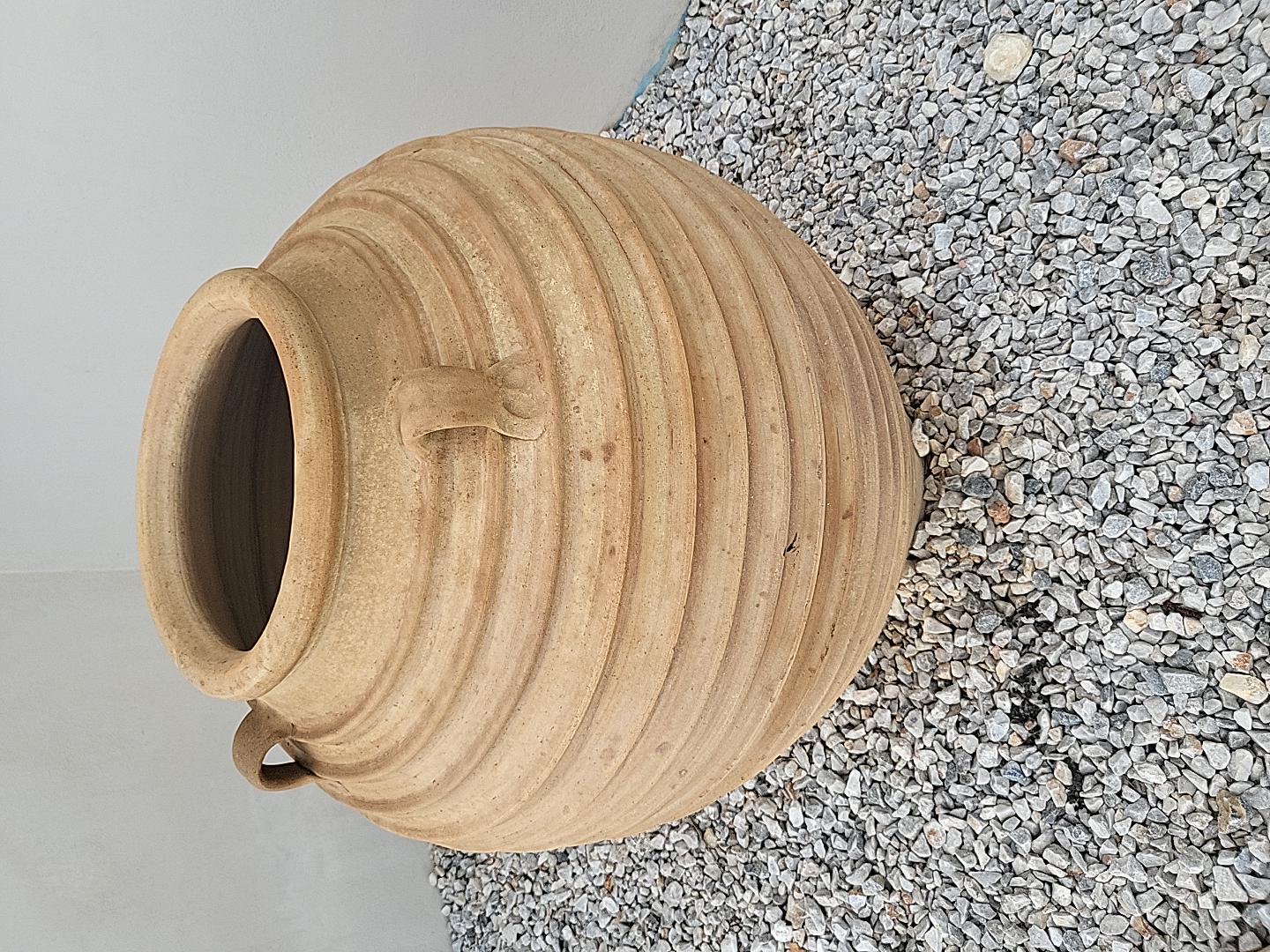
I do not know precisely where it was made or when. Its appearance alone cannot establish whether it came from Thrapsano, Margarites or another pottery centre. Nor can its age be inferred safely from a form that has been repeated for centuries.
What can be said is that it belongs to the same enduring tradition of large Cretan storage vessels. Its bands strengthened and stabilised the broad clay body during construction while also giving the surface its restrained decoration. The handles provided points through which ropes could be passed when the vessel had to be moved. Its rounded body distributed the pressure of what it contained, while the base allowed it to be seated securely.
It now stands empty. Its original function has gone, but the intelligence of its making remains visible.
The old jars were never intended for museums. They were made to hold what people had earned from the land and could not afford to lose. Their survival depended upon clay, fire and the judgement of unnamed craftsmen. The survival of the households that used them depended upon what was placed inside.
By the time I reached Ammoudari again, the circuit had closed: twenty kilometres from the inhabited basin of Askifou, through the pines and Tavri, to the high isolation of Niatos and back again. The ride had begun beside an abandoned vessel and ended with the thought of another waiting at home. Between them lay the same country that had supplied their contents and created the need for them.
The pithos endured because its purpose was clear. It held the harvest against hunger, water against drought and the work of one season against the uncertainty of the next. Empires altered, owners disappeared and villages changed around it, but the vessel remained—too useful to discard, too heavy to move without reason and too well made to vanish easily.
Its purpose has changed, but not its meaning. The pithos endures: not as a symbol of glory, but as evidence of continuity.
That was the thought I carried back to Kokkino Chorio. Looking again at the pithos beside the white wall of my house, I put it into four lines of my own:
What’s rooted deep in its own soil
will not bow to the wind—
the pithos, like the soul,
outlasts time and blooms again.