A Force 133 Battlefield Investigation in Crete.
For the past several years I have explored the battlefields, mountain tracks and forgotten corners of western Crete on foot and by E-MTB. What began as an attempt to better understand the Battle of Crete gradually developed into something rather different: a continuing investigation into the relationship between landscape, memory and war.
Crete rewards such enquiry. Unlike much of northern Europe, where modern development has transformed the battlefield, large areas of the island remain remarkably unchanged. Shepherd paths still follow ancient lines of movement. Remote caves continue to shelter flocks during winter storms. Tracks used today by farmers and shepherds often follow the same routes employed by resistance fighters, SOE agents and German patrols during the occupation.
Living on the island has allowed me to combine documentary research with repeated visits to the ground itself. Official histories, war diaries, wartime maps, Commonwealth War Graves Commission records, wartime photographs and local testimony have all contributed to this work. Of these, local testimony has often proved the most valuable. In the mountain villages of Crete, memories of the occupation remain remarkably strong and are still passed from one generation to the next. Yet more often than not it is the landscape itself that provides the final clue. A fold in a hillside, an overlooked shepherd’s path, or the alignment of a distant ridge with an old photograph can sometimes reveal more than the written record alone.
The story of Warrant Officer Class II William Arthur “Bill” Knox of the Intelligence Corps emerged from this wider research. Like many men of Force 133, Knox left behind only fragmentary records. His final action survives in official reports, in local memory and, perhaps most importantly, in the landscape where it occurred.
This article describes an attempt to locate that landscape and, in doing so, to better understand the circumstances of his death on 23 March 1944.
The ride began above Kampanos on a cool October morning, when the first sunlight had only just begun to creep down from the higher ridges and the limestone still held the dampness of the night. The olive terraces, silver-green beneath the early light, descended in orderly ranks towards the valley below, while beyond them the first buttresses of the White Mountains rose in pale layers, their upper slopes already washed in gold.
At first glance, the country appears benign enough. Shepherd tracks thread the hillsides, terraces cling improbably to steep slopes, and scattered groves of olive and chestnut soften the harsher lines of the landscape. Yet appearances deceive. Beneath this cultivated surface lies country designed by geology for concealment.
Within minutes of leaving the tarmac, the track began its descent into broken limestone ground. Loose stone shifted beneath the tyres and winter watercourses had cut deep scars across the surface. The route twisted between folds in the hillside, dropping steadily into a maze of ravines and hidden basins where visibility was measured not in miles but in yards. A man standing on the opposite slope might remain invisible, separated not by distance but by the repeated undulations of the ground.
Accompanying me was Colonel Nick Pedley, formerly of the Intelligence Corps. Like me, Nick had long been interested in the history of SOE operations on Crete, and his professional background provided an additional perspective during the investigation. Between us we carried maps, wartime reports and copies of several indistinct photographs taken during the occupation. The task was not merely to visit a location marked on a modern GPS device. It was to identify, with as much certainty as possible, the precise cave associated with Knox’s death.
The route covered only 7.9 kilometres and was entirely off-road. Yet distance was largely irrelevant here. The track descended from approximately 440 metres to little more than 250 metres above sea level before climbing back out again, gradients exceeding seventeen per cent in places. Progress was dictated not by mileage but by terrain.
As we descended deeper into the valley, the hills gradually closed around us. Goat bells echoed intermittently from unseen slopes and the sharp scent of thyme rose beneath the wheels. There were long periods when the only sound was the crunch of tyres on limestone and the occasional clatter of disturbed scree.
It became increasingly obvious why men of Force 133 had chosen country such as this.
Force 133 was the designation given to Special Operations Executive activities in Greece and Crete. Its agents survived not through numbers but through concealment. German troops controlled the roads, villages and airfields, but the country between them was another matter entirely. Here, among terraces, ravines and shepherd paths, small groups could remain hidden for weeks, sustained by local knowledge and by the remarkable loyalty of the Cretan people.
The landscape around Kampanos illustrates this perfectly. Visibility is restricted by repeated folds in the ground. Small caves and rock shelters abound. Observation from any distance is difficult. A man familiar with the area could move between villages and hideouts while remaining largely unseen.
The same terrain that frustrates modern navigation frustrated German patrols.
Finding the cave proved considerably more difficult than locating the general area.
Existing GPS references led only to a point above the site. They were close, but not exact. In historical research, close is often insufficient.The wartime photographs proved more valuable.
Two blurred images, taken during the occupation, showed little more than a cave entrance and the skyline behind it. Yet those distant ridges, frozen on film more than eighty years ago, eventually revealed the truth.
Standing on the hillside, we compared photograph with landscape, moving repeatedly between positions as we worked our way across the slope. Quite suddenly, after several unsuccessful comparisons, the ridgeline aligned perfectly. There could be little doubt. After more than eighty years, the cave had been found.
It is a surprisingly modest feature.

There is no dramatic cavern entrance. No imposing rock face. Merely a small opening in the limestone, partially concealed by scrub and lying below the skyline. A person could pass within a few metres and never notice it.
Its value lay not in comfort but in concealment.Standing there today, the tactical advantages become immediately obvious. The surrounding ground is broken by terraces, gullies and ridges that restrict observation. Even at short distances, men disappear from sight.Yet the terrain also reveals the weakness of the position.
Once discovered, escape options become limited. Any withdrawal requires movement across exposed ground or along predictable routes. The same country that concealed the cave offered little protection once German troops knew precisely where to look.
It was within these same folds of limestone, on 23 March 1944, that Warrant Officer Class II William Arthur Knox made his final stand.
Born at Ketton, Rutland, on 17 August 1916, Knox had begun his military career in the Coldstream Guards before transferring to the Intelligence Corps and eventually volunteering for service with the Special Operations Executive. By 1944 he had become one of many British agents operating with Force 133 in occupied Crete, living a life far removed from conventional soldiering.
There were no barracks, no fixed headquarters and few certainties. Operations depended upon local contacts, resistance networks and secure communications with Cairo. Wireless operators lived under constant threat from German direction-finding equipment. Informers and collaborators posed an ever-present danger. Villages that assisted resistance groups faced severe reprisals.
The risks were understood by everyone involved.
On 23 March 1944, Knox was sheltering in the cave with a small party that included two escaped Cypriot prisoners of war, a wireless operator and local resistance personnel.
The location had been compromised.
According to Lieutenant Geoffrey Barkham’s later report, German forces had been guided to the cave through betrayal.
As the Germans approached, Knox and the two Cypriots moved to confront the threat.
Their actions diverted attention away from the wireless operator and others whose survival was essential to the continuation of SOE operations in the area.
The action itself was brief.
Knox was killed.
The two Cypriots were also killed.
The wireless operator and others escaped.Barkham later summarised the cause with characteristic brevity:
“CSM Knox’s death was certainly due to treachery.”
Standing at the cave today, it is not difficult to understand the tactical reality. Once the position had been betrayed, there was little room for manoeuvre. The occupants faced a simple choice: attempt to buy time for others to escape or be overwhelmed together.
Knox and the two Cypriots chose the former.
We remained at the site for some time.
The cave was cool despite the warmth outside. A light breeze moved across the hillside carrying the scent of wild herbs and dry earth. Far away, goat bells echoed across the valley. Otherwise there was silence.
A small wooden remembrance cross was placed inside the cave.
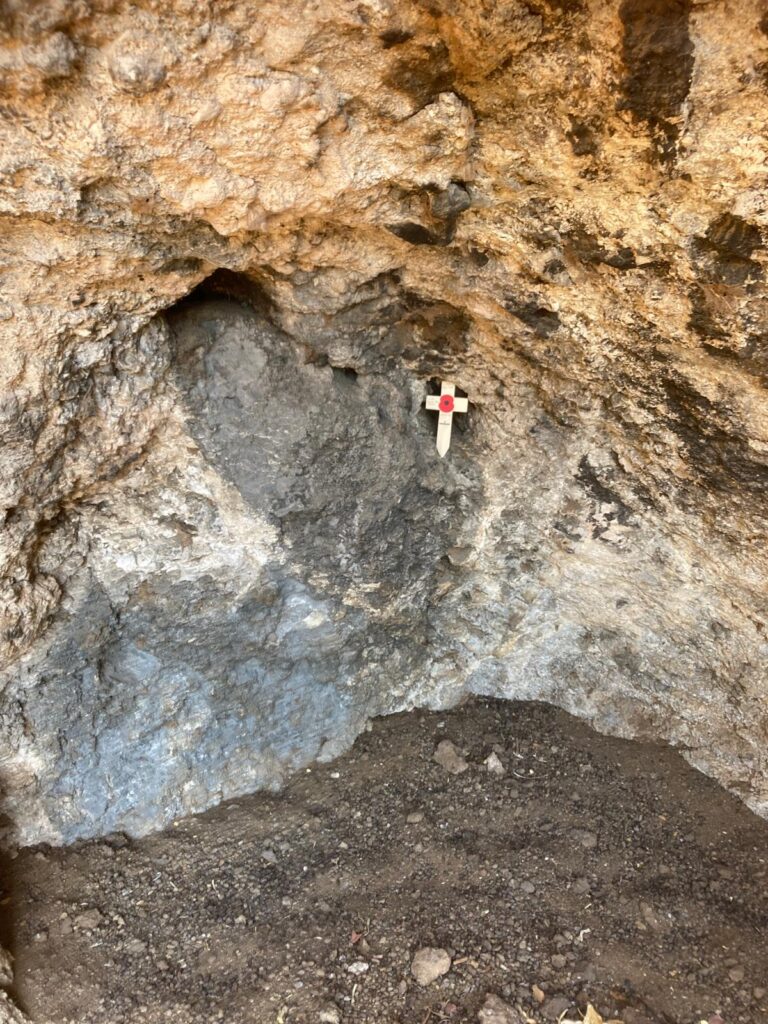
The Ode of Remembrance was read aloud.
There are no memorials here.
No visitor centre.
No signposts.
The cave remains what it has always been, a small opening in a limestone hillside.
Yet this modest place played a part in a much larger story involving resistance, intelligence gathering and clandestine warfare across occupied Europe.
Historical records tell us what happened.
The terrain explains why it happened here.
Standing at the cave, the relationship between concealment and vulnerability becomes unmistakable. The same ground that protected the occupants from discovery ultimately constrained their options once the position had been betrayed.
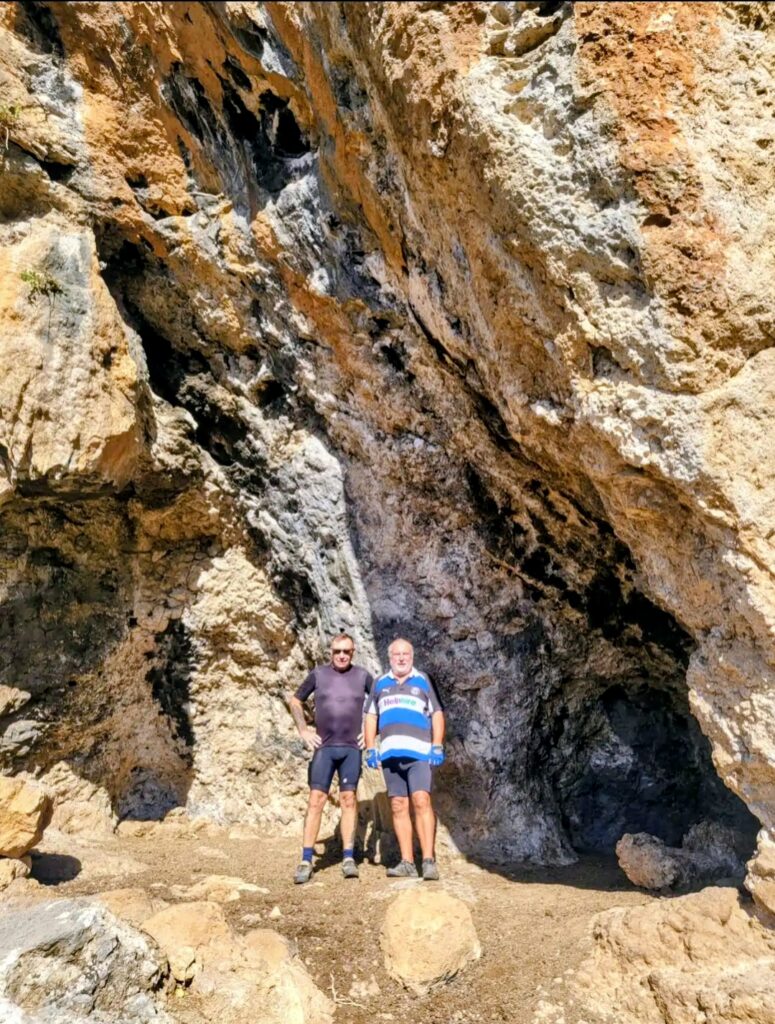
The cave offered concealment.
It could not guarantee survival.
During my first visit to the area, I stopped at the kafeneío in Kampanos. As so often happens in rural Crete, a simple coffee gradually developed into a conversation about the war.
The older men listened carefully as I explained why I had come. The name of Bill Knox was still recognised. The cave, they assured me, was known locally, and before long directions were being given, landmarks described and memories exchanged.
It soon became clear that the events of March 1944 had not entirely passed into history. In Crete, memory can be remarkably long.
The villagers told me that following the action, German troops left the bodies where they fell. Some time later, women from the village recovered the remains and buried Knox and the two Cypriots together nearby. This account accords closely with Commonwealth War Graves Commission recovery records, which identify the location from which the remains were later recovered. The grid reference given by the CWGC corresponds with the site shown to me during my field investigation.
The conversation eventually turned to the betrayal itself.
The villagers spoke freely about the treachery that had brought the Germans to the cave, but when I asked who had betrayed Knox, the atmosphere changed perceptibly. No one would provide a name.
More than eighty years after the event, the identity of the betrayer remains unspoken.
It was explained to me that the man was subsequently removed from the area by the Germans, but his name was still withheld. No one present appeared willing to break that silence.
For an outsider, this reluctance may seem surprising. Yet throughout Crete the occupation remains part of living memory, passed from one generation to the next through family history, village conversation and personal recollection. Acts of courage are remembered. So too are acts of betrayal.
The silence itself was revealing.
Today Knox rests in a collective grave at Suda Bay War Cemetery.
Cemetery. Buried with him are two unidentified soldiers of the Cyprus Regiment, both recorded as having died on 23 March 1944. Commonwealth War Graves Commission Graves Registration records show that the three men were recovered together and subsequently reburied in the same collective grave. Although Knox could be identified, the remains of the two Cypriots could not be distinguished with sufficient certainty for individual identification.
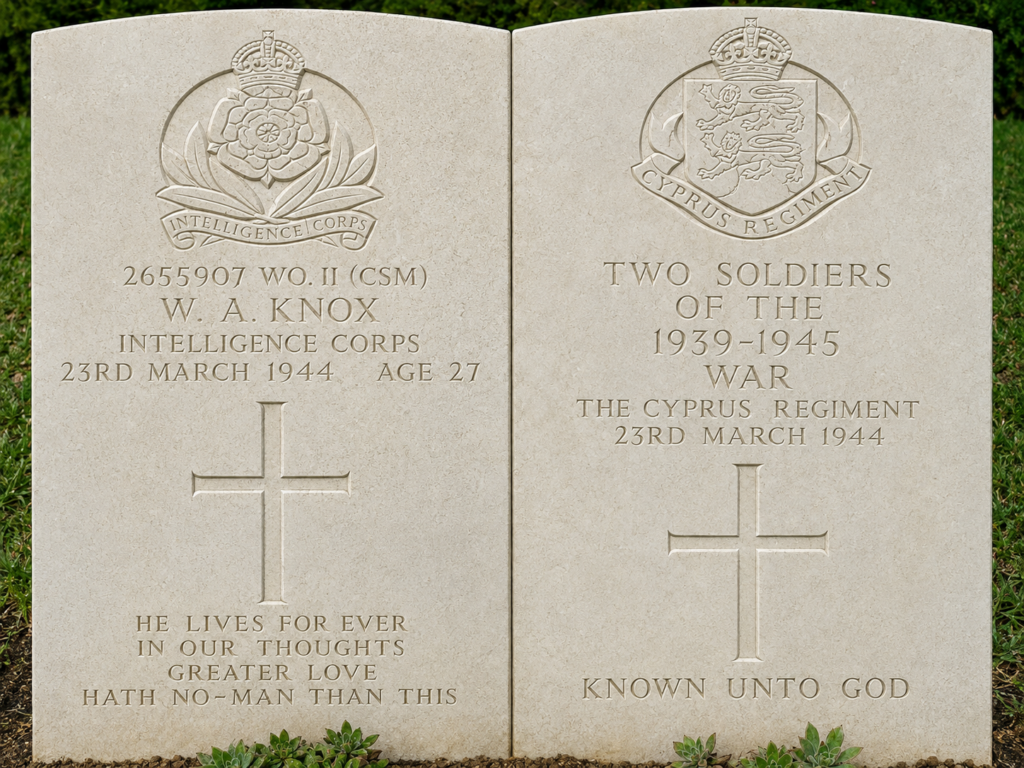
Taken together, the local testimony, Commonwealth War Graves Commission documentation, the physical evidence on the ground and the cemetery records leave little doubt that the two unknown soldiers buried alongside Knox are the Cypriots who died with him at the cave.
In death, as in life, the three men remain together.
For soldiers, perhaps that is remembrance in its simplest form: to return to the ground, to understand what happened there, and to ensure that the names of those who did not return are not forgotten. The cave remains. The terrain remains.
And the memory of Bill Knox and his two unknown Cypriot comrades endures.
This ride was different.
It was not scenic.
It was not playful.
It was hard. And it was important.
The route ended not in myth, but in reality—a cave, a final act, and a name that deserves to be known.
Absent Friends.
Mandináda:
In hollowed stone his courage stays, where silence holds his name;
A man who stood so others lived, and honour guards his flame.