From the high country to the Frangokastello plain, and back by the road through Kallikratis
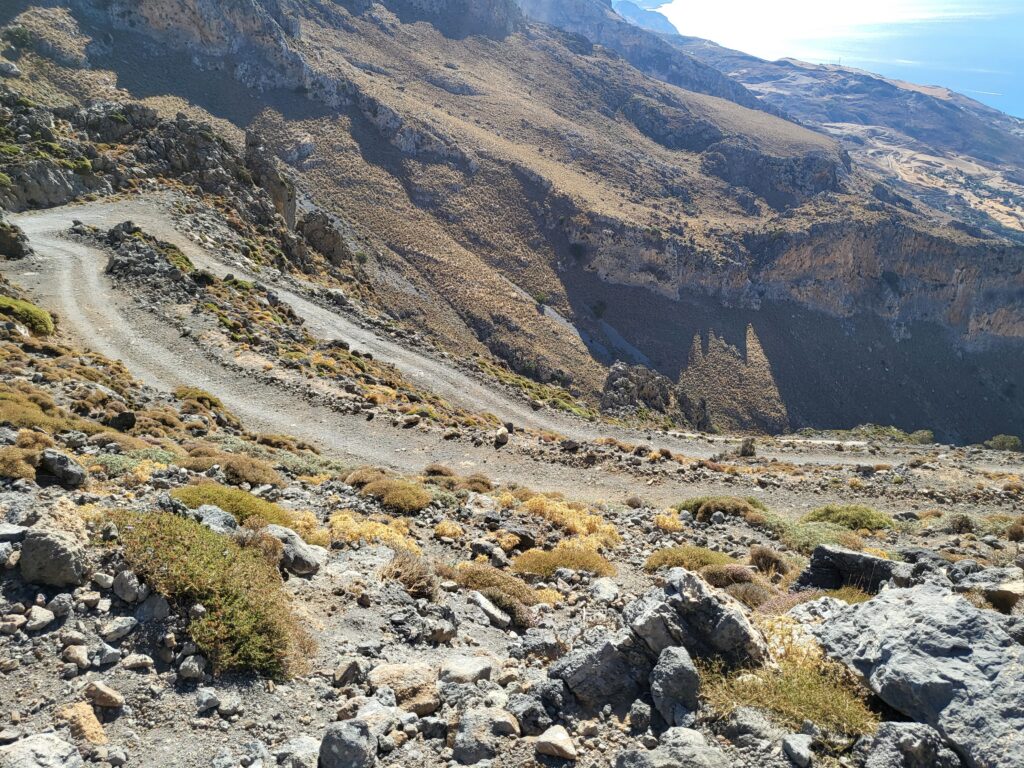
The way down lay in full view and told us almost nothing. It was only a pale thread scratched across the limestone, appearing on one shoulder of the mountain and vanishing behind the next. Far below, the Frangokastello plain spread beside the Libyan Sea, green and geometrical where the high country was all broken stone. We had chosen a simple circuit: descend by the rough track and return by the paved road through Kallikratis. On the map, the two halves were almost equal. In the mountains, they had nothing in common.
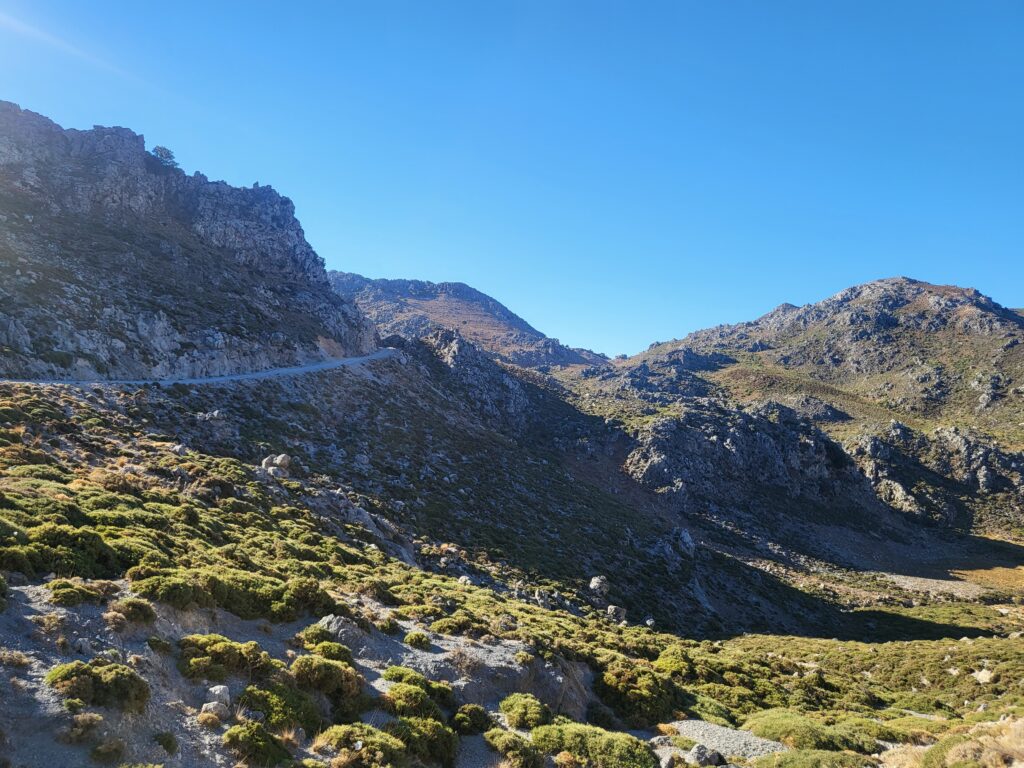
We began high in the Kollitauros–Kryoneritis mountains, among bare ridges, thorn scrub and rock fractured into every conceivable shade of grey. The complete circuit was only 27.9 kilometres, but it contained 980 metres of climbing and almost the same amount of descent. Its highest point was 928 metres; its lowest, on the southern plain, just 97 metres above the sea. The figures described the shape of the ride, although not its character. That would be supplied by the ground beneath our wheels.
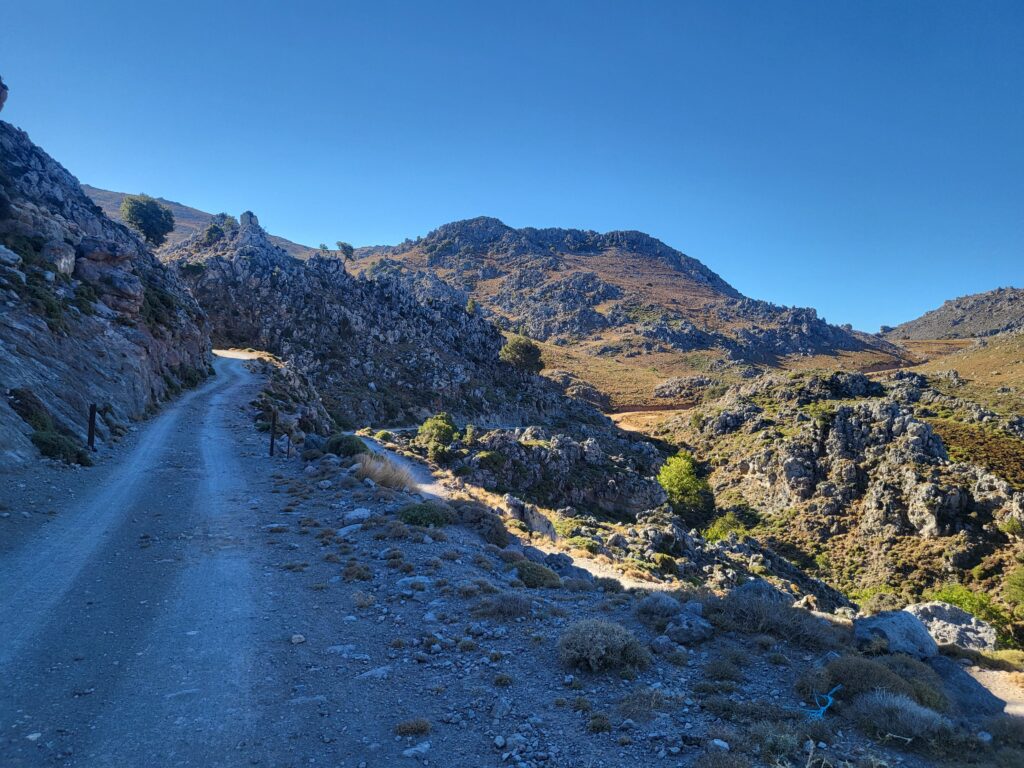
There was no gentle introduction. For the first three kilometres the mountain track climbed, gaining 138 metres at an average gradient of 4.6 per cent. The ascent carried us deeper into the high country, away from the inhabited plain and into a landscape from which nearly everything soft appeared to have been removed. Low, wind-shaped vegetation occupied the spaces between the stones. Occasional trees had rooted themselves in improbable pockets of soil. Beyond them rose successive limestone ridges, each looking more impenetrable than the last.
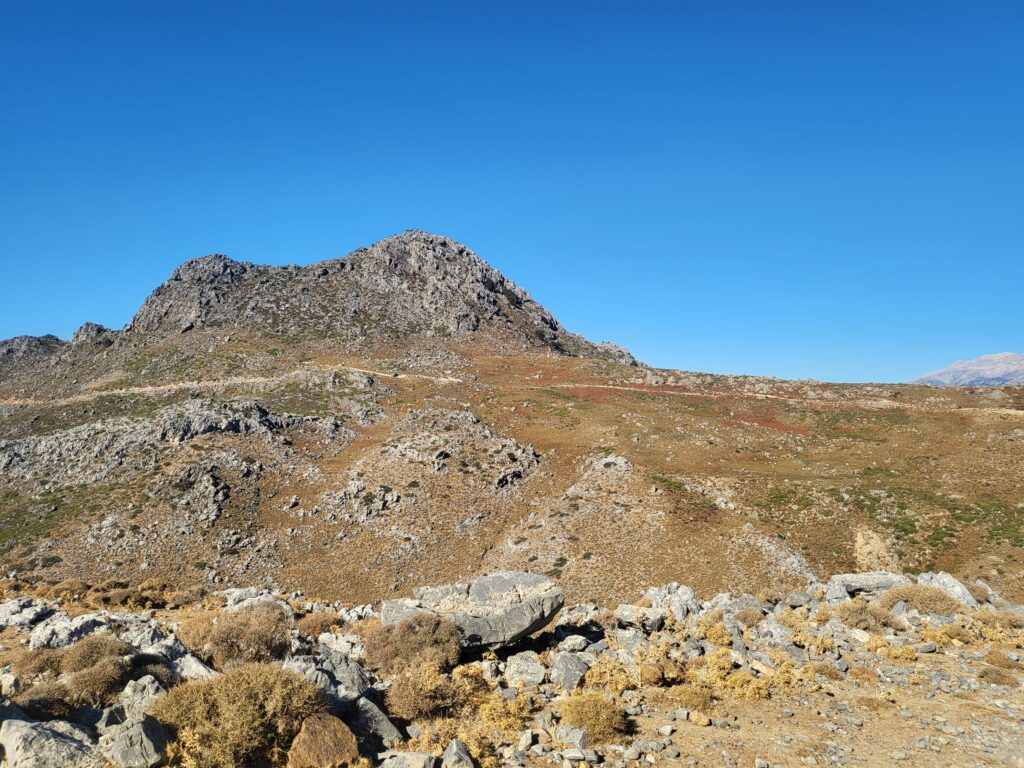
At the high point the track turned, and the mountain fell away.
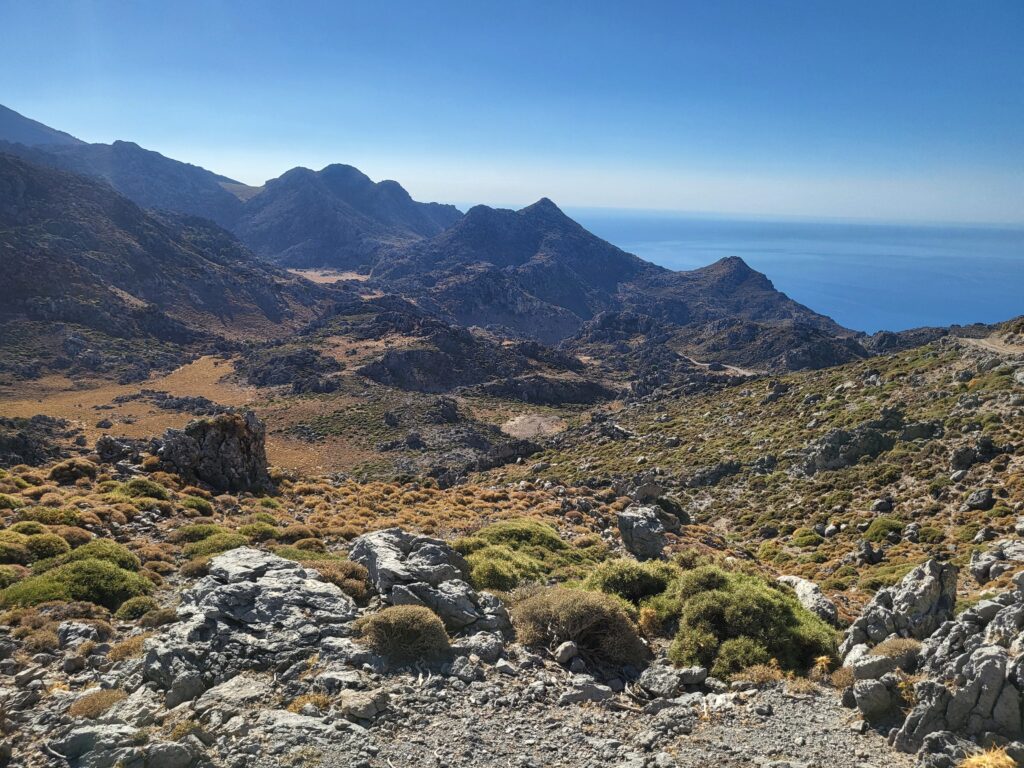
The next 10.1 kilometres lost approximately 860 metres at an average gradient of eight per cent. The steepest recorded pitch was 21.8 per cent. On an elevation profile it appeared to be the easy half of the ride: a clean diagonal line descending towards the coast. The reality was ten kilometres of loose stone, embedded rock, shifting gravel and abrupt changes of direction.
Gravity provided speed, but no assistance. Every few metres brought a fresh decision: which line would hold, which stone might move, how much braking the surface would accept and where the bicycle needed to be before the next turn. In the broader sections there appeared to be a choice of lines, although none was entirely clean. Elsewhere the track narrowed against the mountainside, with rock rising on one side and the ground falling sharply away on the other.
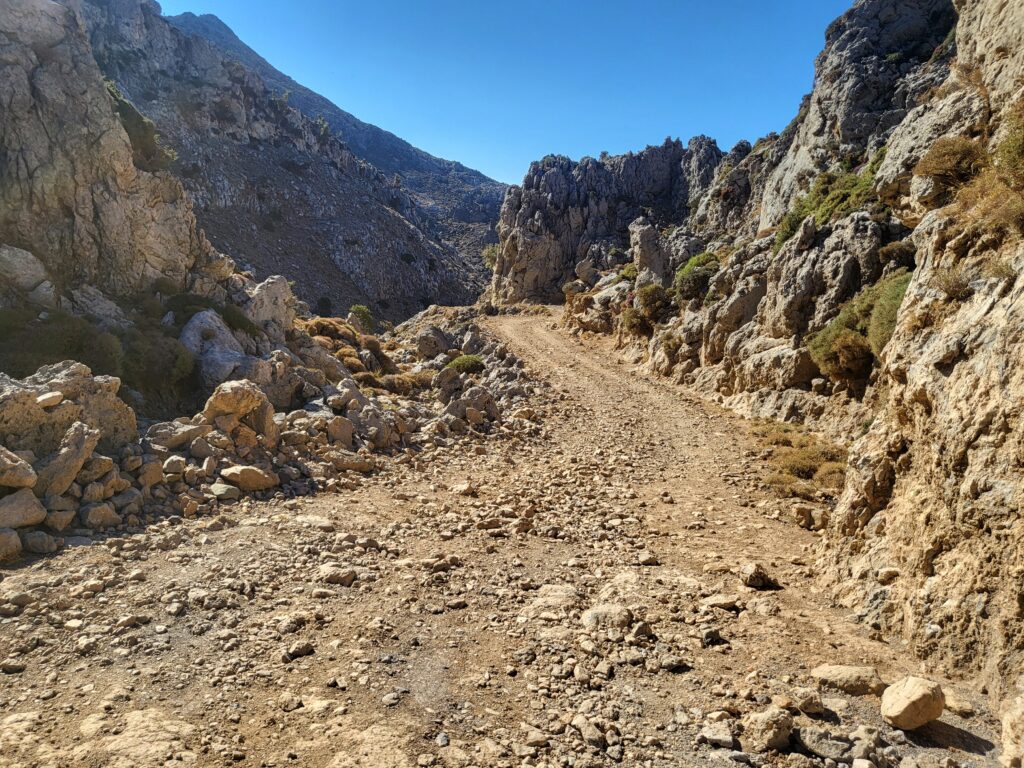
The weight of an E-MTB, so useful when climbing, became something that had to be managed. Once committed to a loose line, the bicycle carried its momentum with it. The motor was merely a passenger; progress depended upon balance, judgement and allowing the machine to move beneath us without permitting it to choose its own course. Arms and shoulders worked continuously against the rough ground. There was little opportunity to relax and none to admire the view for more than a moment.
The track did not descend directly. It followed the folds of the mountain, entered shallow ravines beneath the rock faces and then turned back across the slope. The Libyan Sea appeared between the ridges, vanished behind them and returned a little larger. Far below, the cultivated ground around Frangokastello gradually acquired shape: fields, olive groves, minor roads and scattered houses arranged between the last wall of the mountains and the water.
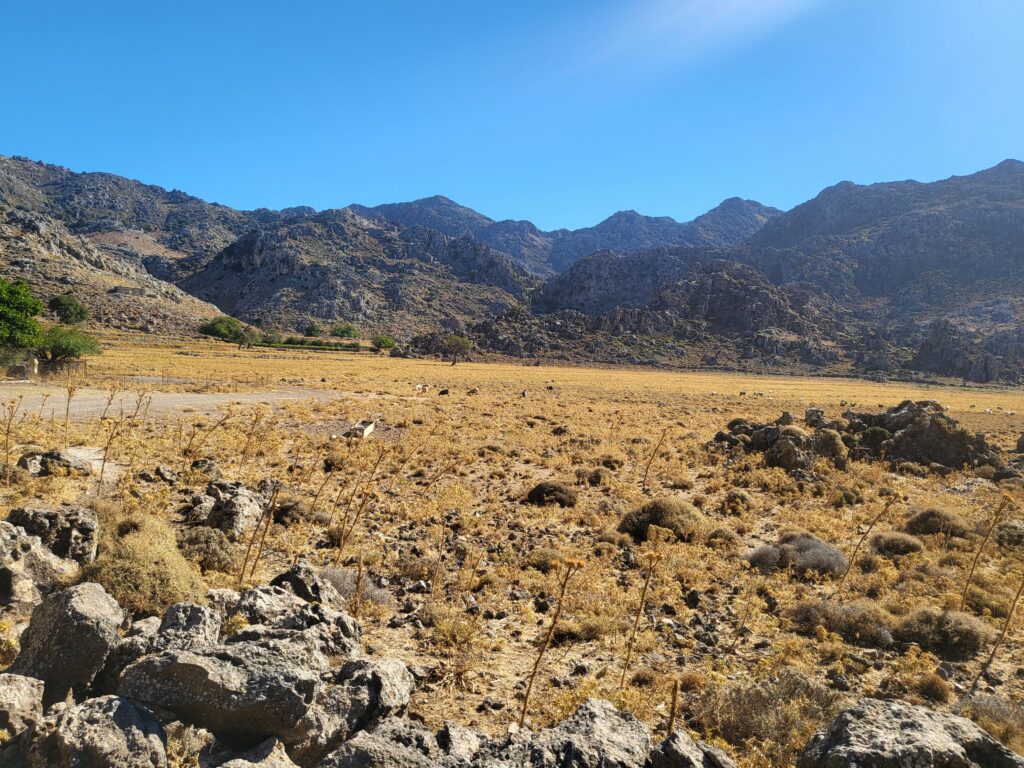
At about seven kilometres the track carried us around the side of a plateau. Two shepherds were there, and we stopped to exchange greetings. They asked the questions that establish a traveller’s position in the world: where were we from, where had we come from and where were we going? Our answers led to further questions and the usual attempt to explain a route that made more sense on a map than it did in conversation.
Before we left, they gave us small red grapes. They were intensely sweet. There was nothing ceremonial in the gesture: a handful of fruit, a few words and a wave as we returned to the bicycles. Yet the encounter seemed entirely fitted to the place. The shepherds remained with their animals on the plateau while we disappeared once more around the mountain, taking the taste of the grapes with us.
Below the plateau the descent became more severe. The track crossed open slopes of loose limestone before entering narrow cuts where the rock closed in on both sides. Some sections had been laid across the mountainside with little more than a low bank of stone between the track and the empty ground below. The route had been found through the mountain rather than imposed upon it; it accepted every fold, spur and weakness in the rock.
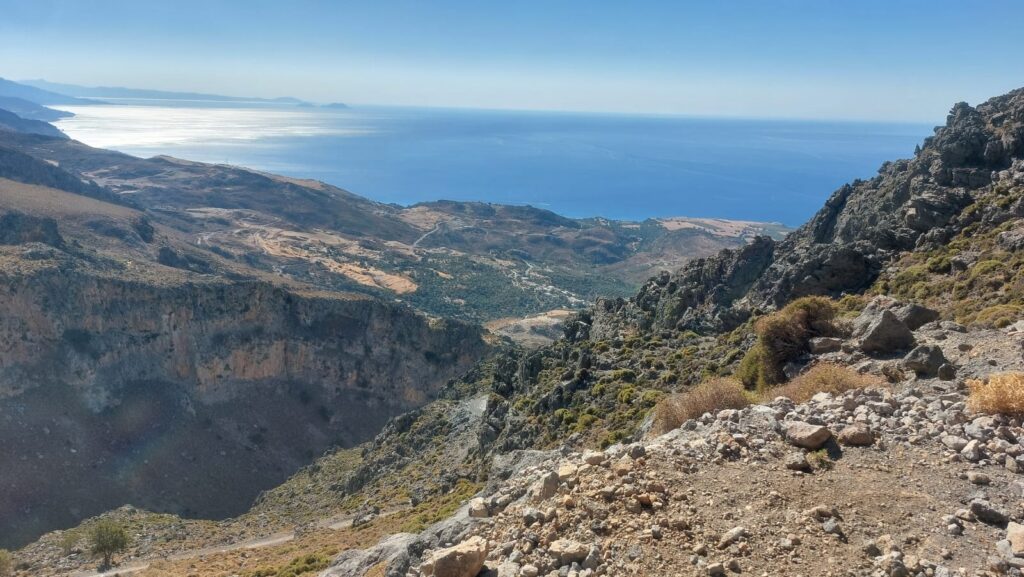
The southern plain continued to rise towards us. What had first appeared as a distant green strip became an ordered patchwork of cultivated land. The contrast was abrupt. Behind us lay a high, dry country of exposed rock and sparse grazing. Ahead was a settled landscape of fields, trees and roads, ending at the straight blue margin of the Libyan Sea.Long before the Venetians built their fortress, people had occupied and cultivated this plain. Archaeological remains show settlement here during the Minoan period and extensive activity in Graeco-Roman times. The castle came much later, constructed between 1371 and 1374 where the mountains finally released their hold upon the coast.
The Venetians officially called it the Castle of Agios Nikitas, after the nearby church. The Sfakians gave it the less respectful name that survived: Frangokastello, the Castle of the Franks. It watched in two directions. Seaward, it guarded against pirates; inland, it was intended to restrain the habitually rebellious people of Sfakia.
The local tradition that villagers removed building materials by night almost as quickly as the Venetians laid them by day may belong partly to legend, but it preserves the truth of the relationship. The fortress was not welcomed as protection. It was understood as an instrument of control.
In May 1828, the castle and plain became the setting for the battle associated with Hatzimichalis Dalianis. Experienced Sfakian captains advised him against holding a fixed position on open ground, preferring the mountain warfare they understood. Dalianis remained at the fort and fought on the plain, where he and many of his men were killed by the Ottoman forces of Mustafa Naili Pasha. Local tradition says that, on certain still mornings towards the end of May, their armed shadows can be seen moving through the dawn mist. They are called the Drosoulites—the dew-shadows. Whether an optical effect or an act of communal memory, they remain part of the landscape.
Our own arrival on the plain was less dramatic but greatly anticipated. After 13.1 kilometres, the off-road track ended on the road close to Frangokastello. We turned right towards Kapsodasos and stopped for coffee at Vigles Taverna—Βίγλες, Χριστόφορος. The rough descent was behind us. Helmets came off, shoulders relaxed and the dust was allowed to settle.
The taverna was the hinge of the ride. The descent had demanded concentration without sustained physical effort; what followed demanded sustained effort without the uncertainty of loose ground.
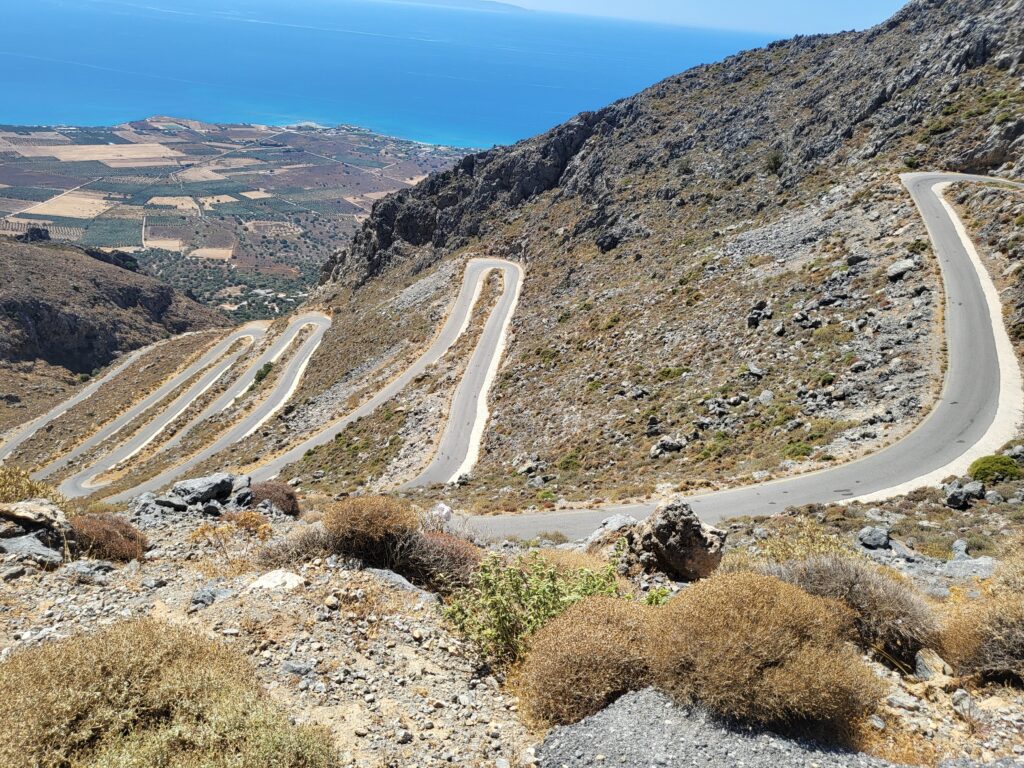
From Kapsodasos, the return to our starting point was a continuous tarmac climb of 13.8 kilometres, gaining 803 metres at an average gradient of 6.7 per cent. The steepest recorded section reached 20.5 per cent.The road began to rise almost as soon as we left. Ahead, its pale surface could be seen laid across the southern face of the mountain in a succession of reversals. The recognised sequence is usually counted as twenty-seven hairpin bends, although the total becomes larger if the broader changes of direction are included. Twenty-seven was sufficient.
Each bend performed the same piece of mountain geometry. The road crossed the slope, turned back upon itself and crossed again a little higher. From below, several levels of tarmac could be seen at once, one above another against the bare rock. From the bicycle, each hairpin briefly concealed what followed, offering a few seconds in which it was possible to imagine that the gradient might ease on the other side.
It seldom did.
The inside of each bend rose sharply. Taking the outer line reduced the gradient but added distance, and the empty road allowed us to negotiate between the two according to legs, gearing and inclination. Where the pitch climbed into double figures, cadence became a matter of discipline. There was none of the nervous calculation demanded by the descent, but there was also no meaningful rest. The mountain had exchanged loose stone for resistance.
Looking back, the Frangokastello plain spread wider with every turn. Individual fields merged into blocks of green and ochre. The fortress became a small, regular mark near the coast, and the sea seemed to rise behind it until the whole southern horizon was blue. The road below revealed itself bend by bend, a dropped length of ribbon pinned repeatedly to the mountainside.
The road linked more than two points on a map. Kallikratis and the coastal villages below have long formed parts of the same seasonal world. Families from Patsianos, Kapsodasos, Skaloti and Argoules traditionally used Kallikratis as their summer settlement, moving into the cooler high country with their animals and returning to the plain as the seasons changed. Livestock, vines, beehives and fruit trees sustained life on the plateau. The modern tarmac is comparatively new, but the movement between mountain and coast is not.
We had made the journey in reverse: first descending from the high country to Kapsodasos, then climbing back by the paved road. The older connection remains visible in the geography. The Kallikratis Gorge also descends towards Kapsodasos, one of the natural cuts through the limestone wall separating plateau from plain. Village and coast may appear isolated from one another, but historically each was the other’s seasonal counterpart.
Kallikratis stands at approximately 760 metres and is divided among four old neighbourhoods scattered across the plateau. Its quietness conceals a severe history. Local memory speaks of the village being repeatedly destroyed during the Cretan rebellions. In October 1943, German troops and a collaborationist unit commanded by Fritz Schubert entered Kallikratis, murdered about thirty inhabitants, looted the houses and burned the village. It is now officially recognised as one of Greece’s martyr villages.
The road carried us through Kallikratis as part of the same unbroken 13.8-kilometre ascent to the starting point. The compact severity of the hairpins eased, but the climbing did not end. Beyond the village houses the road continued through the high country, gaining height more gradually among the familiar limestone ridges. The landscape with which we had begun the morning closed around us again, although it now seemed altered by the knowledge of what lay below.
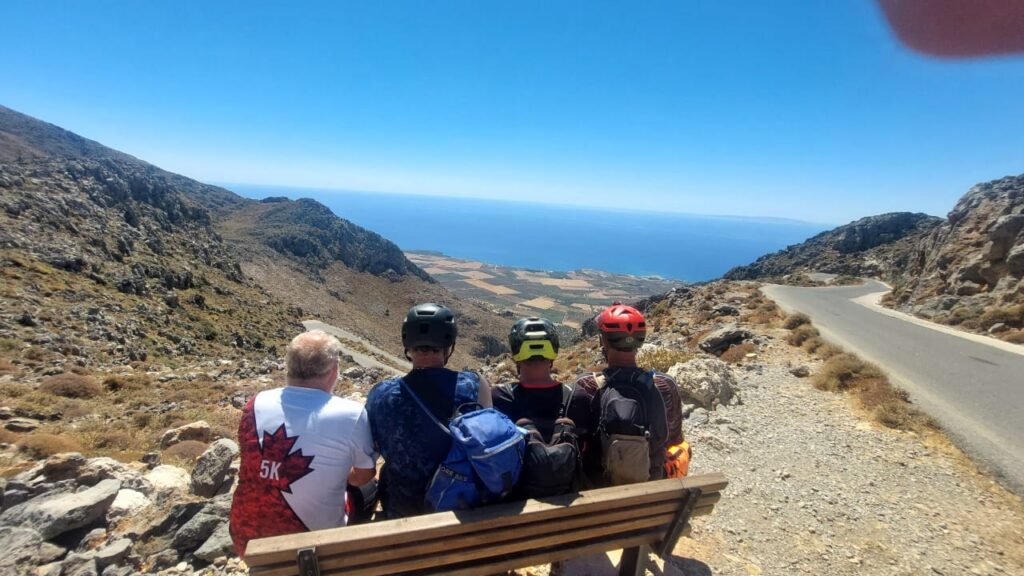
When we stopped the GPS, it recorded 27.9 kilometres, 980 metres of ascent and 975 metres of descent. Our moving time was approximately two hours and twenty-three minutes; the elapsed time was three hours and forty-four minutes. The difference contained much of what made the ride memorable: photographs on the descent, the conversation with the shepherds, the sweet red grapes and coffee before beginning the climb.The circuit had been divided almost exactly in half, but distance was the only thing its two sides shared. The descent required hands, eyes and nerve: ten kilometres of broken limestone in which every metre had to be negotiated.
The return required legs, lungs and patience: thirteen continuous kilometres of tarmac rising through twenty-seven bends from the coastal plain to Kallikratis and the mountains above.
By the finish, the sea had disappeared and the high silence had returned. We had completed a circle on the map, though nothing about it had felt circular. First we found a way down through the stone; then we repaid every metre on the long road back. The mountain had allowed us the descent, but it had not given it freely. It kept an exact account and collected the debt in twenty-seven bends.