Two young men from Leicester became Yeomanry soldiers, volunteered for the Middle East Commandos and reached Crete with D Battalion, Layforce, during the final days of the Battle of Crete. One was killed and lies in Suda Bay War Cemetery. The other escaped from the island and went on to serve in one of the less familiar theatres of the war. Using military records, contemporary accounts, family photographs and memories, and the ground over which they fought, this is an attempt to reconstruct their two remarkable journeys — and the connection between them.
There are stories in a military cemetery that appear, at first, to begin and end beneath a headstone. A name, a regiment, an age, a date. The necessary economy of the Commonwealth War Graves Commission compresses a life into a few carefully cut lines of stone. But sometimes, if you follow one of those names away from the grave and back through the country in which the man fought, another life crosses the trail. The two stories begin to run together, separate, and then meet again in unexpected places.
This is one of those stories
It concerns two young soldiers from Leicester whose paths brought them to Crete during the last desperate days of May 1941. Both had been Troopers in the Staffordshire Yeomanry. Both became Commandos. Both served with D Battalion, Layforce. Both were caught up in a war that had already carried them far from home and would, for one of them, carry him very much farther.
One survived Crete and eventually came home. The other lies in Suda Bay War Cemetery.
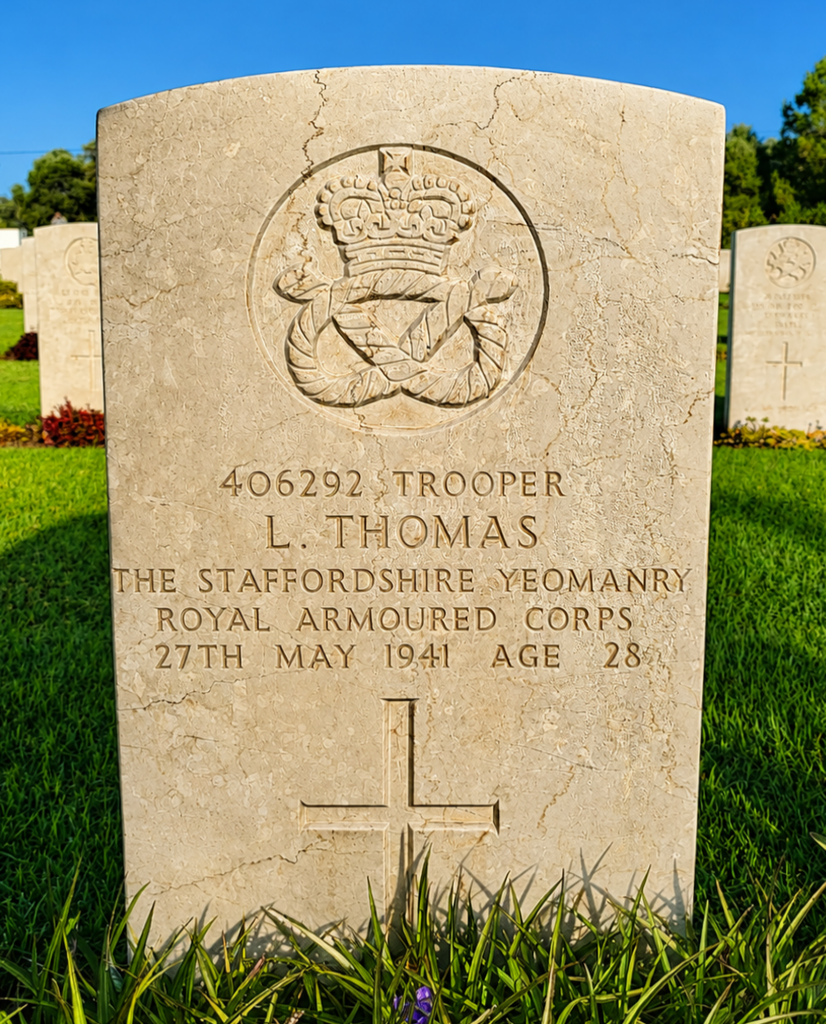
His name was Trooper Leslie Thomas.
The man who survived was Nelson Horace “Jim” Parramore.
As with much of my historical research, this is what we know today. History of this kind rarely arrives conveniently assembled. It survives in a medal inscription, an old photograph, a few words written beneath a picture, a nominal roll, a headstone, a family memory and, sometimes, something a man told his son many years after the events themselves. Put those fragments beside one another and a life begins to emerge.
In Jim’s case, it became quite a life.
LESLIE THOMAS
Leslie Thomas was the son of George Henry and Mary Thomas of Leicester. By May 1941 he was twenty-eight years old and serving as 406292 Trooper Leslie Thomas, Staffordshire Yeomanry, attached to No. 52 Middle East Commando.
The Middle East Commandos were part of Layforce, commanded by Lieutenant Colonel Robert Laycock. No. 7 Commando formed A Battalion, while Nos. 50 and 52 Middle East Commandos were brought together as D Battalion under Lieutenant Colonel George Young.
These were not conventional infantry battalions. Their men had come from regiments and corps scattered across the British Army. Cavalrymen, infantrymen, gunners and specialists found themselves brought together for a form of warfare the Army itself was still learning: raiding, reconnaissance, demolition and operations by small, mobile bodies of men expected to operate with considerable independence.
Many had volunteered for precisely that sort of war. Crete gave them something quite different.
By the time the main body of Layforce arrived, the Battle of Crete was already being lost. The German airborne invasion had begun on 20 May. Maleme airfield had fallen, allowing German reinforcements to be flown onto the island, and the British and Commonwealth position in western Crete was collapsing. The decision had been made to withdraw across the island towards Sfakia, where the Royal Navy would attempt to evacuate the force from the south coast.
That meant getting thousands of exhausted men through the foothills and across the mountains while the Germans followed. Someone had to stand behind them. That was the battle waiting for Layforce.
INTO A WITHDRAWAL
The first 200 men of A Battalion had reached Suda aboard HMS Abdiel. Then, at about one o’clock in the morning on 27 May, British warships entered Suda Bay carrying Laycock’s headquarters and the remainder of A and D Battalions, about 750 men.
There is something extraordinary about the timing. The Commandos were arriving almost at the precise moment everyone else was trying to leave.
Across western Crete, formations that had been fighting since 20 May 1941 were disengaging. Chania was being abandoned; headquarters were moving; communications were breaking down. Wounded men and exhausted stragglers filled the roads, and the long movement towards the south coast had begun.
Into this confusion came the Commandos, and Leslie Thomas was among them.
During 27 May the defensive line contracted eastwards and southwards through Veritiana — the wartime name for the present-day Mperetiana, located on the low ground below Megala Chorafia — and onwards through Stylos and Neo Chorio towards the road running through Babali Hani, present-day Agii Pantes, Vryses and Askifou.
The operational account gives us a clearer picture of what was happening. The remainder of A Battalion, about company strength, occupied positions in the area of Veritiana to cover the road towards Sfakia. D Battalion, accompanied by two tanks, was ordered towards Babali Hani to establish defensive positions farther south. Its task was to protect the escape route if the positions around Veritiana were overrun.
D Battalion was moving into the rearguard, but Thomas never completed the journey.
He died on 27 May, probably less than a day after reaching Crete.
His wartime burial documentation gives us something his headstone cannot: a military map reference for the place from which his body was later recovered. When plotted against the wartime map, it takes us into the Kaina area, close to the country through which the withdrawal was taking place.
Precisely what happened to him there remains unknown, but the date tells us something important. The major action fought by D Battalion at Babali Hani took place on 28 May.
Thomas had died the day before.
So, his final hours belong somewhere in that short and confused interval between the night landing at Suda and the movement south towards Kaina: a young Staffordshire Yeoman turned Commando, newly arrived on an island from which an army was already withdrawing.
HOLDING THE ROAD
What happened to Thomas’s comrades after his death explains why men such as him had been brought to Crete at all.
By midnight on 27–28 May, the retreat had acquired a rough defensive structure. A Battalion was around Veritiana, present-day Mperetiana. Australian and New Zealand formations occupied the country around Stylos and Neo Chorio. D Battalion had reached Babali Hani, present-day Agii Pantes, farther south. Beyond them the road ran through Vryses, climbed towards Askifou and Imbros, and eventually descended towards Sfakia and the Libyan Sea.
The Germans came on early the following morning. A Battalion was attacked at Veritiana at about 0600, while German mountain troops pressed the British and Commonwealth forces around Stylos. The fighting moved steadily south until, at Babali Hani, D Battalion stood in its path.
Behind the Commandos the withdrawing columns; ahead of them, the German advance. At about 1400 the Australian 2/8th Battalion joined the position, and at 1515 the Germans attacked.
The position was held for six hours.
Babali Hani was not being defended because anyone imagined it could be retained indefinitely. Ground had ceased to be the important commodity.
Time was.
Every hour bought there allowed more men to move through Vryses and towards the mountains. Another battalion could get farther south; another group of wounded could move another few miles; more distance could be placed between the withdrawing force and the German advance.
The Commandos and Australians held until 2115 and then withdrew. D Battalion passed through Vryses and continued south, its men already reaching the limits of physical endurance but still moving towards Imbros.
Ahead of them rose the White Mountains.
Beyond them lay the sea.
THE ROAD TO SFAKIA
The route is still there. Suda, Stylos, Neo Chorio, Babali Hani — present-day Agii Pantes, Vryses, Askifou, Imbros, Komitades, Sfakia.They are familiar places to anyone who knows western Crete. Today we pass through them on good roads, perhaps stopping in Vryses or looking across the Askifou plateau towards the mountains. In the final days of May 1941, they marked stages along the escape route of an army.
Men walked without sleep. Units became mixed together. Vehicles were abandoned when fuel ran out or when they could go no farther. Headquarters struggled to communicate with formations that were themselves moving, and orders sometimes arrived late or not at all. The road climbed steadily towards country that imposed its own discipline on everyone who entered it.
Yet the withdrawal continued.
Reaching Sfakia did not mean safety. The Royal Navy could only embark so many men, and the evacuation depended upon ships approaching the coast at night, taking aboard what they could and disappearing again before daylight.Men waited their turn, knowing that there might not be another night.
During the final evacuation approximately 4,050 men were taken from Crete. Those who remained faced captivity or the uncertain prospect of disappearing into the mountains and trusting themselves to the Cretans.
Layforce had paid heavily for the time it had bought.
But among the men who made it away from Crete was another Staffordshire Yeoman turned Commando. Jim Parramore.
JIM
Nelson Horace Parramore was born in 1918 and was known throughout his life as Jim. We can find him before the Army, because in September 1934 the sixteen-year-old Nelson Horace Parramore appears in the London Gazette as a Temporary Postman-Messenger with the Post Office. The circumstances behind that early appearance in the record belong to Jim’s family history. Jim had, for a short period, lived with his father in the Pinner and Harrow area before returning to his home town of Leicester.
Then came the Territorial Army.
HORSES TO PALESTINE
Jim initially served with the Leicestershire Yeomanry, still a horsed cavalry regiment as Britain approached the Second World War. In 1939 it had been intended for the 1st Cavalry Division, but plans changed before the division went overseas. The Leicestershire Yeomanry was selected for conversion to the Royal Artillery and, in early 1940, divided to form two field regiments: 153rd (Leicestershire Yeomanry) Field Regiment, Royal Artillery, formed in February, and 154th (Leicestershire Yeomanry) Field Regiment, Royal Artillery, formed on 15 April. Neither followed the 1st Cavalry Division to Palestine at that time; both initially remained in Britain.
Jim, however, remained a cavalryman. He was rebadged or transferred to the Staffordshire Yeomanry, which remained a horsed regiment and deployed to Palestine with 6th Cavalry Brigade, 1st Cavalry Division, in January 1940. It went with horses.
Jim spoke of sailing for Palestine with the horses and remembered that the animals did not fare particularly well during the voyage. Among his surviving photographs is an album page simply marked:
Palestine 1940.
Jim was awarded the Territorial Efficiency Medal. The inscription around its rim reads:
322616 TPR H. PARRAMORE STAFF YEO
There he is.
Trooper Parramore.
Staffordshire Yeomanry.
The medal, the photographs and the family memory now sit naturally together. Jim had begun with the Leicestershire Yeomanry, remained a cavalryman when that regiment converted to artillery, and gone east with the Staffordshire Yeomanry and its horses.
Palestine would also place him close to the beginnings of another kind of soldiering.
The Middle East Commandos were recruiting from British units already serving in the theatre, and among the men who moved from the Staffordshire Yeomanry into No. 52 Middle East Commando were Lieutenant Richard Babington Jones, Trooper Francis John Hill, Lance Corporal Daniel Green and Trooper Leslie Thomas.
Men also came into the Middle East Commandos from the Yorkshire Hussars, another Yeomanry regiment serving in Palestine. The surviving evidence shows Yorkshire Hussars men entering No. 52 Middle East Commando during the same period.
That becomes important later in Jim’s story.
The Army of 1940–41 was changing rapidly.
Men could begin with one Territorial regiment, be rebadged or transferred to another and then volunteer for Special Service. Jim’s service followed precisely that sort of progression: Leicestershire Yeomanry, Staffordshire Yeomanry, later the Yorkshire Hussars, and then the Middle East Commandos.
The connection is important because Jim followed the same broad road as Thomas from the Yeomanry into the Middle East Commando world.
So, the two men at the centre of this story now have something more substantial in common than we first understood.
So, the two men at the centre of this story now have something more substantial in common than we first understood.
Thomas and Parramore were both from Leicester.
Both Staffordshire Yeomen.
Both became Commandos.
Both served with D Battalion.
And both would find themselves on Crete.
JIM THE COMMANDO
For Jim, the cavalry was only the beginning. He became a Middle East Commando, part of that remarkable wartime movement in which men stepped away from established regimental life and volunteered for Special Service.
The transition would have been less strange than it may appear today. The Army of 1940–41 was changing rapidly. Formations were created, reorganised and dissolved; men were transferred, attached and rebadged; specialists were pulled from one organisation and placed in another.
The neat sequence we might like to see eighty-five years later was not necessarily the sequence experienced by the soldier himself.
What matters is where the trail leads.
Jim’s led from the Yeomanry into the Middle East Commandos and then into D Battalion, Layforce.Nos. 50 and 52 Middle East Commandos were amalgamated at Geneifa on 28 March 1941 to form D Battalion. It was D Battalion that was sent to Crete and committed to the rearguard during the withdrawal.
Jim was one of its men. There he served as a motorcycle dispatch rider.
It was an occupation particularly suited to the battle that developed after 27 May. Headquarters were moving, units were withdrawing through difficult country and communications were repeatedly breaking down. Wireless sets were neither universal nor infallible, and somebody still had to carry orders and information between men who might themselves have moved by the time the messenger reached them.
Jim rode.
The precise roads and tracks he used are lost to us, but the direction of travel is not. As the British and Commonwealth forces withdrew, everything was being drawn south towards the mountains and Sfakia.
The D Battalion positions at Babali Hani — present-day Agii Pantes — now give us a firmer geographical point within that movement.
Somewhere within it was Jim Parramore on his motorcycle.
Eventually he reached the south coast.
And Jim got off the island.
TWO STAFFORDSHIRE YEOMEN
This is where the two stories become inseparable.
Leslie Thomas had begun as a Staffordshire Yeoman and become a Commando. So had Jim Parramore. Both were men of D Battalion, Layforce, in Crete during the final days of the battle, when the battalion was fighting to keep open the road south.
Both also came from Leicester.
That coincidence, hidden when this research began, brings their lives still closer together. I do not know whether they knew one another. The Special Service world in the Middle East was comparatively small, and their backgrounds now bring them tantalisingly close, in all likelihood they probably did know each other.
Their paths are powerful enough as they are.
Thomas’s ended on 27 May, somewhere around Kaina, scarcely a day after his arrival.
Jim’s continued south. Past the country in which Thomas had died, through the foothills and towards the mountains, eventually reaching the ships at Sfakia.
One Staffordshire Yeoman left Crete.
The other remained behind.
JIM’S WAR WAS ONLY BEGINNING
For Jim, Crete was not the climax of his war. In some respects, it was merely the beginning. The next trail leads thousands of miles east, into one of the less familiar British Special Service operations of the Second World War.
Jim joined No. 1 Special Service Detachment — SSD1, part of the British Military Mission to China generally known as Mission 204. Its men were intended for irregular warfare: demolition, sabotage, reconnaissance and the training of Chinese forces fighting the Japanese.
The name can initially be confusing. If this was the British Military Mission to China, why does Jim’s story next take us into Burma?
Because Burma was part of the route and part of the operation.
Mission 204 personnel assembled and trained there before operating with Chinese forces. SSD1 itself operated in Burma in front of the Chinese 6th Army. The mission’s title described its wider purpose; it did not mean that its men simply travelled directly to China and remained there.
There is a striking continuity here. The officer commanding No. 1 Special Service Detachment was Lieutenant Colonel John Alexander Ralph Milman, himself a veteran of No. 52 Middle East Commando and D Battalion Layforce, wounded during the Battle of Crete.
The world Jim entered in Burma was therefore not disconnected from the one he had known in the Middle East. Men, skills and experience travelled east with the war.
And now, for the first time, we can actually see Jim among them.
TAUNGGYI, 3 FEBRUARY 1942
A surviving group photograph shows the men of No. 1 Special Service Detachment at Taunggyi in the Southern Shan States of Burma on 3 February 1942.
Keith has identified his father in the photograph. The accompanying identification material names him:
JIM PARRAMORE L/CPL.
YORKS HUSSARS
M.E.
The significance of the final two letters is now clear.
Middle East Commando.
The young man remembered by his family as having begun in the Leicestershire Yeomanry, and whose surviving medal names him as a Trooper of the Staffordshire Yeomanry, is now recorded as a Lance Corporal of the Yorkshire Hussars with his Middle East Commando connection carried alongside it.
Rather than contradicting the earlier evidence, the annotation gives us another stage in Jim’s wartime movement.
The Yorkshire Hussars were serving in the same Middle Eastern military environment, and men from the regiment are independently known to have entered No. 52 Middle East Commando. In a wartime Army in which men volunteering for Special Service could be transferred and attached between organisations, Jim’s appearance under the Yorkshire Hussars is entirely understandable.
In the photograph, Jim is wearing corporal’s chevrons. The surviving identification records Jim as Lance Corporal, that is clearly an error. The photograph therefore gives us another indication that by the SSD1 period he was no longer simply the Trooper named on his earlier Staffordshire Yeomanry medal.
His own photograph album provides a parallel record. One page is marked:
Burma 1941.
Another: S.S.S. Burma 1942.
Those three letters, once obscure, now have a landscape attached to them:
Southern Shan States.
The album and the military record have arrived at the same place.
WALKING OUT
Then comes one of those family memories that, once placed beside the historical record, suddenly acquires a different weight.
Keith remembers his father saying that he had “walked out of Burma.”
It is an understated description of what followed. Such economy was common among men returning from war. Some experiences were difficult to revisit, others almost impossible to explain to those who had not been there, and military culture itself encouraged understatement. Hardship was endured, dealt with and afterwards often compressed into a few matter-of-fact words. “Walked out of Burma” was enough.
From January to May 1942, Milman’s No. 1 Special Service Detachment was operating in front of the Chinese 6th Army in Burma. Then the Japanese advance broke through to Lashio.
The way back to the main British forces was cut. SSD1 had to get out by another route. The surviving account of the detachment’s withdrawal takes the men through Kengtung, across the Southern Shan States and towards Kunming in China. The annotation preserved with the SSD1 material gives the scale of the journey:
66 days. 630 miles.
But Keith also remembers something else his father said.
Mule tracks.
That recollection fits the country through which SSD1 withdrew.
This was not a 630-mile march along roads. The detachment was moving through remote and difficult country, using mule tracks and such means of movement and transport as were available. Hunger, thirst and disease became part of the journey.
Jim’s expression — “walked out of Burma” — nevertheless captures the essential truth of what Jim and the others had done.
They had been cut off by the Japanese advance. There was no simple road back. So they went out through the mountains.
The photographs now begin to follow the journey.
S.S.S. Burma 1942.
Then:
China 1942.
What had once been a few words beneath family photographs now corresponds with the route of SSD1.
Burma.
The Southern Shan States.
Kengtung.
Towards Kunming.
China.
Jim had escaped from Crete less than a year earlier.
Now he had escaped again.
CHINA AND INDIA
The album does not stop in Burma.
Several photographs are captioned:
China 1942.
Then another group takes us somewhere quite different:
Darjeeling India 1942.
Jim is in one of the Darjeeling photographs, standing with a dog. Here again the family memory supplies the human part of the story. Jim had contracted tropical sprue and Keith remembers that his father spent time at a convalescent home in the Darjeeling area after walking out of Burma.
That fits naturally into what we now know of the SSD1 withdrawal. The men had spent weeks moving through difficult and unhealthy country under conditions in which hunger, exhaustion and disease were constant threats. Reaching safety did not mean that a man immediately returned to full health.
For Jim, the journey out of Burma had consequences.
His recovery took time.
Keith also remembers that his father remained in India for a considerable period afterwards. That too belongs naturally within the wider course of his war. India had become the principal Allied base for operations connected with Burma, and Jim remained a serving soldier in a theatre which was itself being reorganised after the Japanese conquest of Burma.
The photographs continue into India.
For the moment, they take the documentary trail farther than the surviving military records available to us.
NOW THE CONNECTION RUNS DEEPER
Both had been Staffordshire Yeomanry Troopers. Both left the familiar world of the Yeomanry for the unfamiliar one of Commando service. Both served with D Battalion, Layforce. Both came from Leicester. Both came to Crete.
Then their journeys divided.
For Thomas there was Suda, the night landing, the hurried movement south and death near Kaina on 27 May 1941. His war had contracted suddenly to a few miles of Cretan ground.
For Jim, the road kept going.
It led south across Crete and down to the sea at Sfakia; then onwards into a war of almost astonishing geographical reach — Palestine, Burma, the Southern Shan States, China, India and eventually Britain.
One man’s story survives in a grave.
The other’s survived in an old medal, photographs, a few handwritten captions and the memories he left with his family.
Put them together and the two journeys that had run so closely together finally separate.
For Leslie Thomas:
Suda.
Kaina.
And there his journey ended on 27 May 1941.
Jim’s continued:
Babali Hani — present-day Agii Pantes.
Vryses.
Askifou.
Imbros.
Sfakia.
And the sea.
But even that was only another beginning.
Palestine had already brought Jim to the Middle East. After Crete came Burma, the Southern Shan States, Kengtung, China and India, before eventually, after years of war, the journey ended where Leslie Thomas never could.
Palestine had already brought Jim to the Middle East. After Crete came Burma, the Southern Shan States, Kengtung, China and India, before eventually, after years of war, the journey ended where Leslie Thomas never could. Home.
For Jim, Crete became part of the road home.
For Leslie Thomas, Kaina was the end of the road.
RETURN TO SUDA
In April 1992, fifty-one years after the Battle of Crete, Jim Parramore returned to Suda Bay War Cemetery. He was an old soldier now, but he had come looking for young men who had not been given the chance to grow old as he had.
Keith remembers his father studying the cemetery register and then walking among the graves of the fallen. Jim told him that he had found some of his comrades. Like many old soldiers, there was no ceremony about it and few words. After fifty-one years, there were few words that would have made much difference. The names were there, cut into the stone.
For Jim, simply being there was an Act of Remembrance.
They had last known one another when they were young. They had shared the strange, close existence of soldiers at war. Some had gone on and some had not. After the war Jim had come home, married, worked, raised a family and lived through the quiet accumulation of an ordinary life. He had watched his son grow into a man and had himself grown old. The men beneath the headstones had been given none of those years.
That is perhaps the hardest thing about an old soldier standing before the grave of a young one. The survivor has carried the intervening years with him — every birthday, every Christmas, every family gathering, every ordinary morning that seemed of no particular importance at the time. The comrades he had lost had not changed at all. In Jim’s memory they were still the young men he had known in 1941, and on the stones before him they remained forever twenty, twenty-two, twenty-eight.
Keith remembers walking among those graves with his father. He has a distant impression that they may even have stood in the area where Leslie Thomas lies, although after more than thirty years he cannot be certain. What he does remember is his father searching the cemetery register, finding graves and saying that some of his comrades were there.
There would have been men he remembered clearly and others reduced by the years to a face, a voice, a nickname or some insignificant incident which had somehow survived when more important things had disappeared. There may have been men whose deaths he had witnessed and others who had simply vanished during the retreat, their fate learned only later, if at all. Fifty-one years is a long time to carry such names, and Jim had carried them home.
In 1941 he had left Crete while others remained behind. He had gone down through the mountains to Sfakia, reached the sea and been given the chance to continue with his life. Half a century later he crossed Crete in the opposite direction, not as a Commando trying to escape, but as an old man returning to the young soldiers he had left behind.
Keith stood beside his father that day. He could see the graves his father was looking at, but he could not see the Crete that Jim could see. For Jim, somewhere beneath the peace and ordered rows of Suda Bay War Cemetery, there was another island: May 1941, the confusion of the retreat, the men around him, and those who did not reach the ships.
Jim had come home from Crete. Fifty-one years later, he came back for a little while to be with those who had not.
Jim Parramore died in 1999, seven years after that return to Suda Bay.
But Crete had not quite finished with him.
In 2000, the Greek Government posthumously awarded Corporal Nelson Horace Parramore the Commemorative Medal of the Campaigns 1940–1941, recognition from the country in which, as a young Commando, he had fought nearly sixty years before.
There is something fitting in the timing. In 1992 Jim had returned to Suda Bay to remember the young men with whom he had served and who had never come home. He had walked among their graves, found their names and quietly paid his respects. Seven years later Jim himself was gone, and the following year Greece remembered him.Today the medal and its certificate are framed together in Keith’s home, overlooking Souda Bay.
It is a small piece of metal carrying the weight of a much larger story: Leicester and the Yeomanry, horses bound for Palestine, the Middle East Commandos, Crete and the road to Sfakia, Burma, the Southern Shan States, China, India, and eventually home.
Jim had survived all of it. He had been given the years that so many of his comrades had not, and in 1992 he had returned to Crete to remember them.
After his death, Crete remembered him.
And perhaps that is where the story of the two men finally comes together. Leslie Thomas and Jim Parramore had both left Leicester, both become Staffordshire Yeomen, both volunteered for the Middle East Commandos and both reached Crete with D Battalion, Layforce. In May 1941 their paths separated. One remained on the island, forever twenty-eight; the other escaped, fought on, came home and was given another fifty-eight years of life. Yet in the end Crete held a place for both of them — one among the graves at Suda Bay, the other in the memory of a country that, nearly sixty years later, still remembered the young Commando who had fought there.
Rest in peace,
Trooper Thomas and Cpl Parramore.
Duty done.
They shall grow not old, as we that are left grow old:
Age shall not weary them, nor the years condemn.
At the going down of the sun and in the morning
We will remember them.
Alan McWiliams
In The Shadow of the White Mountains
September 2026