We had driven across from Kokkino Chorio with the bikes in the car, leaving the familiar country of Apokoronas behind and crossing Crete towards Sfakia. By the time we reached Anopoli, the journey had already brought us into another landscape. The Libyan Sea lay somewhere below and behind us; ahead rose the great pale mass of the Lefka Ori.
We unloaded the bikes in Anopoli.
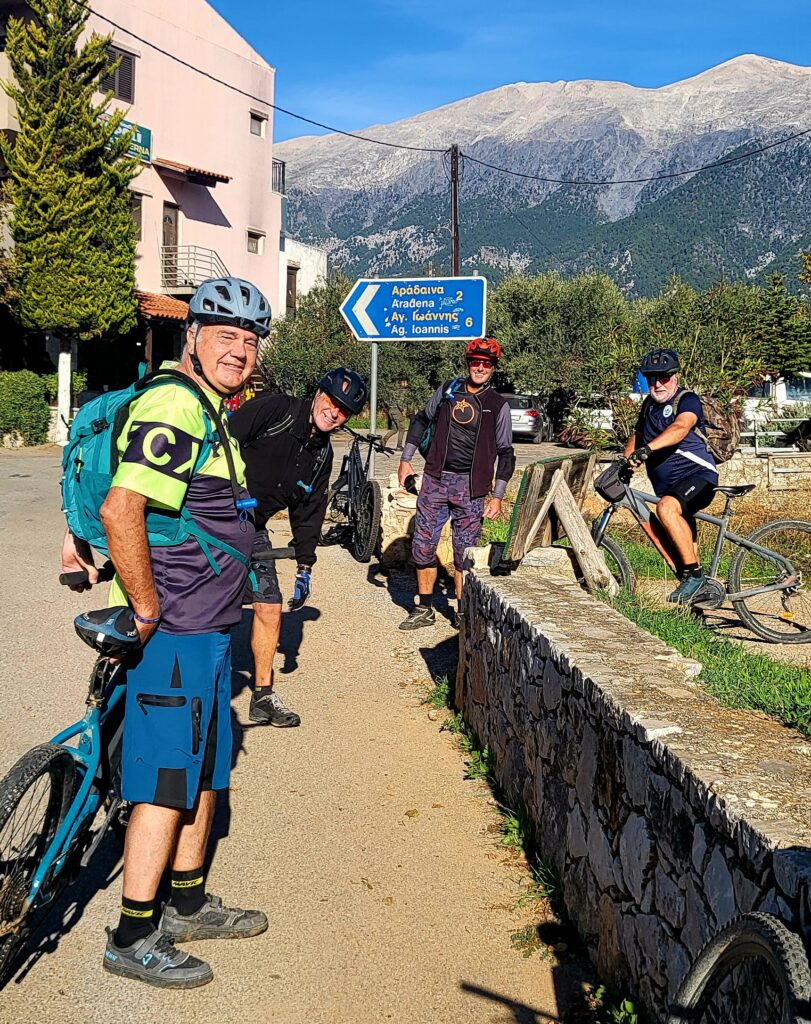
From there, we rode north.
I had called the ride simply The Climb, which was exactly what it was. There was no summit to be conquered and no particular need to turn the day into anything more complicated. I wanted to follow the mountain road out of Anopoli and see how far it would take us into the high country towards Pachnes.
The answer, as so often in Crete, lay in the ground.
Anopoli sits at about 600 metres above the Libyan Sea, on a plateau enclosed by some of the most formidable country on the island. It is a place I have come to like very much. There is something about its position that appeals to me. It is neither coastal nor truly mountain, but occupies the ground between the two. Southwards the land eventually falls towards Hora Sfakion and the sea; northwards the White Mountains rise until the inhabited country simply runs out.
That morning we were going in the latter direction.
The road climbed almost immediately. At first there were still the reassuring signs of ordinary life: houses behind us, cultivated patches, grazing ground, walls and scattered trees. Cypress stood among the limestone and the mountain had not yet entirely taken possession of the landscape.
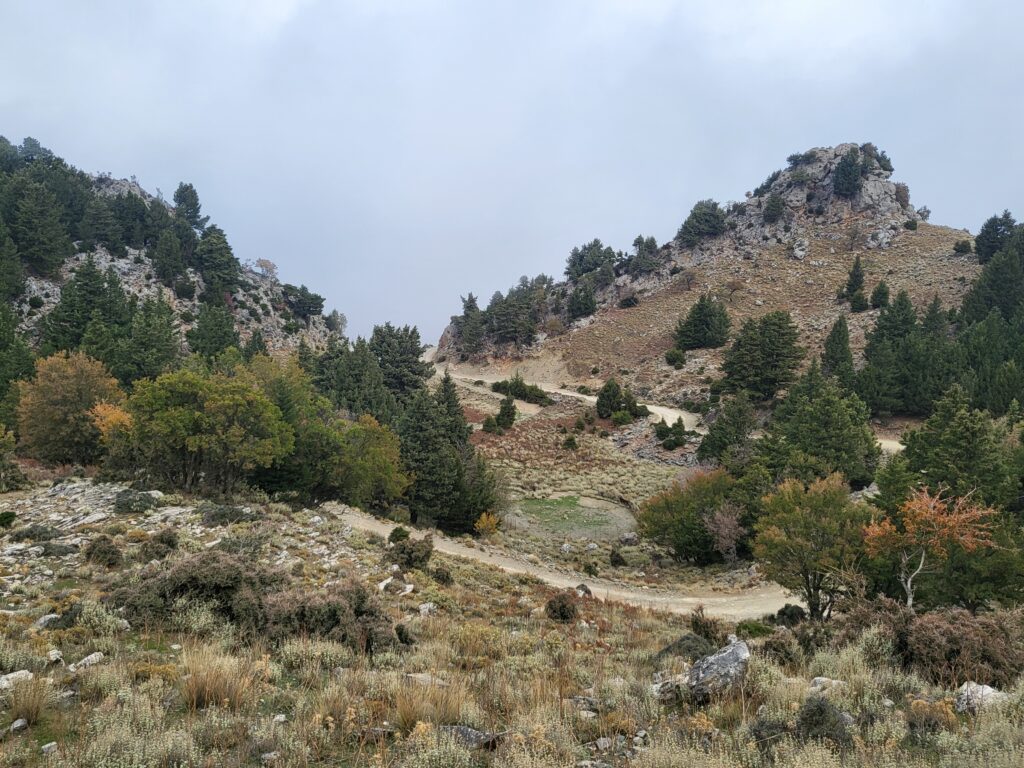
There was no obvious boundary where that changed.
The houses simply disappeared. Cultivation became less frequent. The trees grew farther apart and the road continued upwards, curling through increasingly broken country until a glance back revealed that Anopoli itself had vanished.
This gradual disappearance of the inhabited world is one of the things I remember most clearly about the climb.
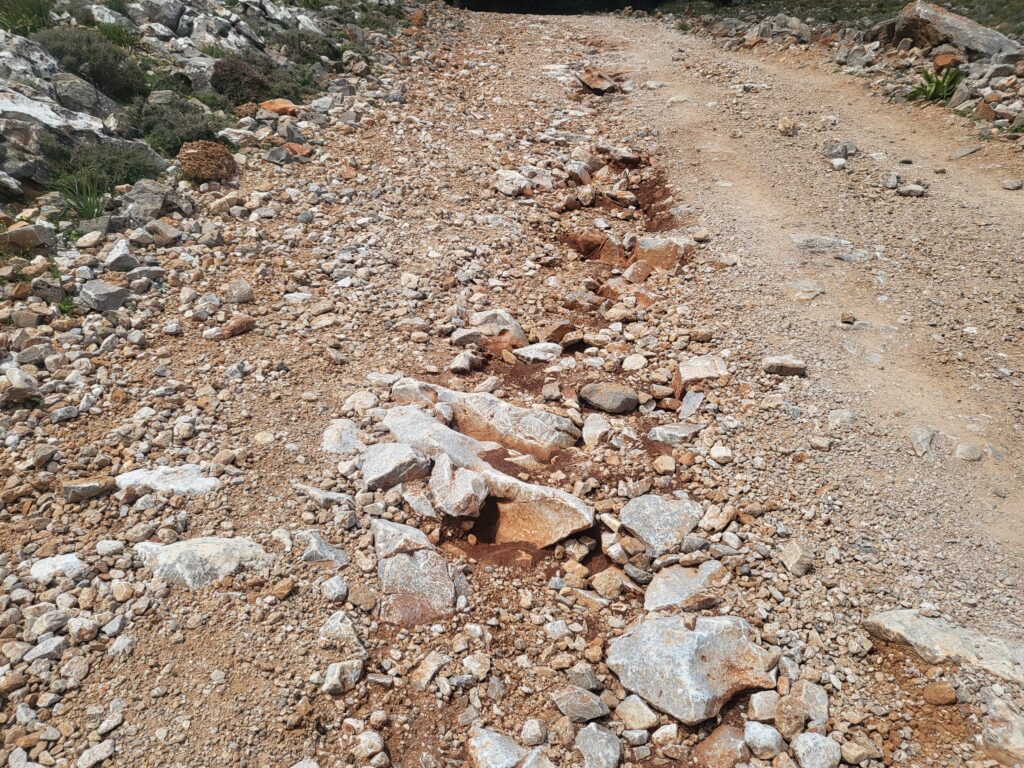
The road is called a road, although the word becomes increasingly generous as height is gained. It was built to reach the pastoral country of the Lefka Ori and eventually climbs deep into the mountains towards the Madares and the approaches to Pachnes. There are stretches of good compacted surface, but also fractured limestone, loose gravel, exposed shelves of rock and the debris left behind by winter weather.
Rain and melting snow do much of the maintenance, although not necessarily in a way appreciated by cyclists. But it adds to the adventure.
An E-MTB helps enormously on a climb of this length, but assistance should not be confused with immunity. The motor can supply power; it cannot provide grip. Nor can it choose a line through loose limestone, decide when momentum is useful or prevent an enthusiastic rider from discovering that too much torque on a steep, broken surface merely spins the rear wheel.
That part remains the rider’s responsibility. I enjoy that.
The climbing becomes a conversation between bicycle and ground. Not an argument, because the ground always wins those, but a succession of small judgements. A little more power here, less there. Stay seated to retain traction. Move the front wheel away from the loose edge. Carry enough speed across the broken section without arriving too quickly at whatever lies beyond it.
There is satisfaction in getting those decisions right, particularly when the climb continues for kilometre after kilometre.
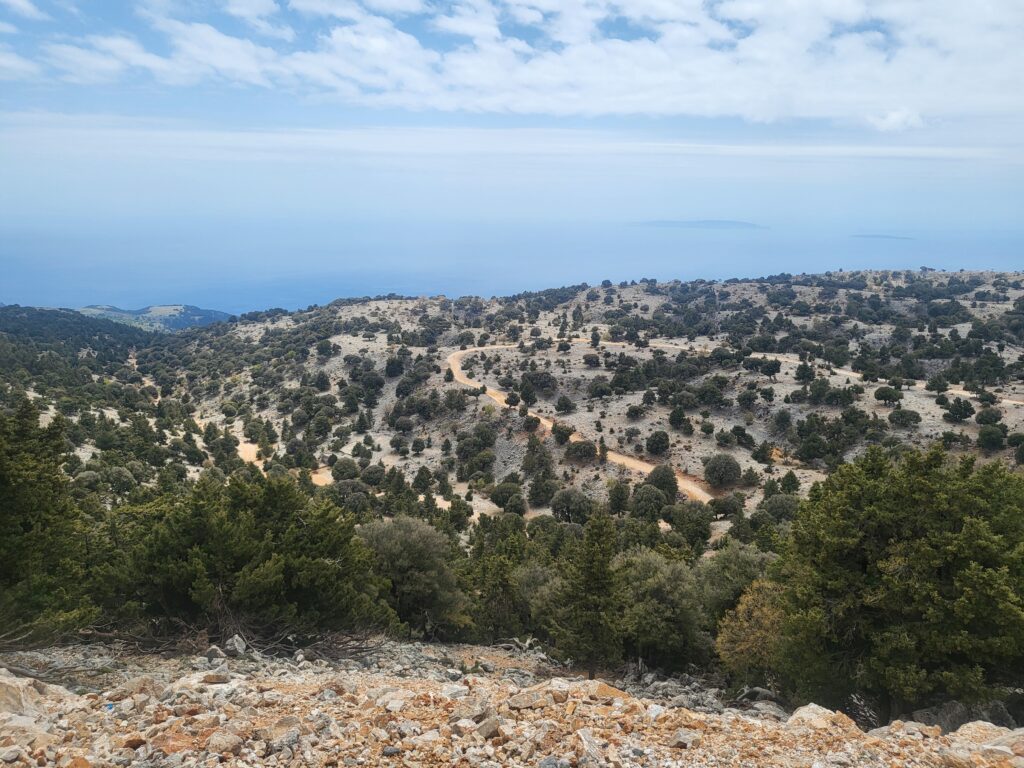
As we gained height, the trees thinned further and the landscape began to open around us. The richer colours of the lower country faded. Grey limestone became dominant, broken occasionally by the dark green of an isolated cypress or the low vegetation that survives among the rocks.
Then even those became scarce.
We were entering the Madares, the high, bare country of the Lefka Ori.
The name suits it.
This is a strange landscape on first encounter. From a distance the White Mountains can appear almost smooth, their pale summits piled one behind another. Inside them there is nothing smooth about the place. The ground is fractured and folded, cut by gullies and depressions, broken into ridges and great limestone basins that conceal one another.
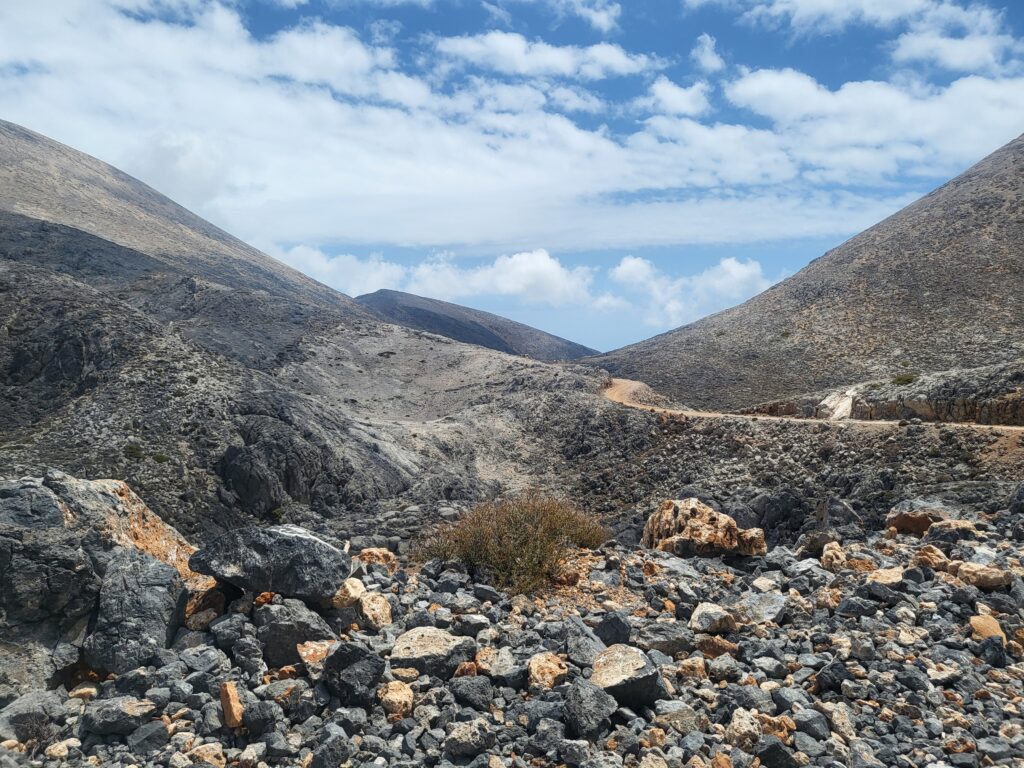
A road or track can be visible half a kilometre ahead and then simply disappear into a fold in the mountain.
Distances become equally deceptive. The air was exceptionally clear, stripping away the haze that normally helps the eye judge scale. A ridge that seemed almost within reach remained stubbornly distant, and reaching it frequently revealed another beyond.
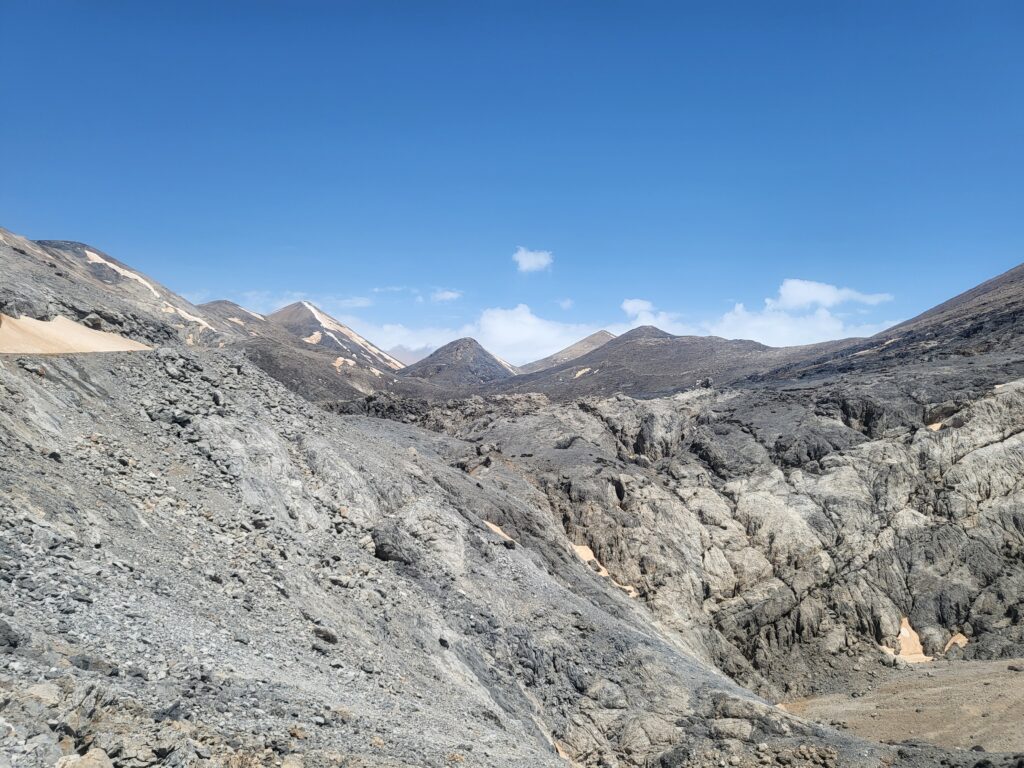
The mountain gave very little away.
By then we were surrounded almost entirely by limestone.
The geology of the Lefka Ori does not require much explanation when you are riding across it. The evidence is beneath the tyres. Water has worked on this rock for immense periods, finding weaknesses, enlarging fissures and disappearing underground. The result is the extraordinary karst landscape of the high mountains: sinkholes, depressions, caves, gullies and hidden drainage.
There is an apparent contradiction here that becomes obvious on the ground. The mountains receive substantial winter precipitation, much of it as snow, yet the high country can seem remarkably dry. The water has not necessarily gone elsewhere. Much of it has gone down, passing through fractures in the limestone into the mountain itself.
Snow was still lying in protected places when we rode there.
Not the clean white snow of winter. These were old snowfields, surviving in gullies and hollows protected from the sun, their surfaces stained cream and brown by dust and debris. Against the dark fractured limestone they looked almost out of place.
We stopped beside one.
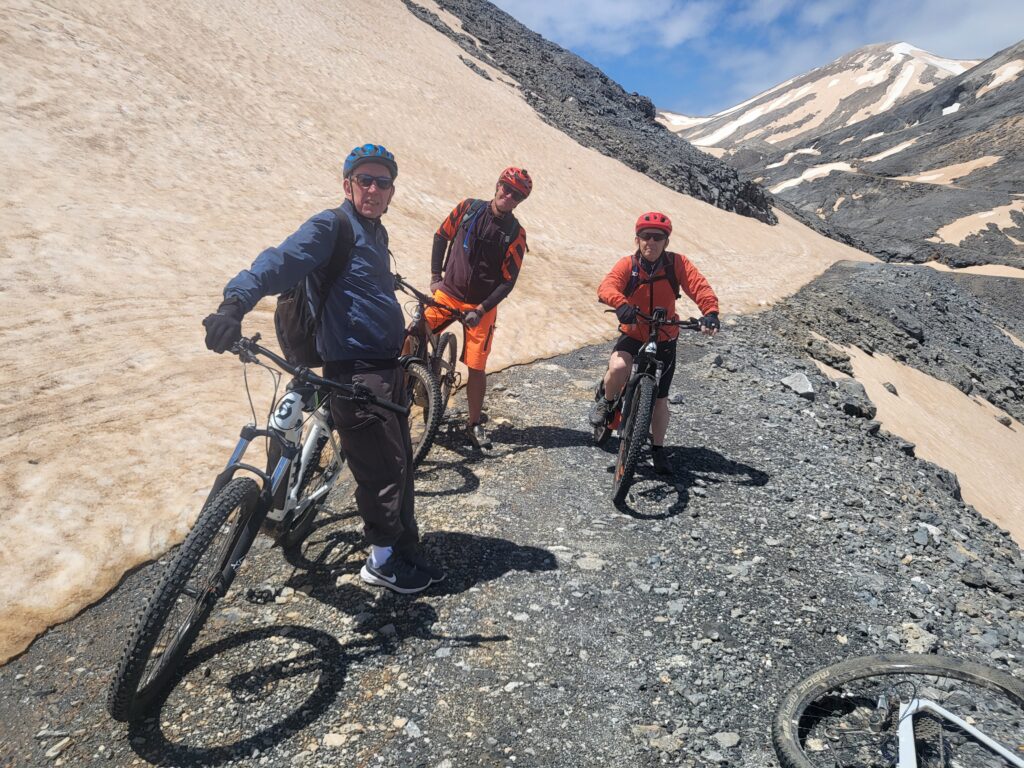
Three riders, three E-MTBs and a remnant of winter in a landscape otherwise reduced almost entirely to rock.
The photographs from that point still give me a better sense of the scale than any map. We occupy very little of them. Behind us the road winds away among the limestone and the mountains continue upwards.
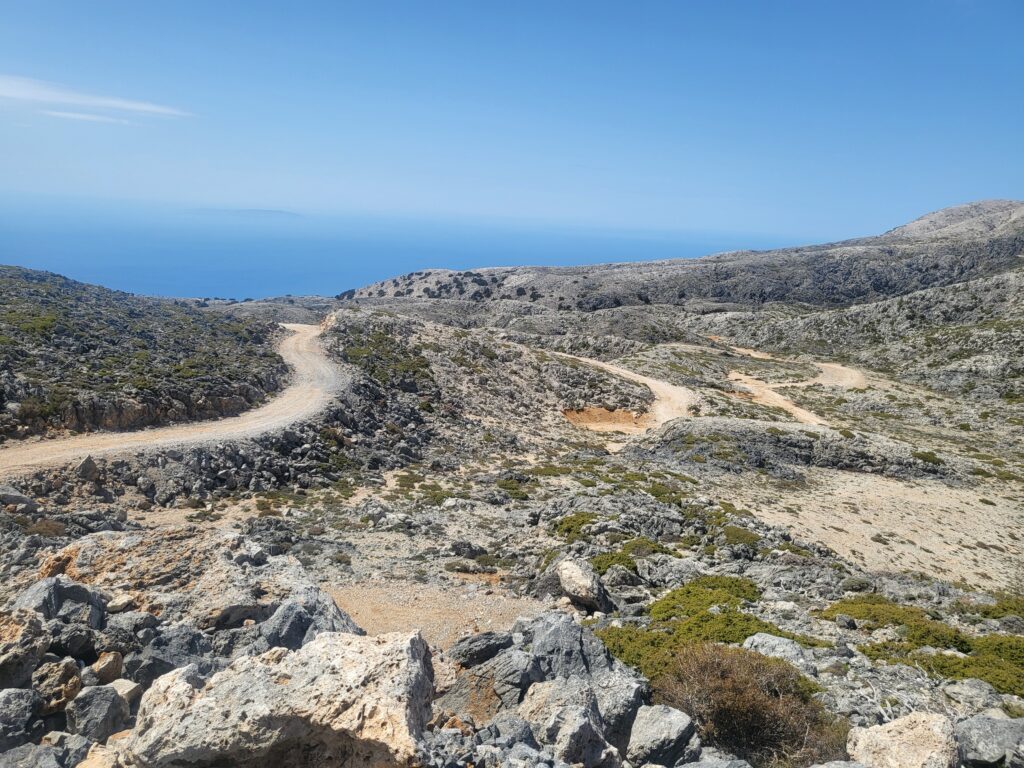
Somewhere ahead was Pachnes.
At 2,453 metres, Pachnes is the highest summit of the Lefka Ori and the second-highest mountain in Crete, only a few metres below Psiloritis. Yet there is nothing solitary about it. It belongs to a great congregation of high summits crowded into the central White Mountains, many rising above 2,000 metres.
Perhaps that is why Pachnes does not dominate the approach in the manner of an isolated mountain. It appears, disappears, and reappears as the road passes between ridges and across depressions. The whole massif is the presence rather than any single summit.
We were not attempting Pachnes itself. The final ascent is a walking route, and that was not the purpose of the day.
I was interested in the road.
And increasingly, in where that road had taken us.
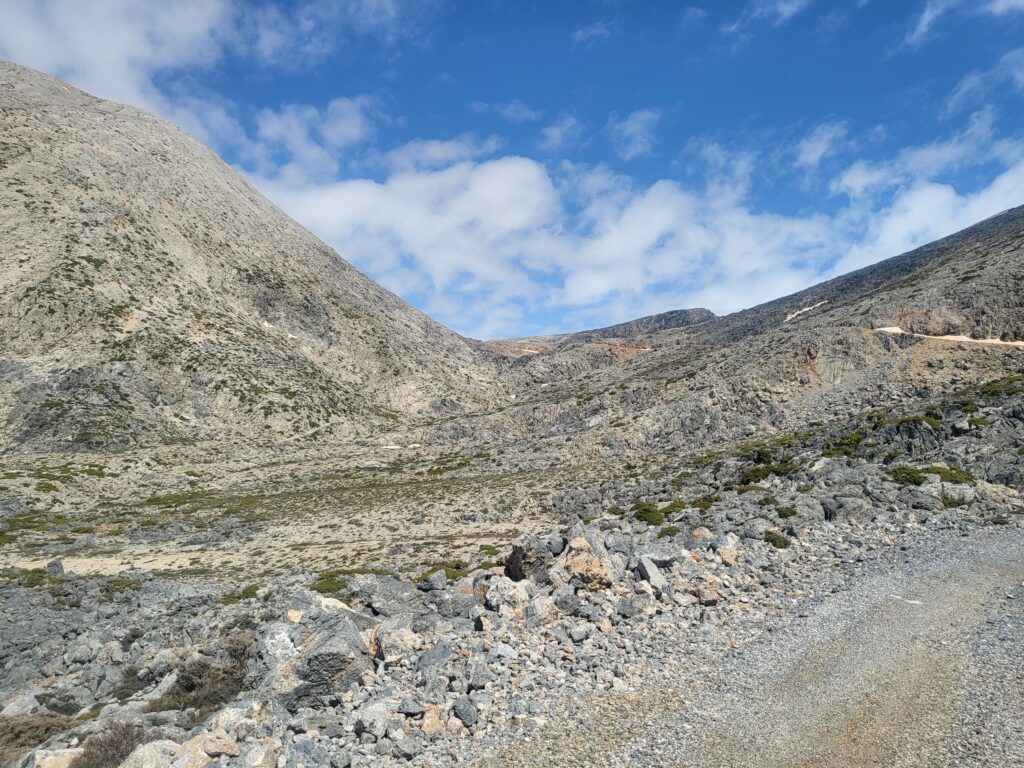
To describe the Madares as empty would be an easy mistake. There are few permanent buildings, no cultivated fields, no electricity poles crossing the skyline and, for long periods, no other people. By the standards of the lowlands it looks unoccupied
But it is not unused country.
For generations this has been the summer world of Sfakian shepherds.
As the seasons changed, flocks were moved between lower grazing and the high pastures. The tracks through these mountains connected water, grazing grounds and shelters. They existed because people who knew the country had learned where movement was possible.
Among the limestone stand the mitata, the dry-stone shelters associated with that pastoral life.
Seen from a distance, an old mitato can almost disappear into the mountain. The reason is straightforward: it came from the mountain. Stone gathered locally provided walls and corbelled roofs in a landscape where timber was limited. Nearby enclosures served the flocks, while the shelters themselves provided somewhere to live and work during periods spent in the high country, including the traditional production of graviera and mizithra.
Nothing was built merely to look picturesque.
It had a purpose.
That practical relationship between people and ground interests me far more than the idea of wilderness. The mountains were never empty spaces waiting to be discovered by visitors. Shepherds knew them intimately. They knew the grazing, the weather, the springs and cisterns, the routes between one part of the massif and another, and the places where shelter could be found when conditions changed.
That knowledge mattered in ordinary life.
At other times it mattered for very different reasons.
Sfakia has a long history of resistance to outside authority, and the White Mountains have always been part of that story. It is tempting to attribute this simply to remoteness, but remoteness by itself explains very little. What mattered was the combination of difficult access and local knowledge.
The distinction became clearer to me as we rode.
From a distance, much of the country looks exposed. Stand within it and people disappear remarkably quickly.
A shallow depression hides a rider.
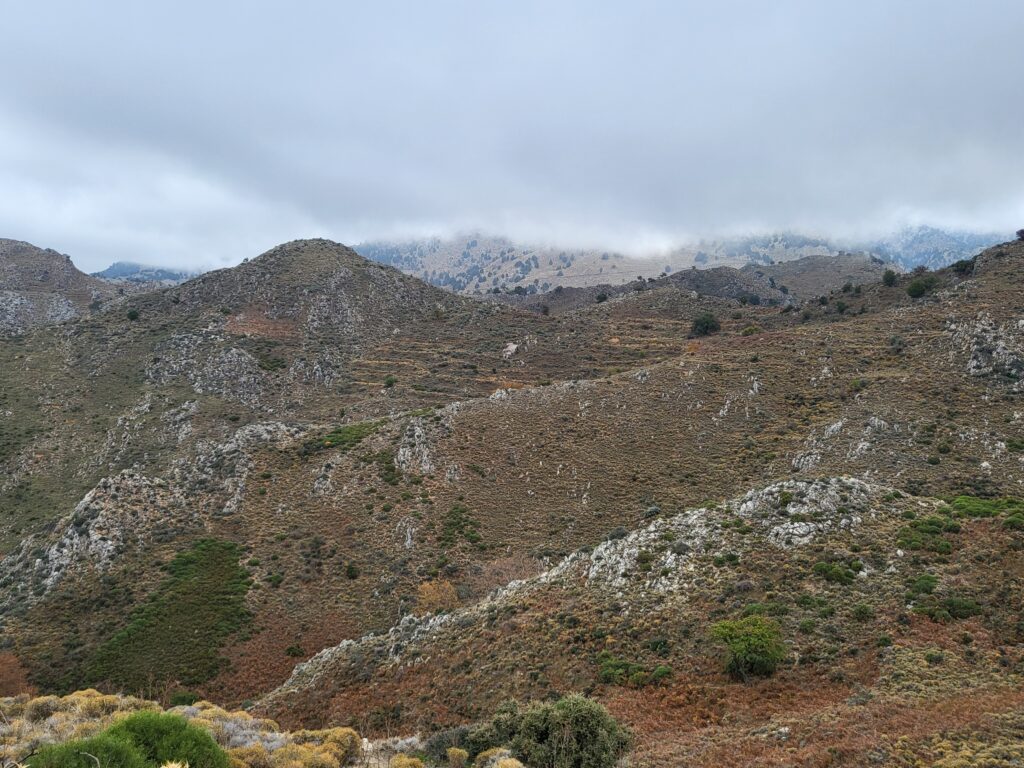
A ridge interrupts a line of sight.
A track slips behind limestone and is gone.
Caves and fissures are invisible until approached closely.
There are routes through this country that someone unfamiliar with the ground would barely recognise as routes at all.
During the German occupation of Crete, those characteristics acquired a new importance.
The main organised Allied withdrawal towards the Sfakia evacuation point in May 1941 did not pass along this particular high road towards Pachnes. The principal withdrawal from the Chania and Souda area came south through the Askifou and Imbros corridor. That distinction matters.
But after the evacuation ended, the wider White Mountains became part of another story.
Allied servicemen who had escaped capture needed hiding places and guides. Cretan resistance groups needed routes that could be used without relying upon the roads controlled by the occupying forces.
British intelligence and later Special Operations Executive personnel depended upon local people who understood this difficult country.
Shepherds, villagers and mountain guides possessed something that could not easily be supplied from Cairo.
They knew the ground.
I thought about that as the road continued ahead of us.
Not because I imagined that the particular stretch beneath my tyres had necessarily carried SOE officers or evaders. That would require evidence. But because the landscape itself was demonstrating why local knowledge mattered.
A stranger could possess a map and still understand very little.
Where was the reliable water?
Which track continued and which ended at a grazing area?
Which gully could be crossed?
Where did snow remain?
Where could a man disappear from view?
How long would it actually take to cross ground that looked straightforward on a map?
A shepherd who had spent his life in these mountains carried the answers without needing to write them down.
The bicycle was giving me only the smallest glimpse of that knowledge.
That is one of the reasons I ride.
A car covers too much ground too quickly.
Walking reveals the country intimately but restricts the distance that can reasonably be explored in a day. The E-MTB occupies useful territory between the two. It allows me to cover substantial distances while remaining exposed to the gradients, surfaces, weather and small changes in terrain that disappear behind a windscreen.
You cannot entirely ignore a mountain when you have to ride up it.The higher we went, the simpler the landscape became. Stone, old snow, sky and the pale line of the road were sometimes almost all there was to see.
And yet I was never bored.
Quite the opposite.
The apparent emptiness encouraged attention. A change in the rock became noticeable. So did the line of an old track, a distant mitato, the remains of snow in a shaded hollow or the sudden appearance of a cypress where there seemed no obvious reason for a tree to survive.
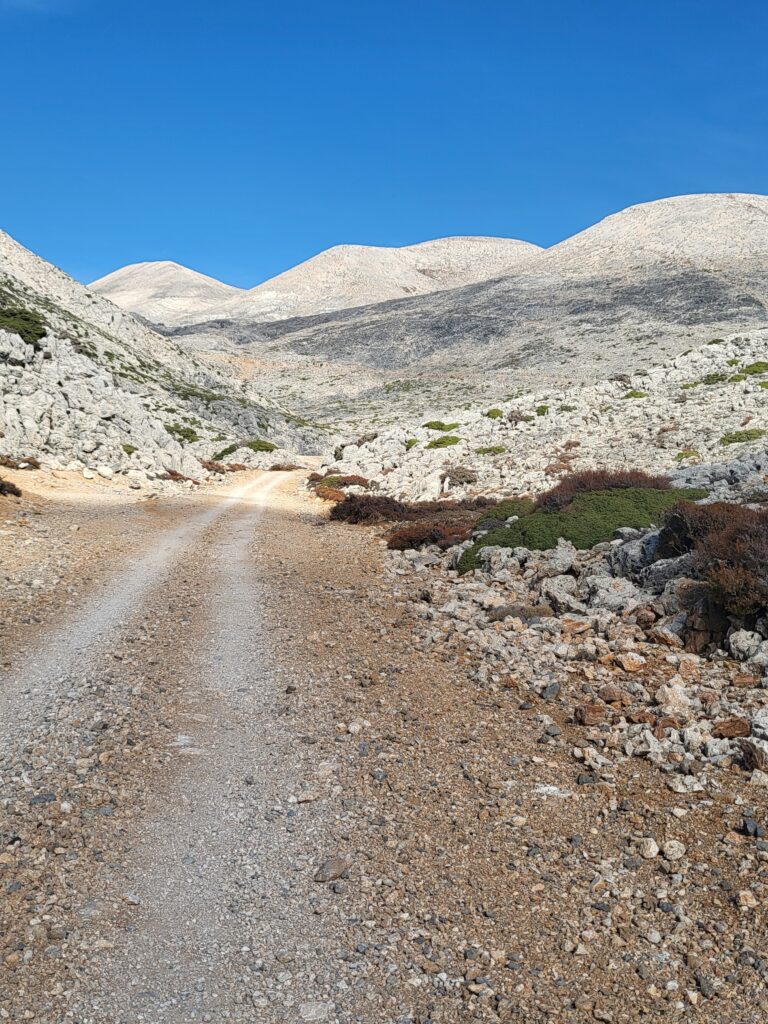
There was also the silence.
Not absolute silence. Mountains are rarely silent when one actually listens to them.
There was wind moving across the open ground, tyres working over stone and occasionally the distant sound of sheep bells.
A raven might cross overhead and disappear behind a ridge.
But the ordinary background noise of modern life had gone.
No traffic.
No machinery.
No village conversation.
Just the mountain and whatever sound we brought into it ourselves.
Eventually, as on every climb, there came a point when continuing upwards had to give way to returning.
There was no grand ceremony to it. No summit photograph and no flag.
We simply stopped, looked around and knew that this was far enough for the day.
I liked that too.
The mountain continued without us.
Turning the bikes south altered everything.
A climb and a descent may occupy precisely the same piece of ground, but they are rarely the same ride. Sections that had demanded careful application of power on the way up now required controlled braking. Loose limestone acquired a different character when approached with gravity rather than against it. Ruts that had been minor inconveniences while climbing became lines best crossed deliberately.
Speed shortened the time available for decisions.
The mountain was still setting the terms.
Gradually the high country began to release us.
The old snow disappeared behind us. Low vegetation returned, then scattered cypress. Grey ceased to be the only colour.
Signs of pastoral activity became more frequent and eventually the human landscape began to assemble itself again.
Then Anopoli reappeared.
There is a particular satisfaction in riding back into a village after several hours in high mountains. What had seemed ordinary when we left now felt surprisingly busy: buildings, roads, people, shade, water, somewhere to sit.
We had not conquered anything.
I have never particularly liked that language about mountains. Pachnes remained where it had always been, and the Lefka Ori were entirely indifferent to whether five men on electric bicycles had ridden into them and returned.
We had simply been allowed a day among them.
But something had changed for me.
Before the ride, Anopoli had been the place where we unloaded the bikes.
By the time we returned, it had become somewhere I wanted to know better.
The climb had shown me enough to make the next questions inevitable.
Where did the other tracks go?
What lay across the lower foothills?
How did the pastoral country around Anopoli connect with the high Madares?
What remained on the ground from the long history of movement through Sfakia?
Most importantly, I wanted to ride north again.
And eventually I did.
I returned to Anopoli, this time not merely for the day but for three days and two nights, staying in the village and riding from it each day. Two rides explored the lower country. The third took me back towards Pachnes.That would become another story.
But the reason for returning began here.
With The Climb
Looking back, I think this remains one of the most important rides I have made in Crete. Not because it was the longest, highest or technically most difficult, but because so many of the things that interest me came together on that single road north from Anopoli.
The bicycle.
The limestone.
The shepherds’ country.
The history.
The old routes.
And, above all, the persistent question of why people moved through this landscape as they did.
The White Mountains do not provide all the answers.
But they make you ask better questions.
That morning we had left Anopoli simply to climb.
We came back knowing we would return.