The hills above Meskla appear quiet now: olive terraces, pine, broken limestone and narrow tracks climbing away from the Keritis valley. During the German occupation, however, this wider landscape was used by an ELAS guerrilla group and became the setting for the defeat of a raiding party from Jagdkommando Schubert on New Year’s Day 1944. My route began at Fournes, climbed into those hills and returned through a valley already marked by German reprisals. At 14.9 kilometres it was a short ride, but neither the gradients nor the history allowed it to be an easy one.
Fournes stands where the cultivated ground of the Keritis valley begins to narrow towards the foothills of the White Mountains. North of the village, the valley opens towards Chania. To the south, the slopes rise around Meskla and Zourva, broken by ravines, terraces and old tracks leading into the higher country. It is attractive ground to ride, but it is also ground marked by the German occupation and by the cost of resistance.
The route was comparatively short: 14.9 kilometres, with 510 metres of ascent and 520 metres of descent. Around 75 per cent was off-road, using compact earth, gravel and double-width mountain tracks, with several short S3 trail sections. The steepest recorded gradients reached 22.5 per cent on the climb and 25.6 per cent on the descent. Moving time was one hour and seven minutes, including 42 minutes of ascent, with an average moving speed of 13.3 kilometres per hour.
I left Fournes in clear light, following a short section of tarmac out of the village before the gradient began to rise. The cultivated lower ground soon fell behind. The surface changed first to gravel and then to firm earth as the track climbed towards the terraces above Meskla.
The views opened early. Behind me, the Keritis valley ran northwards through orchards and olive groves. Ahead, the foothills drew together towards the White Mountains. Meskla occupied the ground between them, close to the springs and watercourses that have sustained settlement here since antiquity.
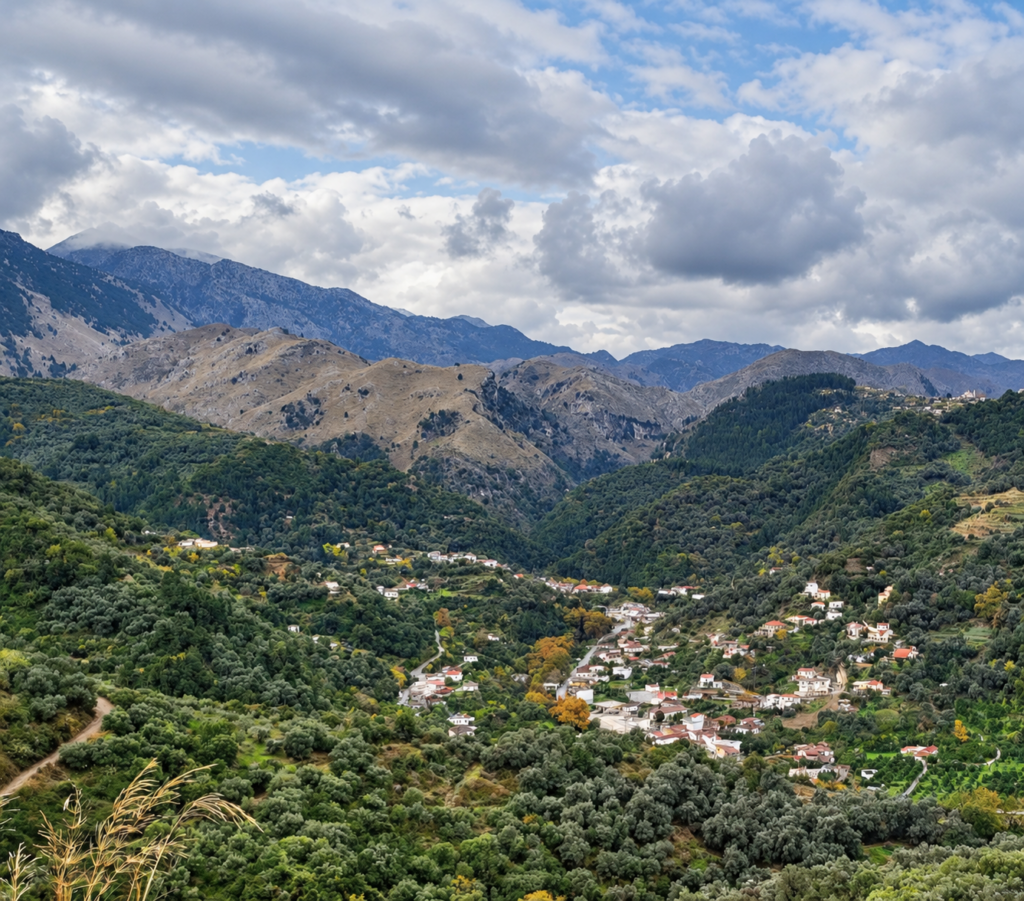
The climb maintained a steady rhythm through a series of switchbacks. Most of the gradients were manageable, although several short ramps required a committed line and careful use of assistance. On the steeper pitches there was little advantage in attacking the climb. Maintaining traction and a controlled cadence was more effective, particularly where loose gravel had gathered on the inside of the bends.
Higher up, the route turned across the hillside. The sustained climbing eased into a mixed traverse through olive ground, patches of pine and sections of exposed limestone. The wider tracks allowed the bicycle to move freely, but some shorter sections required more attention. These were narrow and uneven, with loose rock, restricted lines and occasional steep entries where momentum had to be controlled.
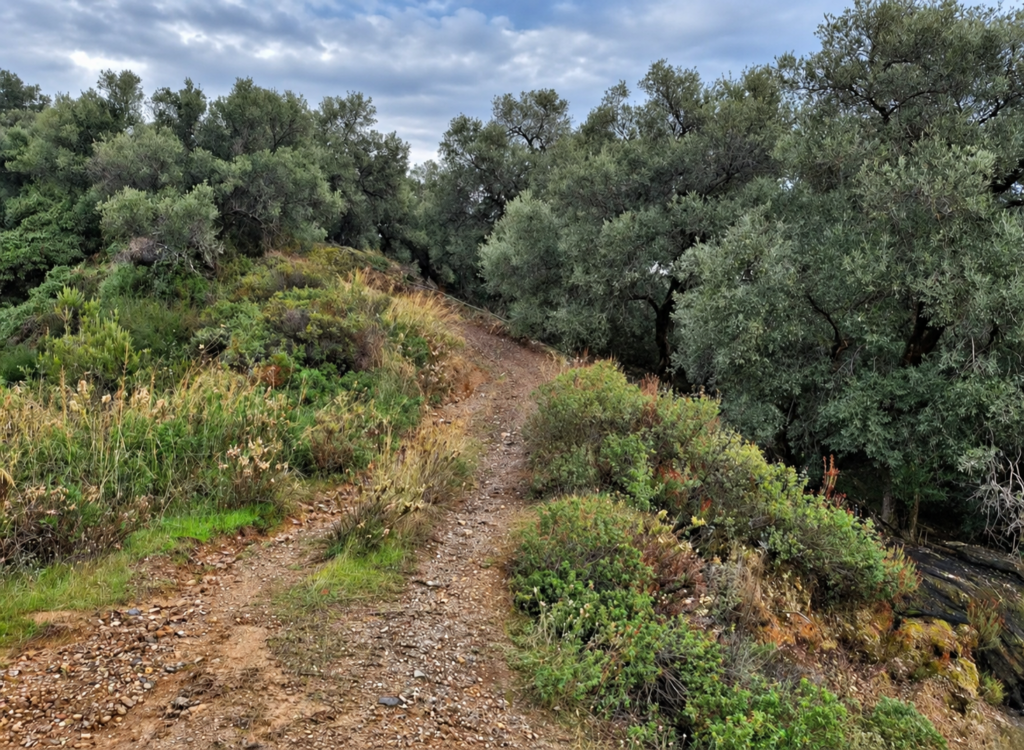
The upper ground was quiet. There were no long technical sections and no single obstacle that defined the route. Its character came from the repeated changes in surface and gradient. Firm earth became loose gravel; broad agricultural tracks narrowed briefly into trail; short rises were followed by level ground before the traverse resumed.
The return began with a long mixed-surface descent. The gradients were appreciably steeper than those of the climb, reaching a recorded maximum of 25.6 per cent. Gravel held for much of the way, although several sections required controlled braking and a deliberate choice of line. Lower down, the surface became firmer and the track opened sufficiently for the speed to rise. The maximum of 36.7 kilometres per hour was recorded on these lower run-outs rather than on the steeper technical ground.
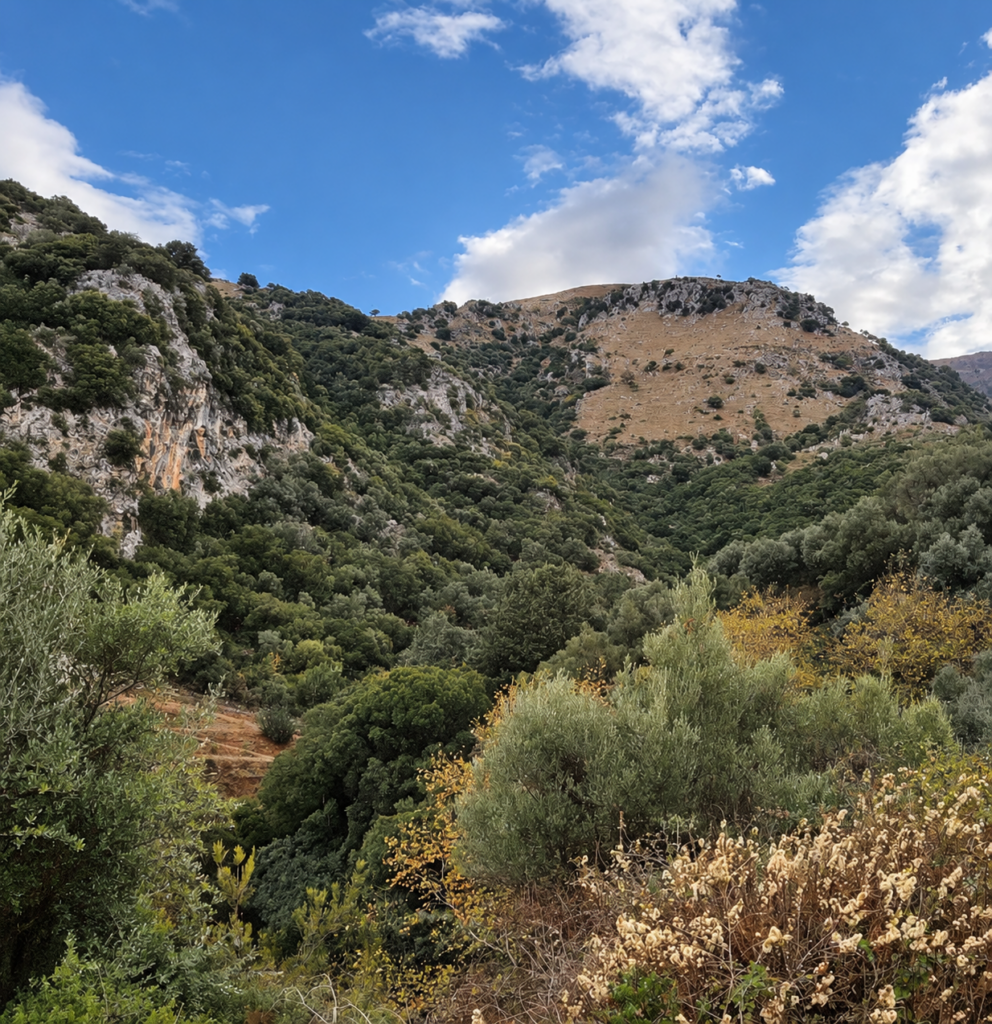
The route brought me to the memorial at Meskla. By then I had crossed the wider hill country associated with the village and the resistance activity of 1943 and 1944. Without a contemporary operational map, the precise course of the New Year’s Day engagement cannot be placed upon every modern track, but the terrain remains relevant. The steep slopes, wooded ravines, restricted approaches and commanding observation points explain why local knowledge mattered so greatly.
The memorial records the losses of Meskla across successive periods of conflict. Its inscriptions extend from the Cretan uprising of 1897 through the Balkan Wars, the campaigns in Macedonia and Asia Minor, and the Second World War. They include men killed in combat and residents who died during the occupation, in reprisals, air attacks and German captivity.
Several surnames recur: Sarantakis, Mavragakis, Lampakis, Valtadakis, Paraskakis, Fragkakis and Roustanakis. Their repetition shows how military service and loss passed through the same extended families over several generations. The memorial is therefore more than a list of isolated deaths. It records the accumulated cost paid by one rural community over almost half a century.
Fournes belonged to the same troubled landscape. After the Battle of Crete, the German occupation authorities conducted a series of reprisals against communities in the Keritis valley. On 1 August 1941, German forces surrounded villages including Alikianos, Skines, Vatolakkos, Koufos and Fournes. Men were arrested and taken to the banks of the Keritis near Alikianos, where 118 civilians from the surrounding communities were executed.
The operation was part of the German response to the resistance encountered during the Battle of Crete. Civilians in the Keritis valley had fought alongside Greek, New Zealand and other Allied troops during the battle. The executions were presented by the occupying authorities as reprisals. In practice, they were collective punishment imposed upon communities for the actions of their inhabitants during the invasion.
By 1943, organised resistance had developed in the hills above the valley. An ELAS guerrilla group was formed at Meskla during the summer of that year; local histories describe it as the first ELAS guerrilla group established in the Chania district. Its members operated through the Meskla–Zourva country and drew upon support from families living in the surrounding villages.
The formation of the group brought Meskla into direct conflict with one of the most violent auxiliary forces employed by the German occupation authorities: Jagdkommando Schubert, the Schubert Hunting Detachment.
Its commander, Fritz Schubert, was a German NCO who spoke Greek and had initially served on Crete as an interpreter. He was not a German-born Greek, as he has sometimes been described. He was born in Dortmund and served within the German military and security structure.
Schubert’s detachment was not a conventional Wehrmacht field unit. It was a semi-independent, German-controlled paramilitary formation used for counter-resistance operations, searches, arrests and punitive actions. Its personnel included Greek collaborators, some of whom had been recruited from prison. They wore German uniform and became known locally as the Schuberianoi—the Schubert men.
The unit’s record on Crete included beatings, torture, looting, house-burning and murder. At Kali Sykia on 6 October 1943, members of the detachment burned twelve women and an elderly man alive after the women refused to reveal where the village men were hiding. Two days later, Schubert’s men participated in the killings and destruction at Kallikratis.
On New Year’s Day 1944, a party from Schubert’s detachment came to Meskla to locate and attack the ELAS group. Schubert himself was not present. The surviving accounts agree about the failure of the operation, but differ over the number of men involved and the exact sequence of events.
One resistance account states that three men entered Meskla pretending that their own guerrilla group had broken up and that they wanted to join the local ELAS detachment. The Meskla fighters became suspicious, separated and questioned them, and learned that twelve more armed men were waiting outside the village. The resistance group and local supporters then moved against the waiting party. According to this version, three attackers were killed during the fighting, two were captured and seven escaped. The three alleged infiltrators were also held.
Resistance testimony states that the five prisoners were taken into the higher country, brought before a guerrilla court, sentenced to death and executed. Local tradition connects the disposal of some of the bodies with the Voulisma chasm above Meskla. These procedural details come principally from resistance and local accounts; the material presently available does not include a contemporary German operational report with which to confirm them independently.
Other accounts describe the defeated force more simply as an eight-man party. General Bruno Bräuer, speaking during his post-war trial, referred to seven members of Schubert’s group being killed at Meskla and confirmed that Schubert had not accompanied them. The safest historical conclusion is therefore that the New Year’s Day operation failed and that seven or eight members of Schubert’s force were killed, some during the fighting and some, according to resistance testimony, after capture.
The distinction matters. The whole Jagdkommando was not destroyed at Meskla. A raiding party from it was defeated, with heavy losses. Nevertheless, the action was important locally. It demonstrated that Schubert’s men could be identified and overcome when they entered territory in which the resistance possessed better information, local support and a detailed knowledge of the ground.
Schubert was removed from Crete soon afterwards and transferred with part of his force to Macedonia. The surviving evidence does not establish that the Meskla action was the sole reason for his removal; German testimony indicates that the conduct and possible disbandment of his group were already under consideration. The defeat at Meskla nevertheless added to the discredit surrounding the unit.
The consequences for the local population did not end with Schubert’s departure. On 10 February 1944, German forces conducted a major cordon and search operation across Meskla, Zourva, Fournes, Lakkoi, Theriso and villages in eastern Selino. Hundreds of men were detained. Those taken from Meskla, Zourva and Lakkoi were initially held in the school at Meskla before being transported to Agia Prison.
After interrogation and selection, many prisoners were moved through mainland Greece and Yugoslavia to Mauthausen and its satellite camps. A number died in captivity. Their deaths are part of the history recorded on the village memorial. The sequence is important: armed resistance in the hills, the defeat of Schubert’s party and, weeks later, a German operation directed against the communities from which the resistance drew its support.
In Macedonia, Schubert and his remaining men continued the same pattern of violence. On 2 September 1944, his detachment participated with German forces and other collaborators in the massacre at Chortiatis, where approximately 150 civilians—predominantly women and children—were murdered. Many were confined in buildings and burned.
Schubert was captured after the war, returned to Greece and tried for war crimes. He was convicted and executed on 22 October 1947. The punishment of individual members of his force was far less complete, and many collaborators avoided effective prosecution.
Standing at the Meskla memorial, the broader relationship between the ground and the history became clearer. The terrain did not make the outcome inevitable, but it influenced every movement. A force approaching Meskla from the valley or along the limited road network could be observed. Local fighters could move through secondary tracks, ravines and wooded slopes that were difficult for an outside force to control. Concealment, observation and local warning systems all favoured those familiar with the area.
That advantage did not protect the villages from reprisals. The occupation forces could return in greater strength, surround several communities simultaneously and punish families who had supported, or were merely suspected of supporting, the resistance. The February 1944 arrests demonstrate the limit of tactical success. Schubert’s party had been defeated, but the population remained exposed to the power of the German security system.
From the memorial, the route returned towards Fournes. The descent continued over gravel and compact earth before the ground hardened nearer the valley. The final tarmac section into the village was short and uncomplicated, bringing the loop back to its starting point after 14.9 kilometres.
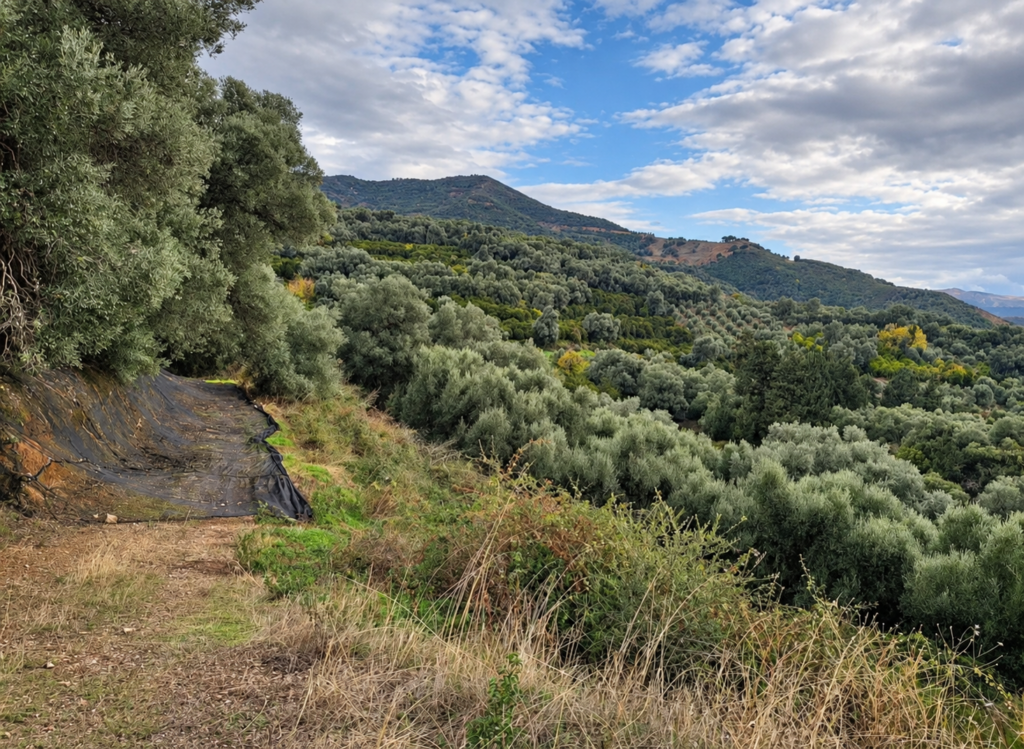
The ride had been deliberately contained: one sustained climb, a measured upper traverse and a controlled descent into the Keritis valley. Its 510 metres of ascent and short sections of narrow and uneven loose rock provided enough technical variation to demand attention without turning the route into an extended mountain expedition.
The history was less contained. Fournes, Meskla and Zourva were connected by resistance activity, German reprisals, imprisonment and loss. The memorial brought those events together through the names of the people who experienced them. Riding the surrounding ground did not recreate what happened there, but it helped explain the physical conditions within which people had to move, hide, observe, fight and survive.
By the time I returned to Fournes, the GPS had recorded the gradients and distances of a short winter ride. The memorial recorded a different measure of the same landscape. Between them stood the enduring connection between terrain, military action and the families who lived with the consequences.
RESEARCH
The account of the New Year’s Day action was checked against the Municipality’s Meskla and Voulisma history, the documented study of the subsequent February 1944 arrests published by Χανιώτικα Νέα, and Thanasis Fotiou’s archival study of Jagdkommando Schubert.