Synchronicity, curiosity and a journey that began in 1968
There are occasions when the past does not return gradually. It arrives complete.
I was rummaging through a local book exchange here in Crete when a familiar cover appeared among the shelves.
From the Silent Earth: The Greek Bronze Age, by Joseph Alsop.
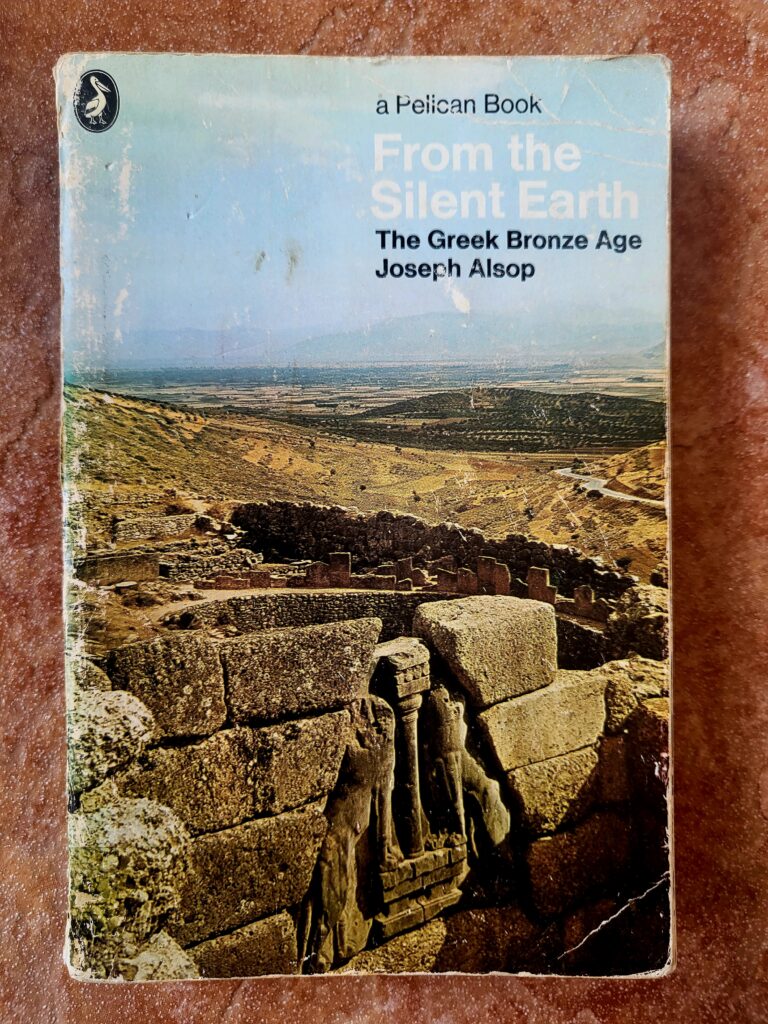
I picked it up.
And suddenly I was no longer standing beside a book exchange in Crete.
I was back in our lounge in 1968.
My father was there, handing me two things: a copy of the Evening Standard and this book.
The memory was remarkably clear. Not simply the title, nor the fact that my father had given it to me, but the moment itself. Nearly sixty years had passed, yet picking up that book brought the scene back almost intact.
It was only the second book my father had given me.
For a teenager, The Greek Bronze Age hardly sounds irresistible. In less capable hands it could have been very dry indeed: pottery sequences, ruined palaces, disputed chronologies and arguments between archaeologists about people who had been dead for thousands of years.
But that is not how I remember it.
Alsop made the subject easy to read and surprisingly interesting.
More importantly, he made me want to continue.
I wanted to know what came next.
Curiosity.
It really was as simple as that.
I did not know in 1968 that I would eventually live in Crete. I certainly did not imagine that much of my later life would be spent travelling across this island, following tracks through mountains and villages, stopping at old walls, wells, churches, shrines, abandoned buildings and the physical remains of events that had taken place long before I arrived.
The bicycle gets me there.
Curiosity determines what happens next.
I want to know where a track leads. If an object stands beside it, I want to know why it is there. If something happened on that ground, I want to understand why it happened there rather than somewhere else.
One answer usually produces another question.
I recognise now that the same impulse was already there when I read Alsop in 1968.
I simply did not have a name for it.
Reading the Book Again
This was not, of course, my father’s copy. The publication page established that immediately. Alsop’s book had appeared earlier, but the Pelican edition I had found was published in 1970, two years after my father gave me my copy.
That bibliographical detail interested me, but something else mattered considerably more.
I began reading.
And it soon became apparent that although the book was familiar, the reader was not.
When I first encountered Alsop, Crete existed for me on the printed page. Knossos, the Minoans, Mycenae and the Bronze Age belonged to a distant world of archaeological sites, photographs and maps.
Now I live here.
Places that were once names have become physical ground.
Then, while going through the index, another familiar name appeared.
Pendlebury, J. D. S.
And the book took me somewhere I had not expected.
Pendlebury Before the War
John Devitt Stringfellow Pendlebury is a name I now associate immediately with Crete and the Battle of 1941.
Alsop returned me to an earlier Pendlebury.
The archaeologist.
Pendlebury had wanted to become an archaeologist from an early age. After Cambridge and the British School at Athens, he worked in both Egypt and Greece and developed a particular attachment to Crete. In 1930 he became the second Curator of Knossos. He established the Knossos library, produced the first visitor’s guide to the palace and tackled the formidable accumulated archaeological material left by earlier excavation.
But Pendlebury did not understand Crete solely from excavation trenches and pottery fragments.
He travelled through it.
He and his wife Hilda crossed the Cretan countryside extensively, visiting sites, villages and remote country and acquiring an intimate knowledge of the island and its people. The British School at Athens now considers that knowledge important to understanding the role he would later play during the war.
That immediately interested me.
There is a considerable difference between knowing a landscape from a map and knowing it by moving through it.
Pendlebury did both.
And there he was in Alsop’s book, not yet the wartime figure, but an archaeologist trying to interpret what the physical evidence of Crete was telling him.
Arguments in Stone
On page 52 Alsop brings Pendlebury into the argument over the relationship between Minoan Crete and Mycenaean mainland Greece.
This was archaeology presented not as a collection of established answers, but as an argument.
Evidence existed.
Archaeologists examined it.
And they disagreed.
Pendlebury belonged broadly to the interpretation that attributed enormous cultural influence to Minoan Crete. Others, notably Alan Wace, increasingly challenged the idea that Mycenaean civilisation on the mainland could simply be understood through Cretan dominance.
Later, Alsop returns to the question of Minoan power at sea: the famous idea of a Minoan thalassocracy.
How extensive had that power really been?
Was Knossos the centre of something approaching an Aegean maritime empire?
Or are we looking instead at trading communities, commercial connections and sufficient maritime strength to protect them?
The ruins could not answer the question themselves.
They supplied evidence.
The archaeologist had to interpret it.
Pages 286 to 289 brought me back to Pendlebury again.
This time the evidence included architecture: masonry, paving, columns and changes in construction.
Pendlebury wondered whether some of these alterations represented what he called a “change of spirit.”
Behind that apparently simple phrase lay a much larger question.
What does political change actually look like in the archaeological record?
If new rulers arrive but continue employing local craftsmen, using existing buildings and adopting elements of the culture they have conquered, where exactly is the archaeological line separating one political order from another?
Conversely, if pottery or architectural styles change, does that necessarily demonstrate invasion or conquest?
The ground contains evidence.
It does not contain an explanation.That distinction now seems fundamental to me.
I doubt I thought about it in those terms when I first read Alsop as a teenager.
But I kept reading.I wanted to know what came next.
The Archaeologist Goes to War
For Pendlebury, knowledge of the ground eventually acquired an entirely different purpose.
With war approaching Crete, the archaeologist became an intelligence officer.
His Greek, his relationships with Cretans and the extraordinary geographical knowledge accumulated during years of archaeological travel made him particularly valuable. The British School at Athens records that his intimate knowledge of the island directly informed his work organising resistance.
There is something important in that transition.
The wartime Pendlebury did not suddenly appear in 1941.
The archaeologist made the intelligence officer possible.
Years spent crossing Crete had taught him routes, villages and mountain country. Archaeological exploration had taken him beyond Knossos and Heraklion and into communities across the island.
He knew Crete by moving through it.
When the German airborne invasion began on 20 May 1941, that knowledge was no longer merely archaeological.
Pendlebury fought in the Heraklion sector
The surviving accounts of his final hours contain differences of detail, and those differences should not be concealed. What is established is that he was wounded during the fighting, fell into German hands and was subsequently executed during the opening days of the Battle of Crete. The British School at Athens records that he was wounded outside Canea Gate in Heraklion, taken to a local house for treatment and shot after another German unit arrived the following day.
He was thirty-six years old.
The archaeologist who had spent years trying to understand Crete’s ancient past had died defending the island in the present.
Suda Bay
Pendlebury’s journey eventually brought him west.
He lies today in Suda Bay War Cemetery.
I know the cemetery well.
When I conduct tours there, Pendlebury is one of the men whose grave I visit.
And that is where finding Alsop’s book began to acquire a significance I had not expected when I first picked it from the shelf.
In 1968 Pendlebury had been a name encountered in a book my father gave me.
Nearly sixty years later, I live on the island Pendlebury explored. I travel through some of the same landscape. I read about the archaeological questions that occupied him. And when I take people around the Commonwealth War Graves cemetery at Suda Bay, I can stand beside his grave.
There was no plan connecting those things.That is precisely what makes the connection interesting.
The Book and the Evidence
There is another reason I am glad to have found the book again.
Archaeology has moved on.
Some of the interpretations Alsop discusses belong very clearly to the intellectual world in which he was writing. Questions concerning Minoan maritime power, the political dominance of Knossos, Mycenaean control of Crete, invasion and cultural discontinuity have continued to be reconsidered as excavation, chronology, scientific analysis and new methods have changed the available evidence.
That does not diminish From the Silent Earth.
In some respects it makes the book more interesting.
I can now read it twice.
First, as an account of the Greek Bronze Age.
Second, as evidence of how that Bronze Age was being understood and argued about when the book appeared.
That may also explain why I found it so interesting as a teenager.
Alsop did not make archaeology seem settled.
There was a question.
Someone proposed an answer.
Someone else disagreed.
Then another piece of evidence altered the argument.I wanted to know what came next.
Curiosity
Finding the book again has made me think about that more than anything else.
My father could not have known where giving me From the Silent Earth in 1968 would eventually lead.
Neither could I.
I certainly did not read it and decide that one day I would live in Crete. Life is rarely that orderly.
But I recognise the curiosity.
It is the reason I still leave the tarmac and follow an unfamiliar track.
Where does it go?
It is why I stop beside an old well, a roadside shrine, a dry-stone wall or an abandoned building.
Why is it there?
Who built it?
Who used it?
What happened here?
What evidence remains?
And what happens when the evidence does not quite agree with the story we have been told?
The E-MTB is now one of the means by which I pursue those questions.
It is not their cause.
The curiosity came first.
In 1968 it kept me turning the pages of a book about the Greek Bronze Age.Nearly sixty years later, in a small book exchange in Crete, I picked up From the Silent Earth again.
Pendlebury was no longer simply a name in its pages.
Knossos was no longer a distant archaeological site.
Crete was no longer somewhere in a book.
Much had changed.
The curiosity had not.