The Minoan Tholos Tomb of Azoires–Stylos
Today’s circular ride began and ended in Kokkino Chorio, covering 51.7 kilometres with 980 metres of climbing through the varied landscapes of Apokoronas. The ride took 4 hours 8 minutes overall, including stops for exploration and photography, with 3 hours 6 minutes of riding time. The highest point reached 310 metres above sea level before descending through fertile valleys towards Stylos. Fifty-five per cent of the route was off-road.
The route passed through vineyards and olive groves, along quiet village roads and rougher tracks, before descending towards the fertile country around Stylos and eventually returning to the coast.
None of these individual features appeared remarkable on their own.
Together, however, they formed part of a landscape that has attracted and supported human communities since the Bronze Age and probably long before it.
Every ride has its destination, but occasionally the landscape offers something entirely unexpected.
Today’s route brought me to an archaeological site hidden only a short distance from the modern village of Stylos.
From the surface, very little announces its importance.
Among the olive trees, a narrow stone-lined passage disappears gradually beneath ground level. At its far end is a low entrance constructed from massive limestone blocks. Above the lintel is a triangular opening designed to relieve some of the weight of the masonry above.
Beyond the doorway lies a circular burial chamber built more than three thousand years ago. This is the Late Minoan tholos tomb of Azoires–Stylos, one of the best-preserved Bronze Age funerary monuments in western Crete. It is a remarkable place to encounter during a bicycle ride.
The modern road remains nearby. Olive trees surround the site. Yet once the bicycle is left behind and you begin walking down the ancient entrance passage, the relationship with the landscape changes completely.
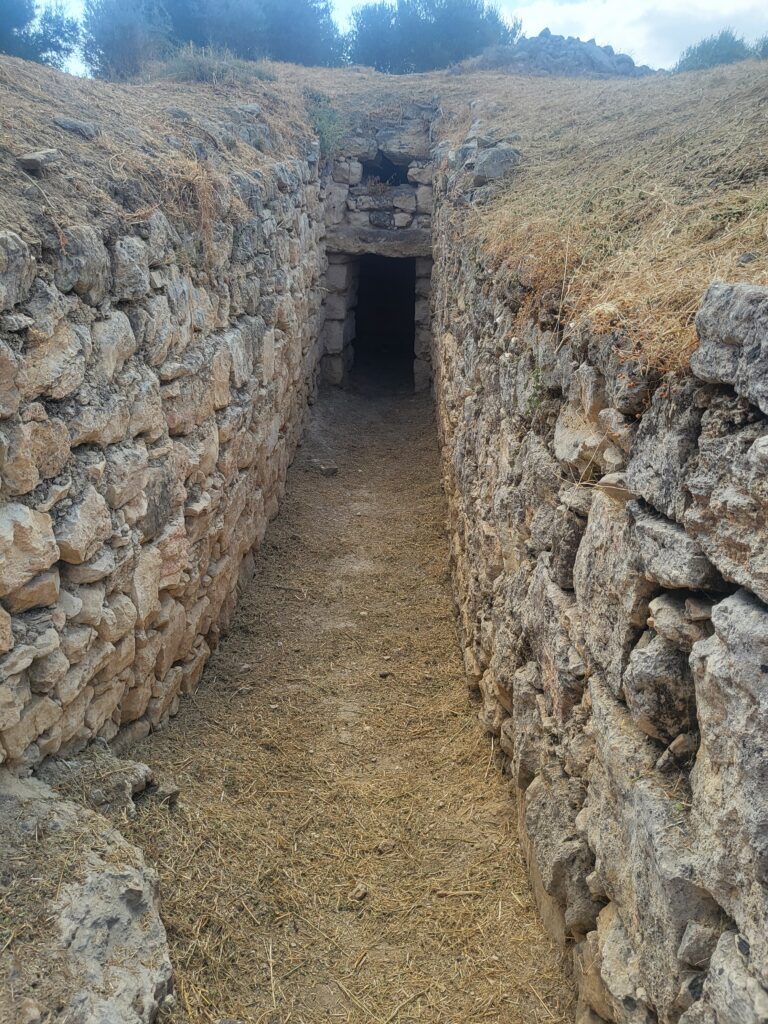
The passage is not simply an opening cut into the hillside.
It is architecture.
The dromos extends for approximately 20.8 metres. Its sides were deliberately constructed in stone and part of its floor was paved. Archaeological investigation revealed that the two sides were not symmetrical: the southern wall extended approximately 6.3 metres farther than the northern side. A further section of paving was discovered beyond the dromos and may once have remained visible when the passage itself was covered, marking the position of the tomb.At the end of the descent stands the entrance.
Passing beneath the great stone lintel leads into the circular chamber itself.
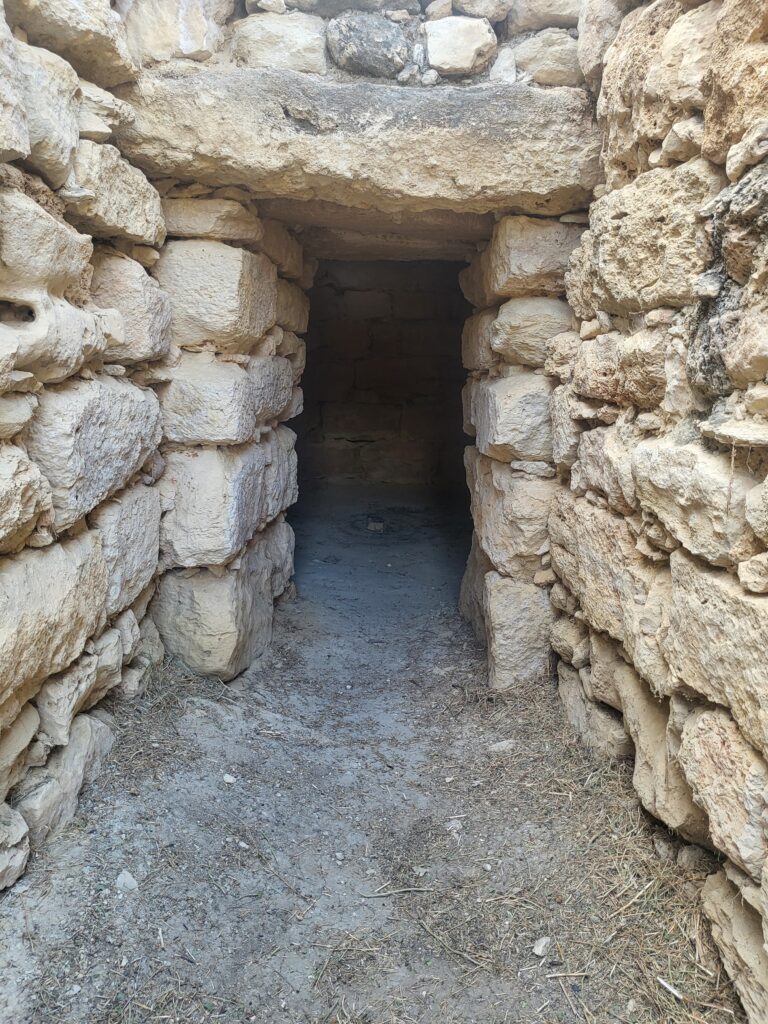
Unlike many archaeological sites, the monument can be experienced from within. You walk along the ancient approach, pass through the entrance and stand inside the space constructed by its Bronze Age builders.
The chamber measures approximately 4.3 metres in diameter and rises to about 4.8 metres internally. The doorway itself is approximately 2.3 metres high.
The limestone blocks remain remarkably well preserved.Standing inside, looking upwards at the courses of stone gradually projecting towards the centre until the vault closes above, the achievement of the builders becomes much easier to appreciate.
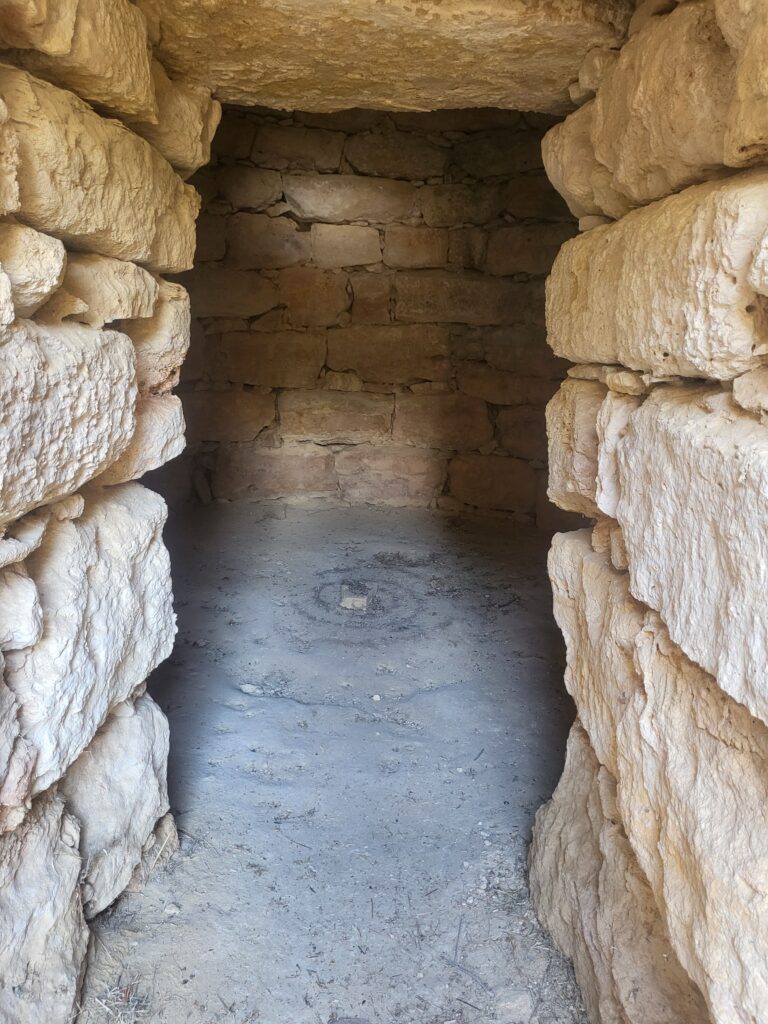
More than three thousand years have passed. The structure remains.
What is a Tholos Tomb?
The Greek word tholos — θόλος — refers to a circular structure or chamber.
The monument at Stylos consists principally of two elements.
The first is the dromos, the long entrance passage approaching the tomb.
The second is the tholos, the circular burial chamber itself.The chamber was constructed using corbelled masonry. Each successive course of stone projects slightly inwards beyond the course beneath it, gradually reducing the opening until the structure closes towards the top. It is an apparently simple principle requiring considerable skill in execution.
Late Minoan tholos tombs belong to a wider tradition of monumental burial architecture found in Crete and the Aegean. Such tombs could accommodate repeated burials and are generally associated with people of significant social standing, although the precise identity and status of those buried at Stylos cannot now be established.
The tomb was robbed in antiquity.
We therefore cannot know with certainty who was buried here, how many individuals the chamber once contained, or what objects accompanied them. Yet the architecture survives.
Standing inside the chamber today, it is difficult not to consider the people who once approached it along the same passage.
Whatever ceremonies accompanied burial here, those taking part would have travelled down this dromos, passed beneath this lintel and entered this chamber.
The physical route survives even though the people and their names have disappeared.
The Archaeology
The tomb belongs to the Late Minoan III period, broadly the 14th–13th centuries BC.
It was excavated in 1961 by the archaeologists Nikolaos Platon and Kostis Davaras, with investigation of the dromos continuing later.
The tomb had already been looted in antiquity.
Much of its original funerary material had therefore disappeared, although fragments of Late Minoan pottery remained within the disturbed deposits. The monument is consequently particularly important for its architecture. The circular chamber is exceptionally well preserved, as are the entrance and much of the long constructed dromos.
There is also evidence that the monument retained significance long after the Bronze Age.
Twelve later vessels were discovered in the relieving triangle above the entrance, while other later pottery has been recorded around the monument. The precise interpretation and dating of this later activity have varied in published accounts, so it is safer not to assign a single explanation to it.
What can be said is that people returned to this ancient monument centuries after its original use had ended.
By then, those who constructed the tomb belonged to a distant past. The structure itself had survived.
More Than a Tomb
The burial monument forms only one element within a much larger archaeological landscape around Azoires and Stylos.
Nearby excavation has revealed part of an important Late Minoan settlement.
A substantial wall approximately 11 metres long was uncovered, together with the remains of buildings showing several phases of construction. Archaeologists also discovered a pottery kiln, evidence that this was not simply a place of residence but also one in which specialised production took place.
The wider area is particularly interesting because it has been associated by archaeologists with a-pa-ta-wa, a place name recorded in the Linear B tablets from Knossos and generally connected with later Aptera.
The identification is important, but it should not be treated as absolute certainty.
What the archaeology does demonstrate is that a significant community existed here during the later Bronze Age.
The settlement continued through the Late Minoan period, with occupation in the wider area extending into later periods.
Archaic remains have been found nearby, and the landscape continued to be used through antiquity and into the Byzantine period.
Close by stands the Byzantine church of Panagia Zerviotissa.
The result is not evidence for one settlement remaining unchanged for more than three thousand years.It is something more interesting.
Successive communities repeatedly occupied and used the same landscape.
The reasons are visible from the bicycle.
Water is available.
The soils are productive.
The slopes are manageable.
Routes through the surrounding valleys provide connections between the interior of Apokoronas, the coast and the higher ground.
These physical characteristics existed long before modern roads were constructed.
Olive trees and vineyards now surround the archaeological remains. Modern agriculture has transformed the appearance of the ground, but the underlying advantages of the landscape remain.
The name itself is modern.
The people who inhabited Bronze Age Crete did not call themselves “Minoans” as far as we know. The term was adopted by modern archaeologists from the legendary King Minos of Crete.
From the early second millennium BC, major centres developed at Knossos, Phaistos, Malia and Zakros, alongside numerous smaller settlements and regional centres.
These were not simply monumental buildings.
They formed part of sophisticated political, economic, religious and administrative systems that connected communities across Crete and linked the island with the wider eastern Mediterranean.
Minoan seafarers and merchants participated in networks reaching Egypt, Cyprus, the Levant, the Cyclades and mainland Greece. Their craftsmen produced elaborate pottery, jewellery, stone vessels and frescoes. Their architecture incorporated complex building plans, storage areas, water-management systems and drainage works.
They also developed systems of writing. One of these, known today as Linear A, remains undeciphered. Consequently, despite more than a century of archaeological investigation, fundamental questions concerning Minoan language, government, religion and society remain unanswered.
Later, Linear B was used on Crete to record an early form of Greek associated with Mycenaean administration.
The political world of Crete changed substantially during the fifteenth century BC.
Many Minoan centres suffered destruction around 1450 BC, after which Mycenaean influence became increasingly evident. Knossos continued as an important administrative centre for a period, and Mycenaean Greek appears in the Linear B tablets.
The eruption of Thera, modern Santorini, had occurred earlier, probably during the seventeenth century BC. It had significant environmental and economic consequences in parts of the Aegean, but it cannot simply be presented as the event that destroyed Minoan civilisation.
Earthquakes, political change, economic disruption, warfare and increasing Mycenaean influence have all formed part of the archaeological debate.
There was no single moment when everything Minoan simply disappeared.
Communities continued to occupy Crete throughout the later Bronze Age, including the period when the tomb at Stylos was constructed and used.
That makes this monument particularly interesting.
It belongs not to the famous age of the great earlier palaces, but to a later and changing Crete in which older traditions continued alongside growing Mycenaean influence.
Timeline of Minoan Crete
c. 3100–3000 BC — Beginning of the Early Minoan period.
c. 2000 BC — First major palace complexes develop on Crete.
c. 1700 BC — Earlier palaces destroyed or severely damaged, probably in part through seismic activity. Major centres are subsequently rebuilt.
c. 1700–1450 BC — The Neopalatial period and the height of the great Minoan palace centres. Maritime connections and trade extend throughout the eastern Mediterranean.17th century BC — Major eruption of Thera, with substantial effects across parts of the Aegean.
c. 1450 BC — Widespread destruction at many Cretan centres. Mycenaean political and cultural influence becomes increasingly evident.14th–13th centuries BC — Settlement flourishes around Azoires–Stylos. The tholos tomb belongs broadly to this Late Minoan III period.
c. 1200 BC and after — The wider collapse of Bronze Age political systems affects much of the eastern Mediterranean. Communities nevertheless continue on Crete into Late Minoan IIIC and the succeeding Early Iron Age.
A Continuous Poem Guided by the Cretan Mandináda
The traditional Cretan mandináda is a self-contained rhyming couplet, normally composed of two fifteen-syllable lines.
What follows is not a mandináda in that strict traditional sense. It is my attempt to extend something of its character into a longer continuous poem: a sequence of rhyming couplets guided by the Cretan mandináda tradition, but deliberately developed beyond its usual two-line form.
Through stones that held forgotten names, the silent centuries stand,
While riders cross the selfsame ground and seek to understand.
Beneath the vines the old tomb waits, unchanged by sun or rain,
A witness to forgotten lives that shall not come again.
The Minoans built with patient hands what time could not erase,
Their footsteps fading long ago, their craft still marks this place.
The mountains watched their funeral rites, the valleys knew their song,
And still the winds of Apokoronas have carried them along.
We ride across another age, yet history rides beside,
For Crete remembers all who pass, though kingdoms fall with pride.
Historical Note
The Minoan tholos tomb at Azoires–Stylos demonstrates one of the enduring characteristics of Crete: the repeated human use of the same landscape across very different periods of history.
Empires have risen and fallen.
Languages, religions and political systems have changed repeatedly.
Yet the valleys, springs, ridges and fertile ground that attracted Bronze Age communities continue to influence where people live, cultivate the land and travel today.
Across Crete, the evidence of those successive periods frequently exists within surprisingly small areas.
A Byzantine church may stand near an ancient settlement.
An Ottoman bridge may still carry modern traffic.
A Second World War battlefield may lie beside an olive grove.
And beneath an apparently ordinary hillside near Stylos, Bronze Age builders constructed a monumental stone tomb more than three thousand years ago.
Travelling through this landscape by bicycle changes the scale at which these relationships become visible.
The bicycle is fast enough to reveal how one valley connects with another, but slow enough to notice the details between them.
A spring.
An old track.
A change in the underlying rock.
A church positioned beside an ancient route.
Terraces climbing a hillside.
A stone wall whose alignment reflects boundaries far older than the modern road beside it.
The landscape begins to explain movement.
Water, gradients, cultivable ground and natural corridors constrained and enabled movement long before tarmac roads existed. They influenced where people settled, where they cultivated and how one community connected with another.
That remains one of the reasons I ride.
The bicycle provides access to places that can easily be passed in a car, while still allowing enough distance to be covered to understand how those places relate to the wider terrain.
At Stylos, that relationship became unusually direct.
I arrived on a modern E-MTB, left it above ground and walked down a route constructed during the Bronze Age.
For a short distance, my movement through the landscape followed exactly the same physical line used by people more than three millennia ago.
Then I emerged, returned to the bicycle and continued the ride.
Sometimes the most remarkable object along the way is not the one that dominates the landscape.
It is the one that has been quietly waiting beneath it for more than three thousand years.
Further Reading
Readers and riders wishing to explore Minoan civilisation in greater depth may find the following works particularly rewarding.
Although archaeological knowledge has advanced considerably since its publication, Harriet Boyd Hawes and Charles Henry Hawes, Crete: The Forerunner of Greece (1909), remains a fascinating historical introduction to the early archaeological interpretation of prehistoric Crete and its place within the wider Aegean world.
Sinclair Hood’s The Arts in Prehistoric Greece provides a broader examination of the material culture of the prehistoric Aegean, while Keith Branigan’s The Foundations of Palatial Crete examines the development of Cretan society before the emergence of the great palace centres.
For the architecture of Late Minoan tholos tombs themselves, the specialist archaeological literature is particularly valuable, including the structural work of W. G. Cavanagh and R. R. Laxton on corbelled vaulting in the Late Minoan tombs of Crete.
The archaeological reports concerning Stylos and Azoires are especially important because they record the excavation of the tomb, its long dromos and the neighbouring settlement.
As always, no book can replace standing in the landscape itself.
The greatest reward comes from combining careful reading with field observation, allowing the archaeology, the terrain and the written record to illuminate one another.