The landscape itself can preserve the memory of an industry long after the buildings, tools and people have disappeared.
The ride began, as so many do, in Kokkino Chorio, following familiar roads across the Apokoronas before descending towards the coast. The morning was warm but clear, with excellent visibility across Souda Bay. Although the GPS recording ended after the coffee stop, the ride continued as planned and returned to Kokkino Chorio.
The recorded section covered 12.8 km, with 240 metres of ascent and 330 metres of descent. The highest point reached 170 metres, while the lowest was 30 metres above sea level. Moving time was 52 minutes 14 seconds, with an average speed of 14.7 km/h and a maximum recorded speed of 39.9 km/h. The steepest recorded gradients were 19.4% uphill and 13.8% downhill.
Unlike the previous “Objects Along the Way” series, which examined structures created by people, this new series explores the landscape itself. Sometimes the subject will be entirely natural. At other times, as here, it will be a place where geology and human activity have worked together over centuries.
Today that place was the old salt pans.
A Landscape Shaped by Sea and Sun
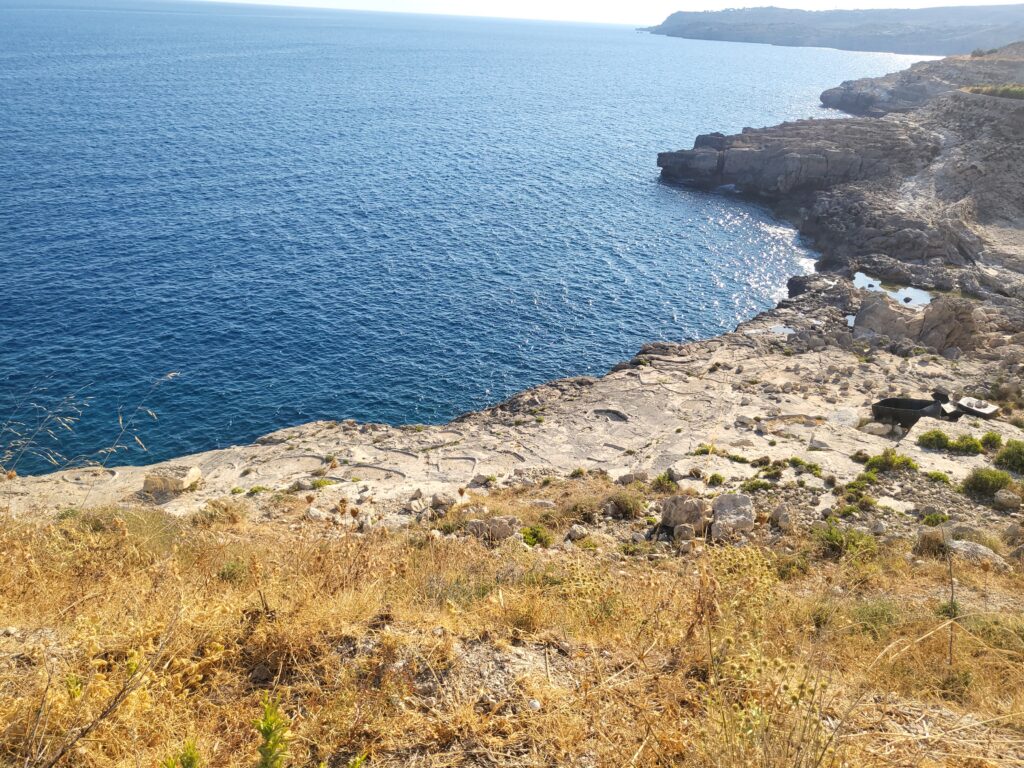
At first glance the shoreline appears little different from many others around Crete. Pale limestone slopes gently towards the sea before breaking into low cliffs and rock platforms. The water is remarkably clear, and the constant movement of the waves disguises what once made this place economically valuable.Closer examination reveals something different.
Across the broad limestone platform are numerous shallow rectangular depressions cut into the living rock. Some remain sharply defined, while others have softened through centuries of weathering. They are too regular to be natural and too numerous to be accidental.
These are the remains of salt pans.
Today they are silent. The sea washes over them during winter storms, grasses grow between the rock and only careful observation reveals their original purpose. Yet for centuries they formed part of an industry that supplied one of the most valuable commodities of the pre-industrial world.
Before refrigeration, salt was essential.
It preserved meat and fish, enabled long-distance trade, supplied ships undertaking extended voyages and formed part of everyday domestic life. Salt was so valuable that governments frequently controlled its production and taxation, recognising it as both an economic resource and a source of revenue.
Crete possessed the two natural ingredients required for its manufacture: abundant seawater and long periods of intense summer sunshine.Where flat limestone occurred beside the sea, shallow basins could be cut into the rock or adapted from natural depressions.
Seawater was admitted into these pans, where evaporation gradually increased the concentration of salt until crystals formed. These were then collected by hand before the next cycle began.
The process required remarkably little technology.
It depended instead upon geography, climate and patient observation of the weather.
Reading the Rock
The limestone platform itself deserves as much attention as the excavated basins.
Limestone is comparatively soft when freshly exposed and can be worked with simple hand tools. At the same time, it is durable enough to withstand repeated flooding by seawater without rapid deterioration. This combination made it an ideal material for constructing shallow evaporation pans directly into the coastal bedrock.
Even after production ceased, the rock retained the evidence.
Unlike wooden structures that decay or metal equipment that is removed, the excavated basins remain part of the landscape. They have become archaeological features rather than industrial installations.
The sea has reclaimed them, but it has not erased them.
A Working Coastline
It is easy to imagine this coast as an untouched natural environment.
It never was.
For generations, people understood every practical advantage it offered. They harvested salt, fished its waters, cultivated nearby land and moved along the coastline in small boats. The shoreline functioned as a place of work rather than simply a place of scenery.
The surviving pans remind us that landscapes are rarely static. They evolve as economic needs change.
Once refrigeration transformed food preservation and industrial methods of salt production became more efficient elsewhere, small coastal salt works lost their commercial importance. Nature gradually resumed possession of the site.
Only the cut stone remained.
Looking More Carefully
From a distance, the old salt pans appear to be nothing more than irregular markings on pale limestone.
Once recognised, however, they become impossible to overlook.
That is one of the pleasures of riding through Crete.
A bicycle travels slowly enough to notice details that disappear from a passing car, yet quickly enough to connect villages, coastlines and mountain tracks into a single landscape. Stopping beside an apparently ordinary stretch of shoreline becomes an opportunity to discover another layer of Cretan history.
The salt pans are no longer producing salt.They continue, however, to preserve something equally valuable.
They preserve evidence of how earlier generations understood their landscape and used the natural resources available to them with remarkable efficiency.
The industry has disappeared.
The landscape still remembers.
This was the first encounter in Reading the Landscape. It began with a few shallow depressions in the coastal limestone, easily passed without a second glance, but they opened a much wider story about geology, climate and the way people once worked with the landscape around them. That is what this series will explore: the things encountered on ordinary rides that encourage me to stop, look more carefully and understand a little more of the ground through which I am travelling.
Reading the Landscape is 50 Rides, 50 Encounters.The next encounter will come from the next ride.
Mandináδα
English
The sea gave up its hidden gift, the sun completed all,
And stone still keeps the memory, though silent stands the shore.
Greek
Ἡ θάλασσα τὸ δῶρο της, ὁ ἥλιος τὸ τελειώνει,κι ἡ πέτρα τὴ θύμηση κρατεῖ,
κι ὁ γιαλὸς δὲν τὴν προδώνει.
Literal back-translation
The sea gives its gift, the sun completes it, and the stone keeps the memory, while the shore does not betray it.