An E-MTB journey through Apokoronas, exploring the architecture, religious traditions and community history of a village church entrance.
Introduction — Learning to Look Again
This is the third story in my Objects Along the Way series, in which I examine the smaller features of the Cretan landscape that I encounter while riding my E-MTB. The intention is straightforward: to stop at places that might otherwise pass unnoticed, examine what is actually there, and investigate the history, purpose and traditions associated with them. The first story considered a roadside shrine, one of the most familiar features of the island’s roads. This time, the subject is another structure that most people would recognise immediately, although relatively few might consider stopping to examine it.
Crete has no shortage of places that demand attention. The White Mountains dominate the landscape, Venetian fortifications remain prominent in the coastal towns, and the island’s archaeological sites attract visitors from across the world. Yet much of Crete’s history is found away from these recognised monuments, in the villages, agricultural tracks and ordinary buildings that form part of everyday life. Some of these objects have documented histories; others present questions that cannot be answered without further investigation. Both are worth examining, provided we distinguish what the evidence establishes from what we merely suspect.
My E-MTB provides an excellent means of undertaking this kind of investigation. I can cover considerable distances, follow rough agricultural tracks and reach places that are less accessible by ordinary road. More importantly, I can stop whenever something attracts my attention. On this particular ride, the object was neither ancient nor especially imposing. It was a stone gateway beside a village road in Paleloni, an entrance I had passed many times without giving it much thought.
This time, I stopped.
The Ride Through Apokoronas
The route began, as so many of mine do, in Kokkino Chorio. Leaving the village behind, I descended towards Plaka before climbing steadily through the olive groves and scattered farmland of the Apokoronas. The morning was already warm, and the limestone hills reflected the early sunlight as the route alternated between quiet tarmac roads and rough farm tracks.
This is characteristic of much of my riding in Apokoronas. The terrain rarely provides a completely straightforward passage between villages. Agricultural tracks follow the requirements of farming rather than the convenience of cyclists, climbing around olive terraces, crossing drainage lines and linking areas of cultivated land. Their surfaces vary considerably, from compacted earth and gravel to exposed limestone, loose stones and sections of broken concrete. Even a relatively short ride can involve frequent changes in gradient, traction and riding technique.
An E-MTB makes these routes accessible, but it does not remove their technical demands. On steep, loose climbs, maintaining traction requires careful selection of assistance and gearing, together with sufficient weight over the rear wheel. Descents can be equally demanding, particularly where loose limestone lies over a hard surface or where water erosion has cut channels across the track. These are working agricultural routes rather than constructed mountain-bike trails, and their condition can change considerably with weather and agricultural activity.
The route eventually entered the small village of Paleloni, where today’s object stood quietly beside the road.
It was not the church itself that first caught my attention. It was the gateway.
The Church Gate
At first glance, the gateway appears to be a conventional entrance to a village church courtyard. Two substantial stone supports carry a carefully constructed upper section, while wrought-iron gates control access to the enclosed grounds. Beyond the entrance, the churchyard provides a quieter space, physically separated from the road and the surrounding village.
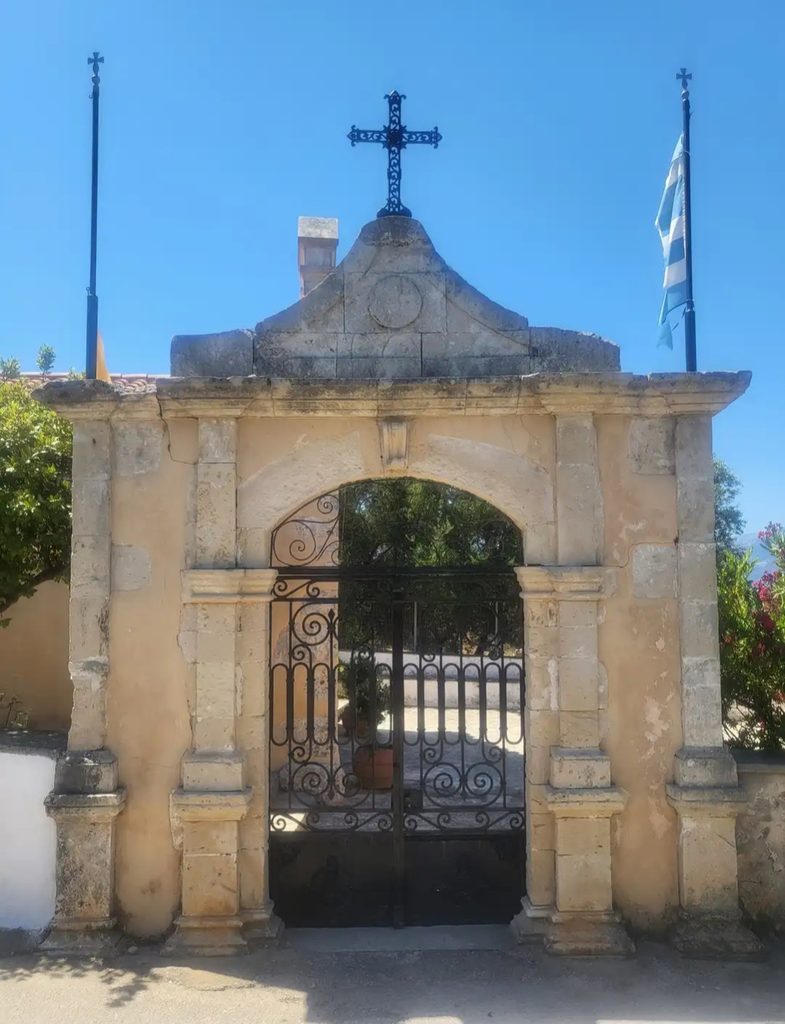
The monumental gateway associated with the Church of Agios Charalambos (Άγιος Χαράλαμπος) is constructed principally from dressed stone, apparently local limestone. Its broad pilasters support a moulded entablature and a curved pediment, above which stands an Orthodox cross. The composition is symmetrical, with the decorative elements concentrated in the upper section rather than distributed across the entire structure.
What interested me was the amount of attention that had been given to an entrance serving a relatively small rural church. The stone had been selected, shaped and assembled to produce something more substantial than a simple opening in a boundary wall. Its builders clearly intended the gateway to have a visual presence of its own.
The proportions are particularly important. The vertical supports give the structure height and definition, while the projecting horizontal mouldings establish a strong division between the entrance and the decorative upper section. The curved pediment softens what would otherwise be a predominantly rectangular composition. The result is formal without being excessively elaborate.
It is also worth distinguishing between the gateway’s architectural form and the materials used in its construction. Limestone is widely available in western Crete and has been used for centuries in domestic, agricultural, religious and defensive buildings. Its presence does not establish the date of a structure. What matters more is how the stone has been worked, how the individual elements fit together, and whether there are identifiable construction phases. The gateway deserves closer examination for precisely these reasons.
Architecture — A Question of Influence and Date
The gateway’s design contains recognisable elements of classical architecture, particularly its pilasters, moulded entablature and pediment. Such features became prominent in European architecture during the Renaissance and continued to be employed, adapted and reinterpreted in subsequent centuries.
Crete provides an interesting setting for examining these architectural traditions. During the period of Venetian rule, conventionally dated from 1211 to 1669, western European architectural ideas influenced the island’s urban buildings, churches, fortifications and decorative stonework. Venetian architectural traditions did not disappear immediately following the Ottoman conquest. Elements of earlier building practice survived, and later Cretan craftsmen continued to employ architectural forms that had become familiar within the island’s built environment.
However, it would be a mistake to assume that a gateway incorporating classical features must have been constructed during the Venetian period. Similar forms were used in later ecclesiastical architecture, including during the nineteenth and early twentieth centuries. Classical ornament was not restricted to a single historical period, and rural buildings often incorporated styles that had developed elsewhere considerably earlier.
Without documentary evidence, an inscription or a detailed architectural assessment, I cannot establish when the Paleloni gateway was constructed. Nor can I confidently attribute it to a particular architectural period. Its appearance is consistent with a tradition of classical-influenced ecclesiastical design, but that is not the same as proving a Venetian origin.
The wrought-iron gates introduce another question. They may have been installed at the same time as the stone structure, or they may represent a subsequent alteration. Their design, method of manufacture and attachment points could provide useful evidence, but appearance alone is insufficient to establish their age.
There is also the possibility that the gateway has undergone repairs or partial reconstruction. Church buildings and their surrounding structures are frequently maintained over long periods, and it is not unusual for original stonework to survive alongside more recent additions. A closer inspection of the joints, mortar, surface finishes and any evidence of replacement stone might help identify different construction phases.
For the moment, the responsible conclusion is that the gateway demonstrates considerable craftsmanship and a clear familiarity with classical architectural forms. Its precise date remains an open question. That uncertainty does not make the structure any less interesting. It simply identifies where further investigation is required.
The Meaning of the Entrance
In Greek Orthodox tradition, the entrance to a church precinct has a significance beyond its practical function. The gateway marks the passage from the public road into the church courtyard, or προαύλιο (proaýlio), an area associated with worship, religious observance and the communal activities surrounding the church. It is important to distinguish the courtyard from the consecrated interior of the church itself. The gateway does not necessarily mark the same liturgical boundary as the entrance to the church building, but it establishes a recognisable transition into a space with a particular religious and communal purpose.
In many Cretan villages, the church courtyard is more than an approach to the building. It provides a place where people gather before and after services, where families meet during religious festivals, and where the community participates in ceremonies associated with important stages of life. Depending on local custom and the arrangement of the church complex, the surrounding space may also be associated with memorial observances and other religious activities.
The entrance therefore has both practical and symbolic functions. It defines the church precinct, provides access and establishes a formal approach to the building. Its architectural treatment can also express the importance attached to the church by the community responsible for its construction and maintenance. The Paleloni gateway is particularly interesting because its design gives prominence to this transition. The substantial stone supports, carefully formed upper section and cross identify the entrance as belonging to a religious building, even before the visitor passes through it. The gateway is not simply a means of entering the courtyard. It is part of the architectural presentation of the church itself.
Agios Charalambos — The Saint and His Traditions
The church is associated with Saint Charalambos, or Άγιος Χαράλαμπος, a figure widely venerated in the Greek Orthodox Church. His feast day is observed on 10 February, and his name remains familiar throughout Greece, particularly in communities where churches and chapels are dedicated to him.
According to Christian tradition, Charalambos was a priest or bishop associated with Magnesia in Asia Minor who suffered martyrdom during the reign of the Roman Emperor Septimius Severus, in the early third century. The traditional accounts describe him as an elderly Christian cleric who refused to renounce his faith despite persecution and torture. As with many early Christian martyrs, the surviving hagiographical accounts combine historical setting with religious tradition, and their individual details cannot all be independently verified.
Saint Charalambos became particularly associated with protection against plague and epidemic disease. In Orthodox devotional tradition, he is invoked as an intercessor during outbreaks of illness, and his image sometimes includes a representation of the plague beneath his feet. Such imagery expresses his traditional role as a protector against disease rather than documenting a particular historical event.
This association would have held considerable significance in earlier Cretan communities. Before the development of modern medicine and public-health systems, epidemic disease could have devastating consequences for villages and towns. Religious observance formed an important part of how communities responded to illness, uncertainty and death, alongside whatever practical measures were available at the time.
There is an interesting example of this tradition relatively close to Paleloni. The Foundation for Gavalochori records local accounts connecting the veneration of Saint Charalambos with outbreaks of plague in Gavalochori during the eighteenth century. According to the village tradition, residents sought the saint’s protection during an epidemic in 1770, and the subsequent ending of the outbreak became associated with his intercession. The account also records later episodes of plague and the continuing importance of the saint to the community. These are valuable records of local religious tradition, although they should not be treated as independent medical evidence of miraculous intervention.
This neighbouring example helps explain why a dedication to Saint Charalambos might have particular significance within the religious landscape of Apokoronas. It does not, however, establish why the Paleloni church received its dedication. That question would require evidence from local ecclesiastical records or the community’s own history.
Nevertheless, understanding the saint’s traditional association with disease and protection adds another dimension to the gateway. The entrance belongs to a religious tradition in which churches were not only places of regular worship but also centres of communal response to hardship, uncertainty and loss.
The Church and the Village Community
One of the most important aspects of a village church is its relationship with the people who live around it. In many Cretan communities, churches have provided continuity through periods of political change, economic difficulty, migration and social transformation. Their buildings may be repaired or altered, their congregations may change, and the surrounding village may develop, but the religious and communal functions associated with them can persist across generations.
Baptisms, weddings, funerals, memorial services and annual feast days form part of this relationship. They bring together families and neighbours, often including people who have moved away but return to their home villages for significant occasions. The church becomes a place associated with family history as well as religious observance.
It would be reasonable to expect that the church at Paleloni has fulfilled many of these functions, although its individual history would need to be established from parish records and local testimony. The gateway itself provides no evidence of how many generations have passed through it, nor does its architectural appearance tell us which ceremonies it has witnessed.
What it does demonstrate is that considerable effort was invested in creating a formal entrance to the church precinct. That decision is significant. Even in a relatively small rural settlement, the approach to a religious building was considered worthy of careful construction and architectural decoration.
This raises several questions that would be worth pursuing. Who commissioned the gateway? Was it paid for by the parish, a local family or an individual benefactor? Was it constructed alongside the church, or added during a later programme of improvements? Does an inscription survive elsewhere on the site identifying a date or donor?
Answers to these questions could transform an architectural observation into a documented piece of village history.For now, the gateway can be understood as evidence of the importance attached to the church precinct, while its more specific historical associations remain to be investigated.
Reading the Stone
“Hitherto my own observation and judgment and inquiry are the vouchers for that which I have said.”— Herodotus, The Histories, II.99, translated by G. C. Macaulay (1890).
Herodotus was writing about his investigations in Egypt more than two thousand years ago, but his distinction between observation, judgement and enquiry remains relevant. Standing before the gateway at Paleloni, I could examine its construction, identify its architectural features and consider how it fitted into the surrounding church complex. What I could not do was establish its age or provenance simply by looking at it. Those questions required further evidence. The distinction is important because the purpose of this series is not merely to describe interesting objects, but to investigate them.
There is an important difference between recognising an architectural resemblance and establishing historical provenance. A feature may look Venetian without having been built under Venetian rule. A weathered stone surface may appear ancient even though it belongs to a much more recent building. Equally, a structure that appears relatively modern may incorporate reused stone or earlier construction. These distinctions matter because the purpose of examining an object is not to give it the most interesting possible history. It is to establish what can reasonably be known about it. In this case, the gateway has already provided enough evidence to justify further investigation. Its formal design, careful stonework and position within the church complex make it an interesting architectural feature in its own right. Whether it can eventually be associated with a particular period, craftsman or benefactor remains to be seen.
A Different Way of Exploring Crete
There is a tendency when travelling through Crete to concentrate on the recognised destinations. The White Mountains, the great gorges, Venetian castles, monasteries and archaeological sites naturally attract attention. They are important places, and I have written about many of them. But concentrating exclusively on these locations risks overlooking the considerable amount of history and craftsmanship found in the ordinary landscape between them.
The agricultural tracks of Apokoronas pass through an environment shaped by generations of settlement, farming, religious practice and local construction. Dry-stone walls define boundaries and terraces. Old wells and cisterns reflect the importance of water management. Roadside shrines commemorate religious devotion or individual lives. Churches, chapels and their surrounding structures demonstrate the continuing place of Orthodox Christianity within the villages.
Not every object is particularly old, and not every feature has a remarkable story attached to it. Some are interesting because of their construction, others because of their function, and others because they raise questions about changes in the landscape.
Travelling by E-MTB allows me to encounter these features at a pace that makes observation practical. I can leave a village, climb through agricultural land, follow a rough track across the hills and return by another route, stopping whenever something warrants a closer look. The ride itself provides the geographical context, linking the object to the terrain and settlements around it.
In Paleloni, the gateway was not the destination I had planned when leaving Kokkino Chorio. It became the subject of the story because I happened to notice it and decided to investigate.
That is an important part of the series. The objects are encountered during real rides, not selected in advance simply because they have an established historical reputation.
Conclusion — The Value of Stopping
I have ridden through Paleloni many times. On previous occasions, the church gateway was simply another feature beside the road, something I passed while concentrating on the route ahead. I knew it was there, but I had never given much consideration to its architecture, construction or history.
Stopping changed that.
Looking more closely at the stonework revealed a carefully designed structure incorporating classical architectural forms. Its position identified it as the formal entrance to a religious precinct, while the dedication to Saint Charalambos provided an opportunity to explore a wider tradition of Orthodox worship and the saint’s historical association with protection against epidemic disease.
The investigation also revealed the limits of what I could establish. I cannot yet date the gateway, identify its builders or explain the circumstances of its construction. Those questions remain open, and I would rather leave them unanswered than assign the structure a history unsupported by evidence.
For me, that is part of the value of this series. An object does not need to be famous, ancient or associated with a dramatic event to justify closer examination. Sometimes its interest lies in the questions it raises and the opportunity it provides to understand a little more about the place in which it stands.
The ride continued, and the gateway was soon behind me. There were still tracks to follow, climbs to negotiate and the familiar limestone hills of Apokoronas to cross before returning home. Yet the most interesting discovery of the day had required no difficult descent, no remote mountain trail and no particular physical effort.
It had required me to stop beside a village road and look properly at something I had passed many times before.
That is what Objects Along the Way is intended to be about. Not simply recording the places I visit, but examining the details that contribute to the history and character of Crete, one ride and one object at a time.
And somewhere along the next route, there will almost certainly be another object worth stopping for.
“Knowing therefore that human prosperity never continues in the same place, I shall mention both alike.”— Herodotus, The Histories, I.5, translated by A. D. Godley (1920).
Herodotus is explaining why his history will consider both great and small cities, recognising that their fortunes change over time.
Looking Ahead — Objects Along the Way, Part 4: Dry-Stone Walls
In the next instalment of Objects Along the Way, I will turn my attention to another familiar feature of the Cretan landscape: dry-stone walls. Built without mortar, these structures have shaped the island’s agricultural landscape for generations, marking boundaries, supporting terraces and managing difficult terrain. Often passed without a second glance, they reveal much about traditional craftsmanship, land use and the practical demands of farming in Crete.