Introduction
The White Mountains of western Crete have always been more than a dramatic backdrop to history. For thousands of years they have offered pasture to shepherds, refuge to rebels, sanctuary to those fleeing occupation, and concealment to those determined to resist it. Their ridges, ravines, and hidden plateaux have shaped the lives of the people who know them, while at times altering the course of history itself.
This article forms part of my forthcoming book, Between Sea and Sky: History, Myth, and Memory in Crete. Every route described in the book is a real journey undertaken by E-MTB, combining field investigation with documentary research, primary sources, and conversations with local people. Rather than simply describing historical events, I seek to understand them through the landscape in which they unfolded. Walking or riding the ground reveals details that maps and archives alone cannot.
Few places illustrate that relationship between landscape and history better than To Koubi—”The Beehive”—a lonely shepherd’s hut in the high mountains above Kares, overlooking the Gournes basin. In January 1943 it became one of the most remarkable SOE hideouts in occupied Crete. Today, reaching it still demands determination. The mountain has changed little since Patrick Leigh Fermor, Xan Fielding, George Psychoundakis, and their companions sought refuge there over eighty years ago.
This ride follows, as closely as modern tracks allow, the approach to that remarkable place.
Ride Summary
This is one of the most demanding rides in western Crete. Starting from the mountain village of Ramni, the route climbs almost continuously through increasingly remote country before reaching the high amphitheatre of Gournes and the SOE hideout known as the Beehive. The return follows the ascent line, creating a complete mountain ride through some of the island’s finest upland terrain.
The ride covers 24.1 kilometres, with 790 metres of climbing, reaching a maximum altitude of 1,160 metres. It is 99% off-road and firmly graded Grade 5, requiring confident bike handling over loose limestone, steep gradients, exposed mountain tracks, and technical descents. The reward is not simply exceptional riding, but the opportunity to travel through a landscape where shepherding traditions, resistance history, and the memory of wartime Crete remain remarkably intact.
Unlike many historic sites, the Beehive cannot be reached by coach or tourist bus.
The final approach still has to be earned.
Only then does the mountain begin to reveal its story.
The Ride Begins
The ride began in Ramni, a village that seems to have been quarried from the hillside and fitted back into it stone by stone. I set off early, before the day’s heat had fully taken hold, though the air was already warm—about twenty-seven degrees—and the whitewashed walls and stone lintels reflected a soft, milky light. A single bark from a yard dog followed me through the last of the houses before the village surrendered to terraces of ancient olives, dry-stone walls, and the pale circles of old threshing floors baked hard beneath the summer sun.
The tarmac lasted only a short distance before giving way to rock and gravel. From that point the climb began in earnest. Loose limestone, rounded stones and exposed bedrock demanded constant attention. There was nothing gradual about it. The track rose immediately, winding upwards through scrub and scattered pines with little thought for comfort.
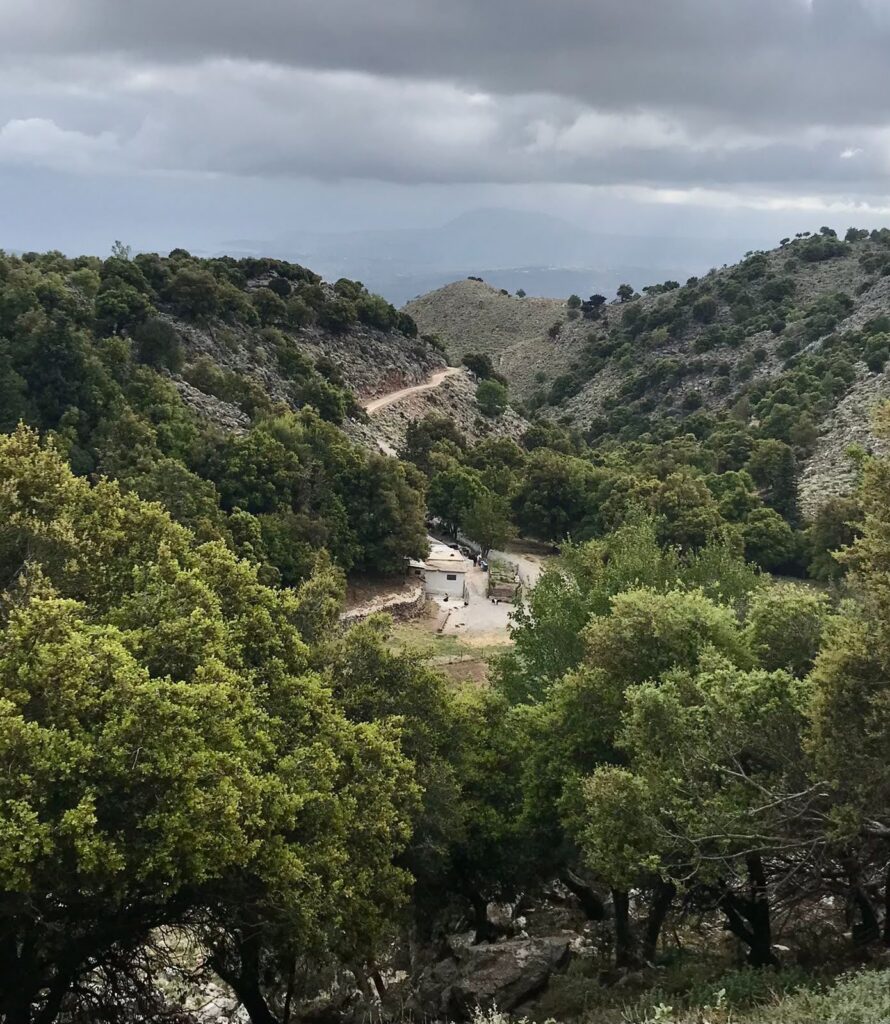
The E-MTB’s motor settled into its familiar rhythm beneath me, a quiet mechanical assistance rather than a substitute for effort. Even so, the gradient required careful line selection, and the front wheel wandered whenever it found deep gravel or loose stone. Momentum had to be managed rather than forced. Every metre of height was earned.
It is impossible to ride tracks such as these without wondering about those who travelled them before. Mine was a modern ascent, assisted by technology unimaginable to earlier generations, yet the mountain remained largely unchanged. Those who crossed these slopes during the occupation carried neither batteries nor suspension. They relied upon endurance, intimate knowledge of the terrain, and the judgement to know which ridge concealed and which ridge exposed.
As altitude increased, the mountain gradually shed the day’s heat. The change came almost unnoticed at first. The air became lighter, carrying the resin of pine and the sharp fragrance of thyme crushed beneath tyres and goat hooves. Goat bells drifted across unseen slopes, each note locating an animal somewhere beyond the next fold of ground. Cicadas rasped loudly where the sun struck exposed rock before falling silent again beneath scattered stands of cypress.
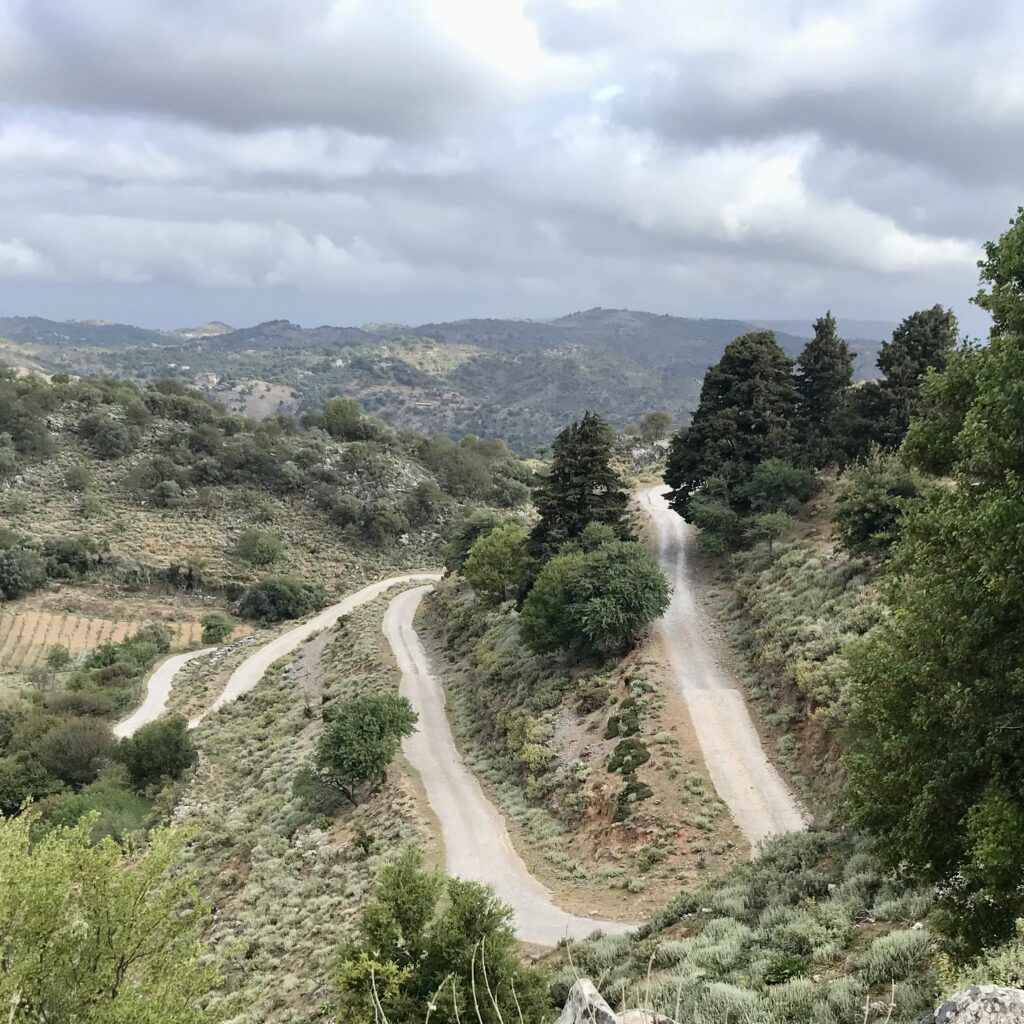
The vegetation changed almost imperceptibly. Olive groves disappeared behind me, replaced by maquis—kermes oak, broom, rock rose and thorn—hugging the thin mountain soils. Beyond them lay open shelves of limestone where centuries of winter storms had stripped away everything except the toughest plants. Here the riding became increasingly technical. Rounded boulders embedded in fine dust shifted unexpectedly beneath the tyres, while loose gravel collected along the edges of the cambered track like marbles waiting to roll under the slightest pressure. I kept the bike high on the inside line wherever possible, allowing the front wheel just enough freedom to find its own purchase.
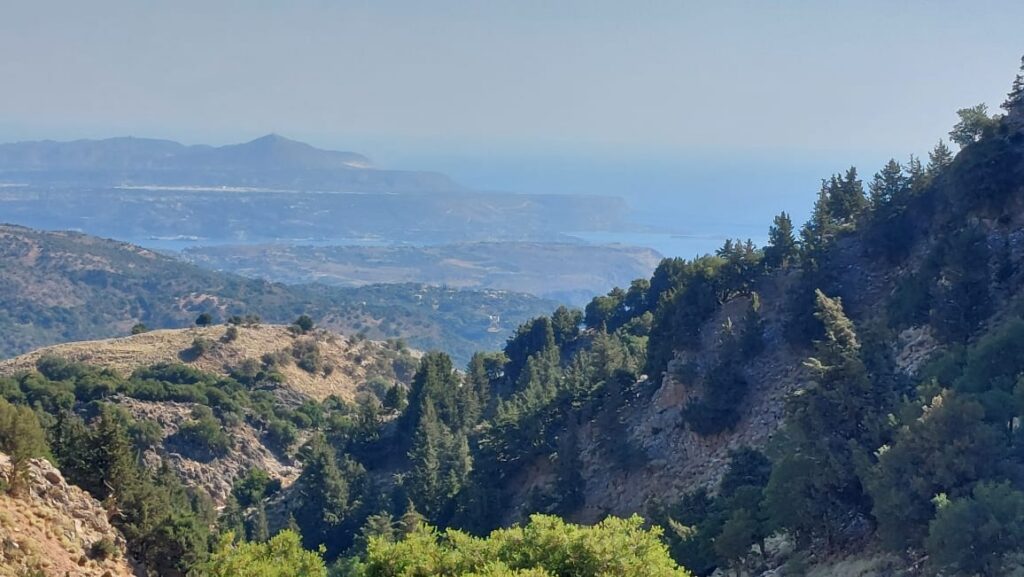
Occasionally the mountain opened to reveal the Cretan Sea far below. Through gaps between ridges the coastline appeared as a thin blue ribbon stretched across the horizon, with villages reduced to clusters of white against the darker olive groves. From this height the landscape became easier to read. Valleys, ridgelines and mountain passes revealed themselves as natural corridors, explaining why shepherds, traders, revolutionaries and soldiers had all moved through this country in much the same way for centuries.
It is often said that mountains preserve memory. In Crete that feels less like metaphor than simple observation. Stories are held here with remarkable persistence. A conversation remembered by a grandfather becomes a family story. A family story becomes part of a village’s memory. Long after documents have disappeared into archives, the landscape continues to carry its own quiet testimony.
I met the first shepherd beside a wind-shaped cypress that offered little more than a patch of shade. His katsouna rested across both hands as he watched a scattered flock moving slowly above us.
We exchanged the customary greetings before he asked where I came from.
“Crystal Palace, South London,” I replied, “but I’ve lived in Kokkino Chorio since 2006.”
He nodded thoughtfully, fitting another small piece into his understanding of who stood before him.
“My grandfather used to speak about To Koubi,” he said after a pause. “When he was a boy, he and his cousins carried food up through these ravines… for the Englishmen.”
He said nothing more.
He did not need to.
The words carried the quiet certainty of something repeated many times over many years, polished smooth by memory rather than embellished by it. Somewhere higher above us lay the place he meant. I thanked him, remounted the bike, and continued the climb towards the White Mountains.
Higher into the White Mountains
Above the shepherd’s solitary cypress, the track became narrower and more demanding. The vegetation thinned as altitude increased, giving way to bare limestone and scattered mountain pines shaped by decades of winter winds. The silence also changed. Down on the lower slopes it had been softened by insects, distant voices and the occasional barking dog. Up here it acquired a different quality altogether, broken only by the wind moving through rock and the faint ringing of goat bells somewhere beyond sight.
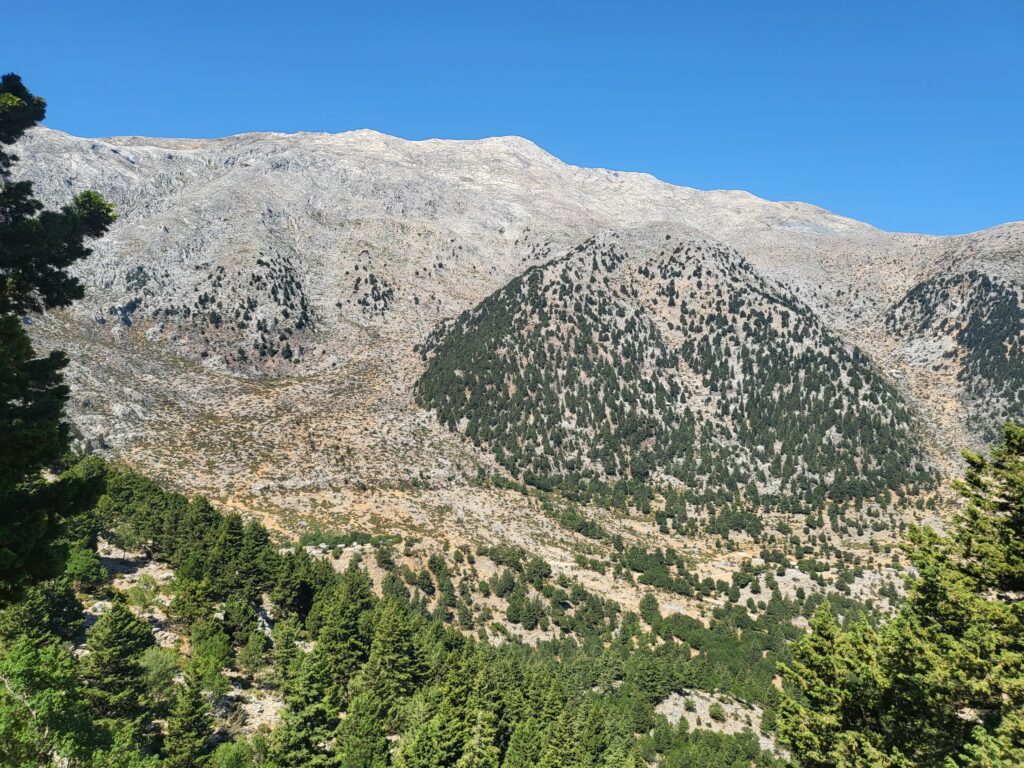
The climb remained relentless. There were few opportunities to recover, only brief shelves of level ground before the mountain asserted itself once more. Loose stone gave way to exposed limestone, polished in places by generations of hooves and weather. The bike demanded complete concentration. Choosing the wrong line could mean losing momentum or spinning helplessly on the smooth rock.
Progress became measured rather than hurried, each successful section simply leading to the next.
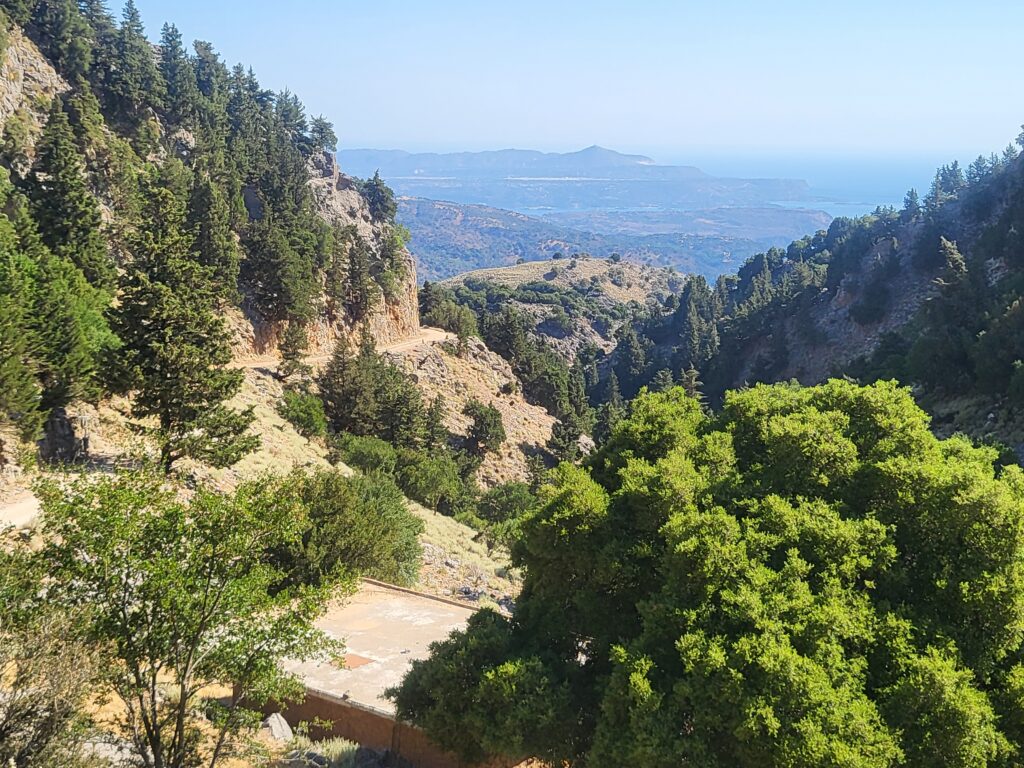
It is one of the characteristics of the White Mountains that they reveal themselves gradually. There is seldom a dramatic arrival. Instead, each ridge uncovers another beyond it, each valley conceals another fold of ground, until eventually the familiar landscape of villages and olive groves has disappeared entirely. You realise almost without noticing that you have entered another world.It was here that I encountered the second shepherd.
He stood beside a low wall of weathered limestone overlooking the great amphitheatre of Gournes. Unlike the first shepherd, whose appearance might have belonged to almost any rural community, this man seemed inseparable from the mountain itself. His black kefalomantilo was wrapped tightly against the wind, while his well-worn vraka disappeared neatly into polished stivania. Across one arm rested his katsouna, the crook carried by generations of Cretan shepherds and as much a symbol of authority as a practical walking staff.
We greeted one another in Greek before settling into an easy conversation. Time passes differently in the mountains. Neither of us appeared to be in any particular hurry.
He asked about the bicycle.I asked about his flock.
He pointed towards distant grazing ground invisible to me and spoke of the changing seasons, of winter snow lingering long after the coast had warmed, and of families who had brought their sheep to these uplands for generations beyond counting. The mountain, he said, taught patience. Anyone who tried to hurry it usually regretted doing so.
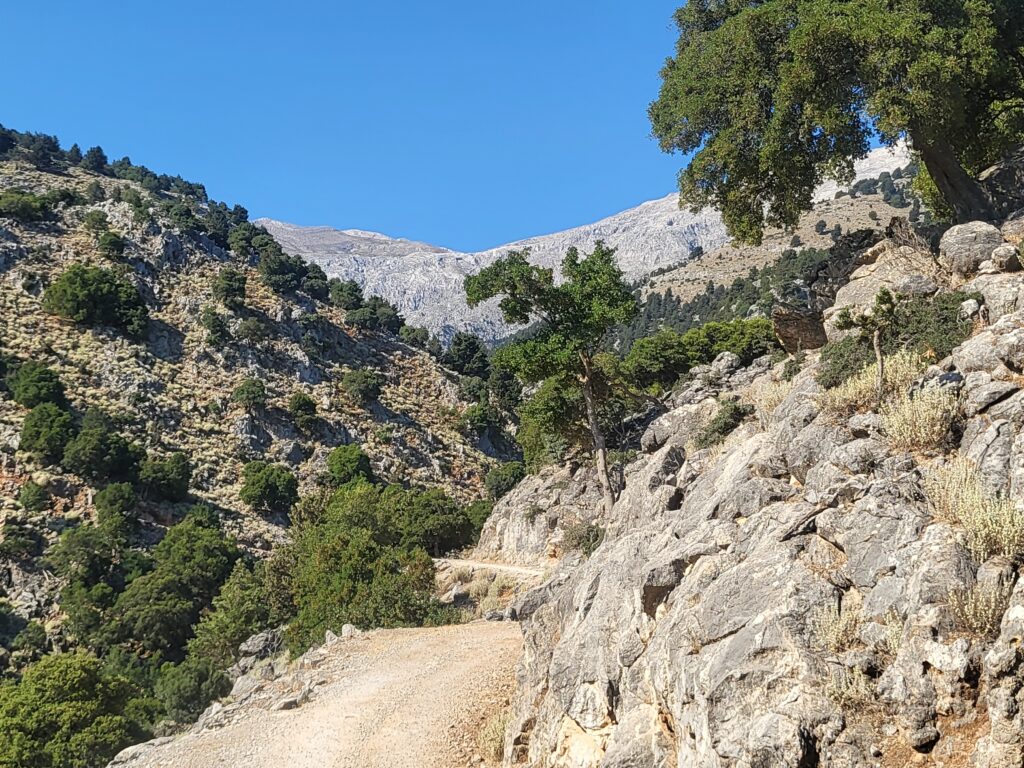
Eventually our conversation turned, as it often does in these mountains, to history.
When I mentioned To Koubi, he nodded without surprise.”Everyone here knows it,” he said quietly.
He gestured towards the high basin beyond us.
“The old people spoke about the English officers. They were hidden well. The Germans searched many times.
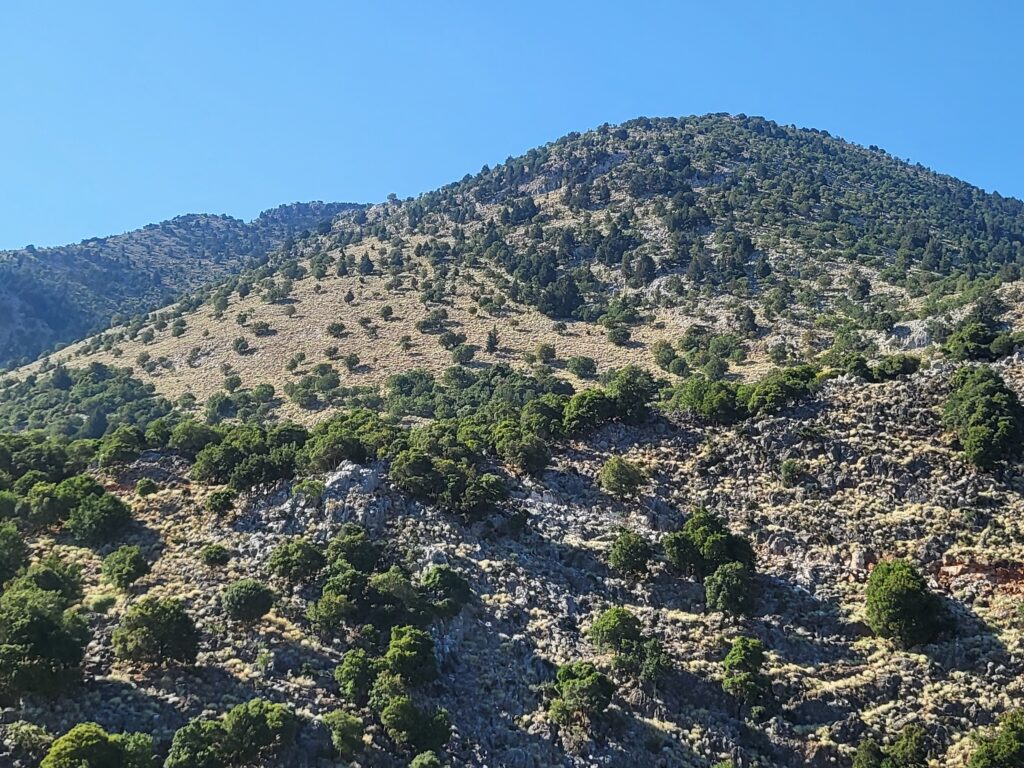
“There was no embellishment, no attempt to dramatise events that have become part of local memory. They were simply facts passed from one generation to the next, woven into the landscape as naturally as the shepherd paths themselves.
We stood together for several minutes overlooking the broad bowl of Gournes. The scale of the country became immediately apparent. Deep ravines cut into the mountainside before disappearing into dense folds of rock and scrub. Narrow ridges linked hidden basins that could not be seen from below. Countless tracks crossed and recrossed one another, some made by shepherds, others by animals, many impossible to distinguish from one another.
Looking across that broken country, it became immediately obvious why these mountains had frustrated every occupying army, from the Venetians and Ottomans to the Germans. A man who knew the ground possessed an advantage that no map could provide.
The shepherd smiled, adjusted his kefalomantilo, and wished me a safe journey.
I watched him disappear along a faint path that I had not noticed until he began to walk it.
Only then did I continue towards the Beehive.
The final climb felt different.
It was no longer simply a demanding mountain ride.
Every turn of the pedals brought me closer to one of the most remarkable SOE hideouts in occupied Crete, a place where landscape, courage and local knowledge had combined to preserve not only lives, but the resistance itself.
The Beehive
The final approach was steeper than anything below it. The track narrowed to little more than a shepherd’s path, climbing through broken limestone where centuries of rain, frost and grazing had stripped the mountain to its essentials. The last few hundred metres demanded complete concentration. Loose stone shifted beneath the tyres, while exposed shelves of limestone offered grip one moment and none the next. It was easy to understand why, for generations, these uplands had belonged more naturally to shepherds than to soldiers.
Then, almost without warning, it appeared.
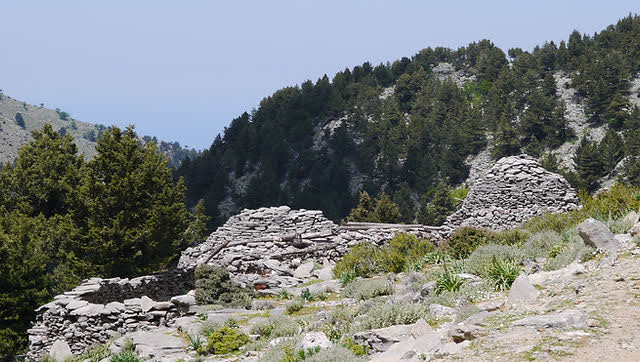
The Beehive, sits quietly against the mountainside, as though it has always belonged there and expects nothing from those who visit. There is nothing monumental about it. No dramatic architecture. No imposing walls. Simply a circular stone building rising from the hillside, its roof formed by overlapping limestone slabs weighted against the fierce winter winds. Built entirely from the mountain itself, it seems less constructed than revealed.
The name “Beehive” was given by the Special Operations Executive. Long before the war it had simply been another mitato, one of the traditional shepherds’ dwellings scattered throughout Crete’s high mountains.
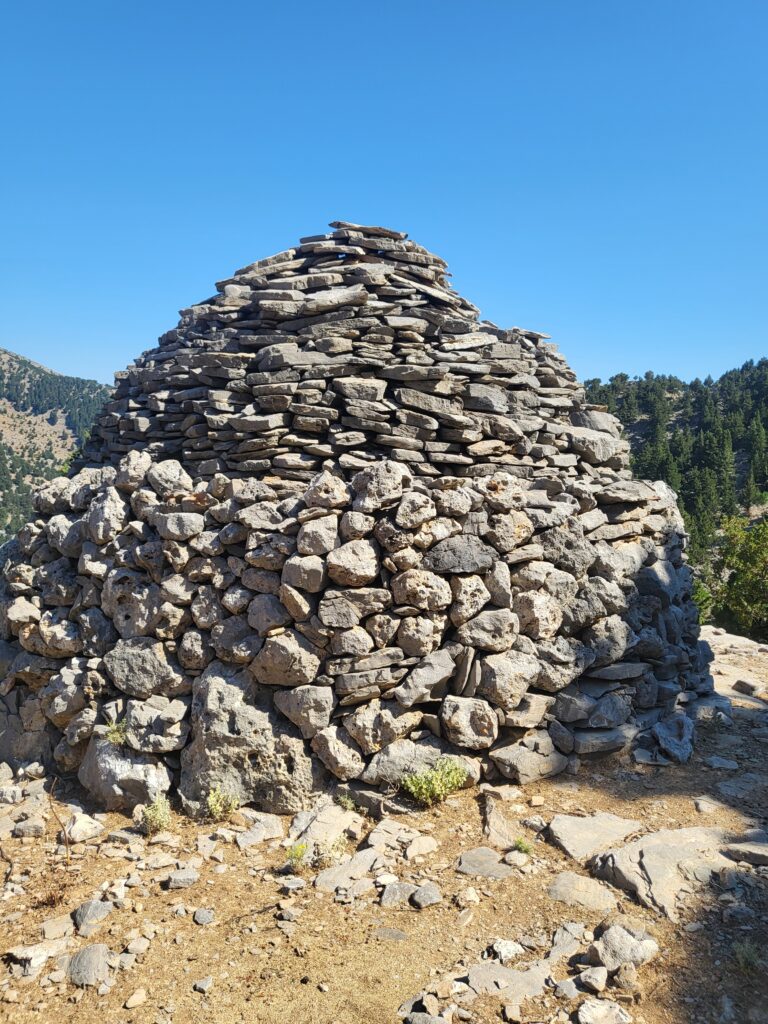
A mitato is far more than a shelter.
For centuries these buildings have formed the centre of seasonal pastoral life. During the summer months shepherds brought their flocks into the high country, living for weeks or months amongst the grazing grounds while producing the cheeses that remain central to Cretan mountain culture. The buildings provided shelter from snow, wind and blazing summer sun alike. They were places to sleep, cook, make cheese, repair equipment and wait out storms that could arrive with astonishing speed.
Inside, simplicity governs everything.
A low hearth blackened by countless fires occupies the centre of the floor. Niches built into the walls once held lamps, knives, salt and the few possessions needed during long months on the mountain. A raised stone platform served as a bed, usually softened only by woven blankets or sheepskins. Every feature exists because it performs a function. Nothing is decorative.
Traditionally, ownership of a mitato implied responsibility for substantial flocks, often numbering well over a hundred sheep or goats. Many therefore operated cooperatively, with several shepherding families pooling both labour and animals.
Even today, the rhythms of mountain life continue much as they always have. During the annual sheep shearing, families gather on the uplands where work, food and music merge into celebration. Rizitika songs echo across the mountains, lamb turns slowly over open fires, and the evening concludes, almost inevitably, with glasses of raki raised amongst friends.
The mountains preserve traditions as carefully as they preserve history.
Standing in the doorway, it required little imagination to understand why SOE chose this place.
The position commands an extensive view across the surrounding ridges while remaining remarkably difficult to detect from below. Deep ravines provide multiple escape routes. Shepherd paths disappear into folds of ground invisible to anyone unfamiliar with the terrain. A visitor approaching without local guidance could pass within a few hundred metres and never realise the hut was there.
Its greatest defence, however, was not stone.
It was the people.
Without the shepherds and villagers who knew these mountains intimately, the Beehive would have been merely another isolated mountain shelter. With their support it became something altogether more valuable—a refuge, an observation post, a meeting place and, for a time, one of the safest hideouts in occupied Crete.
On 23 January 1943, that quiet mountain hut became the centre of one of the most remarkable episodes in the island’s wartime history.
Five men were sheltering there: Major Patrick Leigh Fermor, Xan Fielding, Arthur Reade, Alec Tarves, and the young Cretan courier George Psychoundakis.
Outside, winter held the White Mountains in its grip. Snow lay deep across the surrounding ridges, and every footprint risked betraying their presence.
Then came warning.
A German patrol was approaching.
There was no time for discussion.
Decisions had to be made in seconds.
Four of the men climbed silently into the snow-covered branches of the great cypress tree standing immediately above the mitato. Hidden amongst its dense limbs, they remained absolutely motionless despite the bitter cold, scarcely daring to breathe as the patrol drew nearer.
George Psychoundakis made a different choice.
Knowing he could move across the mountains faster than anyone else, he slipped away from the hut before the Germans arrived. Like generations of shepherds before him, he crossed the frozen ridges almost without leaving a trace, disappearing into the vastness of the White Mountains.
The German search found nothing.
No tracks.
No movement.
No evidence that five of the most wanted men in occupied Crete had been only yards away.
The mountain, the cypress, the mitato and the people who understood them had combined to preserve a secret that day.
More than eighty years later, they still do.
Why These Mountains Mattered
Standing beside the Beehive, it becomes clear that its significance extends far beyond the events of a single winter’s day. This was not simply an isolated hiding place. It formed part of a landscape that had become central to the resistance against the German occupation.
To understand why, it is necessary to return to May 1941.
On 20 May 1941, Germany launched Operation Merkur, the first large-scale airborne invasion in military history. Thousands of Fallschirmjäger descended upon Crete around the strategically vital airfields of Maleme, Chania, Rethymno and Heraklion. British, Australian, New Zealand and Greek forces resisted with determination, often fighting at close quarters against paratroopers who landed directly amongst their positions.
The battle proved costly for both sides. German casualties, particularly amongst the Fallschirmjäger, were so severe that Adolf Hitler never again authorised a major airborne assault on this scale. Nevertheless, the capture of Maleme Airfield allowed German reinforcements to be flown onto the island, gradually overwhelming the defenders. By 1 June 1941, organised Allied resistance had ceased, although thousands of soldiers had already escaped across the White Mountains to evacuation beaches along the south coast.
For the Cretans, however, the war was only entering a new phase.
Occupation transformed the mountains into contested ground. German patrols controlled the roads and larger settlements, but the higher country remained beyond their complete control. Shepherds continued to move their flocks across the uplands as they always had. Ancient paths linked villages hidden in neighbouring valleys. Every ravine offered concealment. Every ridge concealed another beyond it.
The White Mountains possessed something no occupying army could easily overcome: local knowledge.
For centuries, Cretans had learned to move through this country almost instinctively. Shepherds could cross ridgelines in darkness or poor weather with remarkable confidence. They knew where water could still be found in late summer, where snow lingered longest, which gullies remained passable after heavy rain, and which caves or mitata offered shelter when conditions deteriorated. That knowledge became one of the resistance’s greatest strengths.
The Special Operations Executive (SOE) recognised this almost immediately. Rather than attempting to impose an unfamiliar system upon the island, its officers adapted themselves to an existing way of life. Shepherds became guides. Villagers became couriers. Food, clothing, intelligence and wireless equipment moved quietly through a network built upon trust rather than formal organisation. A loaf of bread might conceal a message. A shepherd walking to his flock might also be carrying information destined for Cairo.
The work demanded extraordinary courage from everyone involved.
Discovery rarely affected only the individual concerned. Entire families and villages could suffer the consequences. Throughout the occupation, German reprisals were often swift and severe. Villages suspected of assisting the resistance were burned. Hostages were taken and executed. Livestock was confiscated. Communities that had existed for centuries were reduced to ruins in a matter of hours.
Yet the resistance endured.
Not because the mountains were impregnable, but because they could never be fully understood by those who did not belong to them.
Looking out from the doorway of the Beehive, it is easy to appreciate why this particular mitato proved so valuable. The surrounding landscape appears almost limitless. Deep ravines disappear into shadow before re-emerging on distant slopes. Shepherd paths intersect and vanish amongst rock and scrub. A man familiar with the terrain could be lost from sight within moments.The mountain itself became an ally.
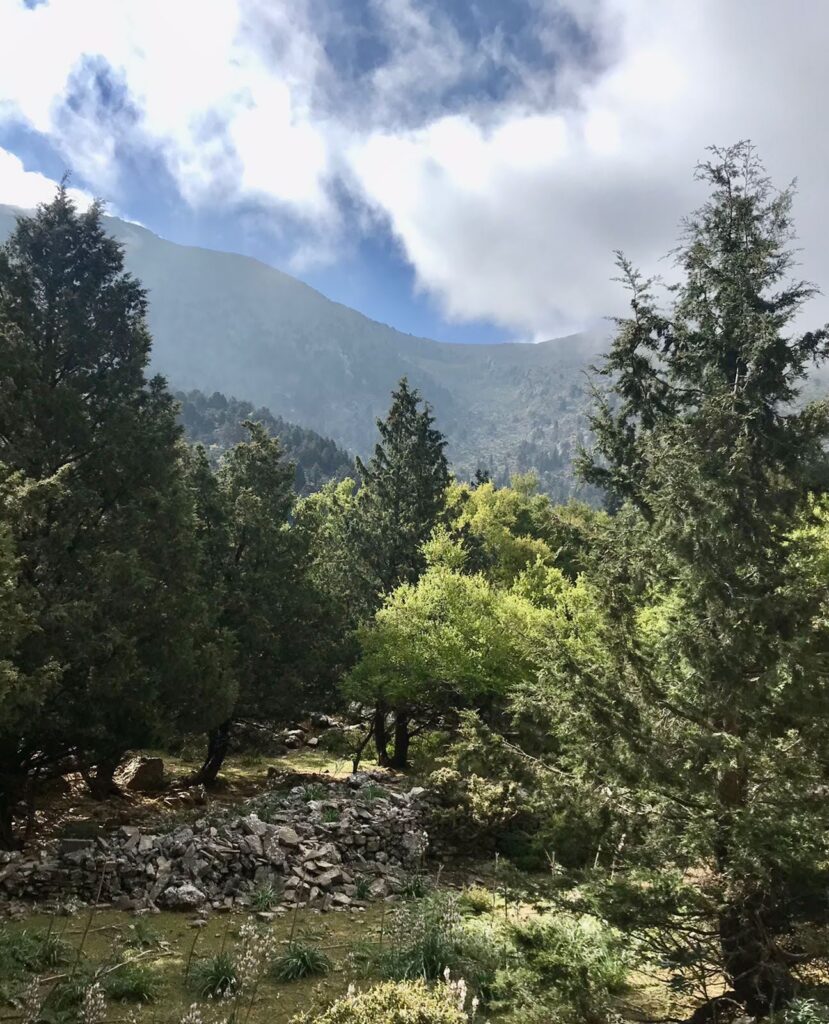
It concealed movement, absorbed sound, frustrated pursuit and rewarded patience.
Those qualities had protected shepherds for generations before the war. During the occupation they protected resistance fighters and SOE agents with equal impartiality.
The Beehive was never important because of the building alone.
It mattered because it stood within a landscape whose greatest strength lay not in its remoteness, but in the enduring relationship between the mountains and the people who knew them best.
The Descent
I lingered for a while beside the mitato before beginning the return journey. The silence seemed reluctant to release me. A light wind moved through the cypress above the hut, setting its branches gently against one another with a sound scarcely louder than a whisper. It required little imagination to picture five men listening to that same wind on a bitter January morning, willing themselves to become part of the mountain until danger had passed.
Eventually, the ride demanded my attention once more.
Descending mountain tracks requires a different discipline from climbing them.
Obstacles that slow your progress on the ascent become genuine hazards on the way down. Gravity is no longer an opponent but an accomplice, urging greater speed than judgement sometimes welcomes.
The first section was steep, technical and unforgiving. Loose limestone rolled beneath the tyres, while exposed shelves of rock alternated unexpectedly with deep gravel. The front wheel searched constantly for grip, demanding light hands and complete concentration. Momentum had to be managed carefully. Too much braking invited the wheels to slide; too little risked carrying unnecessary speed into the next switchback.
Gradually the descent settled into a rhythm.
The mountain that had demanded patience during the climb now rewarded smoothness rather than strength. The bike flowed from corner to corner, suspension absorbing the larger impacts while the tyres searched for traction amongst the fractured limestone. Every successful line brought a quiet satisfaction, not because it had been difficult, but because it felt earned.
As altitude fell, warmth returned almost unnoticed. The cool mountain air gave way once more to the familiar scents of thyme, pine resin and dry earth. Goat bells drifted across distant slopes, sounding no different from those I had heard on the climb. The mountains continued with their daily routines, indifferent to visitors and entirely unconcerned with history.
On a broad shelf overlooking a dry ravine, I met the second shepherd once again.
He recognised me immediately and raised his katsouna in greeting before producing a battered metal flask from the pocket of his jacket.
There was no need for words.
He unscrewed the cap and handed it across.
The tsikoudia carried the unmistakable warmth of Crete. It burned briefly before leaving behind the clean taste of grapes and mountain herbs. Like so many Cretan customs, the gesture was simple, generous and entirely without ceremony.
We stood looking across the White Mountains in comfortable silence.
After a few moments he raised the flask once more.
“Στην υγειά μας.”
“To our health.”
I returned the toast.
Then, almost instinctively, another followed.
“To those who fought here.”
He nodded quietly.
No further explanation was required.
For the people of these mountains, the occupation is not ancient history. It remains within living memory, carried through families whose parents and grandparents experienced it directly. The stories are not preserved only in books or archives but in conversations, place names and shared recollections passed from one generation to the next.
We spoke briefly about the weather, the sheep and the condition of the track before parting company.
He turned uphill towards his flock.
I continued downhill towards Ramni.
The village appeared gradually below me, its stone houses emerging amongst the olive groves exactly as they had disappeared several hours earlier. The final kilometres passed quickly. The harsh mountain terrain gave way to familiar tracks and, eventually, to the quiet lanes leading back between the first houses.
The ride was over.
The journey, however, was not.
Coffee in Ramni
Back in Ramni, I brushed the dust from the bike before finding a small kafeneio overlooking the village square. The tables stood beneath a tree-covered terrace, their worn wooden tops polished by years of coffee cups, conversation and summer heat. Nothing appeared to have changed for decades, and there was no reason why it should.
The woman who brought my coffee asked the familiar question.
“Where are you from?”
“Kokkino Chorio,” I replied.
Her face brightened immediately.
“Do you know Yannis?”
I laughed.
“Of course.
He owns the taverna—and he’s also the mayor.
“She smiled.
“We were classmates.”
Crete is full of such moments. The island has a remarkable way of reducing distances between people. A chance meeting in one village frequently reveals a family connection in another, and before long strangers discover they have mutual friends, shared acquaintances or distant relations.
Our conversation soon drifted towards names.
I explained that my surname was McWilliams, and that the Gaelic prefix Mc, or Mac, simply means son of. Across Scotland and Ireland it identifies descent from an ancestor, preserving family connections that stretch back centuries.
She nodded thoughtfully before explaining the Cretan ending -akis.
“It is one of the ways you know someone is Cretan,” she said. “You hear the name before you know the person.”
Like my own surname, it carried history within it.
Many of Crete’s most familiar family names—Manousakis, Papadakis, Xylourakis, Mitsotakis—immediately reveal their island origins. Elsewhere in Greece different regions developed their own distinctive surname endings: -poulos in the Peloponnese, -idis amongst families with Pontic roots, -atos in the Ionian Islands, -ellis on Lesbos. To anyone familiar with them, surnames form a map of Greece every bit as revealing as its mountains.
Our conversation lasted only a few minutes, yet it illustrated something I have come to value deeply about living in Crete.
History is rarely confined to museums.
It survives in language, customs, family names and everyday conversations. A simple question over coffee can become an unexpected lesson in identity, linking the present with centuries of continuity.
I finished the last of my coffee while looking back towards the White Mountains.
From the village, there was little to distinguish one ridge from another. Somewhere beyond those folds of limestone stood the Beehive, hidden once again amongst the shepherds’ country.
Most visitors to Crete will never know it exists.
Perhaps that is exactly as it should be.
Some places reveal themselves only to those prepared to climb far enough to listen.
Absent Friends
There is a small ritual I have kept for many years. It requires no audience and no ceremony. At the end of certain rides—particularly those that follow the paths of soldiers, resistance fighters or ordinary people caught in extraordinary events—I pause before leaving and quietly offer a simple toast.
“Absent Friends.”
It is a phrase heard throughout the British Army and far beyond it. To those unfamiliar with military life it may seem a modest gesture, but its meaning reaches well beyond those two words. It is an act of remembrance without speeches or fanfare, acknowledging those who are no longer with us and recognising the debt owed to those who came before.
Standing in the mountains above Gournes, the toast carried particular significance.
It was for Patrick Leigh Fermor, Xan Fielding, Arthur Reade, Alec Tarves and George Psychoundakis, whose courage and judgement allowed them to survive one desperate winter’s day. It was for the shepherds who climbed these same tracks carrying food, messages and intelligence, knowing the consequences if they were discovered. It was for the villagers who offered shelter, often at immense personal risk, and for those who paid the ultimate price for helping strangers in their homeland.
It was also for the countless men and women whose names seldom appear in official histories. Couriers who crossed mountain passes by night. Wireless operators who transmitted messages from hidden valleys. Families who opened their doors without asking questions. Children who carried food because they attracted less attention than adults. Their contribution was no less important simply because history recorded it less completely.
The White Mountains have witnessed successive generations of resistance. Long before the Second World War they sheltered those who opposed Venetian and Ottoman rule. During the German occupation they performed that role once again, protecting not only those who fought but also the ideals for which they fought.
As I stood beside my bicycle, I raised my water bottle towards the mountains.
“Absent Friends”
The words disappeared into the wind almost as soon as they were spoken.
No audience.
No audience.
Only the quiet satisfaction that remembrance, however modest, remains a responsibility rather than an obligation.
I tightened the straps on my pack, wheeled the bike back onto the road and began the journey home.
High above Ramni, hidden amongst the limestone and mountain pines, the Beehive remained exactly as it had for generations. The cypress still watched over the old mitato. The wind still moved through its branches. Shepherds still crossed the high pastures with their flocks.
The mountain had kept its secrets for centuries.
It continues to do so today.
Mandináda
No journey through Crete feels complete without a mandináda. These traditional Cretan couplets have been part of the island’s oral tradition for centuries. Usually composed in fifteen-syllable lines, they are recited or sung to express love, grief, humour, friendship, defiance, or remembrance. Many are spontaneous; others are passed from one generation to the next. Together they form a living tradition that remains an important part of Cretan identity.
Each ride concludes with an original mandináda inspired by the landscape, the history, and the people encountered along the way. I write each one first in English before it is translated into Greek, followed by a literal back-translation to preserve its original meaning.
English
Five men hid upon the slope, and silence was their shield,
The Beehive held its breath that day—and Crete refused to yield.
Greek
Πέντε άντρες κρύφτηκαν στ’ απόκρημνο βουνό,
Το Κουβί σώπασε γι’ αυτούς — και η Κρήτη είπε όχι στο χαμό.
Back-Translation
Five men hid on the steep mountain,
The Beehive fell silent for them—and Crete said no to destruction.
Author’s Note
Every route described on my website and in Between Sea and Sky is a real journey undertaken by E-MTB through western Crete. The historical narratives are based upon field investigation, documentary research, primary sources, and conversations with local people. My aim is not simply to recount history, but to understand it through the landscapes in which it unfolded.
If this story has encouraged you to look more closely at Crete’s mountains and the remarkable people who lived, fought, and found refuge amongst them, then it has achieved exactly what it set out to do.
Sources and Acknowledgements
This article is based upon my own field investigations in the White Mountains of western Crete, undertaken by E-MTB, together with documentary research, published memoirs, official histories, and conversations with local people whose knowledge of these mountains has been passed from one generation to the next.
I am indebted to the writings of Patrick Leigh Fermor, George Psychoundakis, and Xan Fielding, whose first-hand accounts remain indispensable to anyone seeking to understand the Special Operations Executive in occupied Crete. I also acknowledge the official histories of the campaign and the continuing generosity of the people of western Crete, whose willingness to share their history has greatly enriched my understanding of the island.
Selected Sources and Further Reading
Patrick Leigh Fermor — Abducting a General
George Psychoundakis — The Cretan Runner
Xan Fielding — Hide and Seek
Antony Beevor — Crete: The Battle and the Resistance
Hellenic Army General Staff — The Battle of Crete