Crete in November offers good reasons to take an E-MTB into the mountains: autumn colour among the trees, green returning to the hollows and cloud changing the views across the higher slopes. Our ride from Imbros brought all three, along with a rabbit hunter whose morning had been less productive than he had hoped and a descent that required reconsideration. The plan was to climb into the White Mountains and return by a different track. It was a perfectly reasonable plan, drawn up before we had seen what the rain had done to the track.
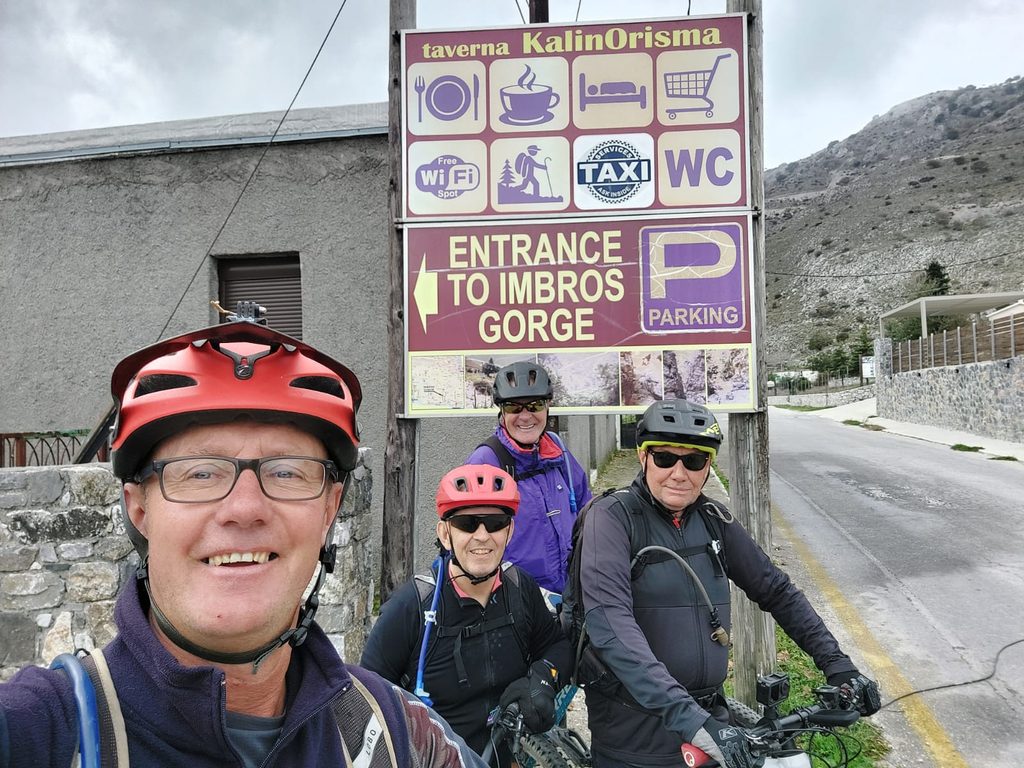
Seventeen and a half kilometres sounds a modest distance for a morning on an E-MTB. It is the sort of figure one might mention casually, leaving the listener to imagine a gentle outing with ample provision for refreshments. Add 615 metres of ascent, loose mountain tracks and an abandoned descent, however, and the description requires some adjustment. We started from the village of Imbros, at roughly 780 metres according to the ride profile, which I considered a sensible concession to the business of climbing into the White Mountains. There seemed little merit in beginning at sea level when somebody had already provided a road.
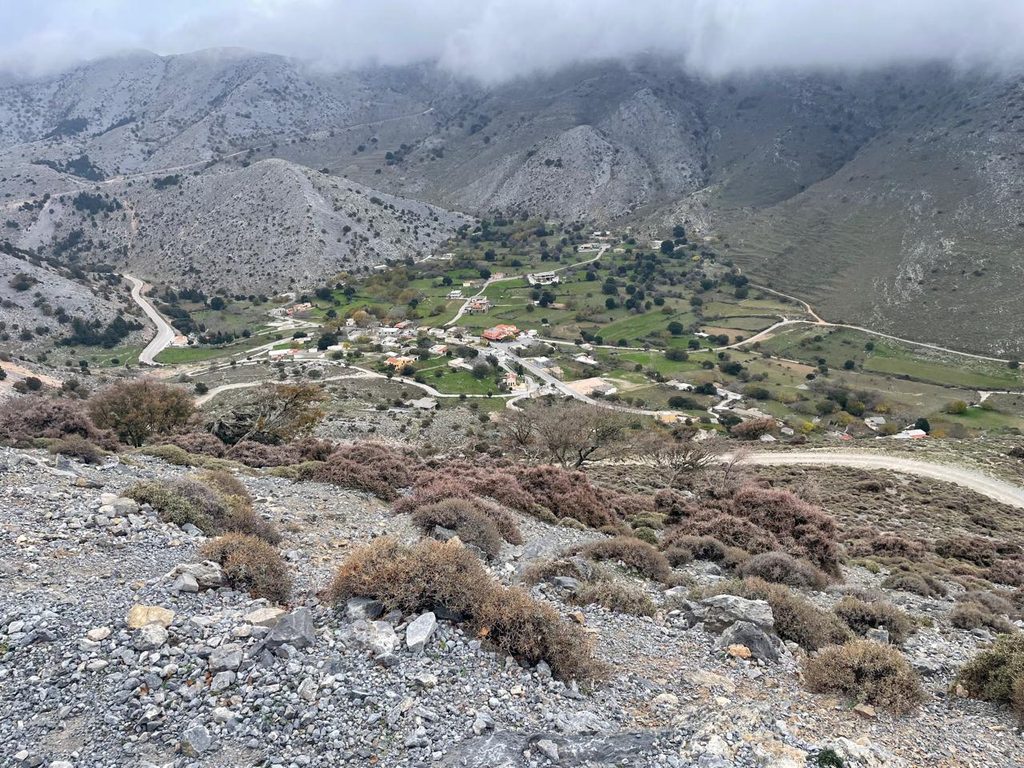
Above the village, low cloud obscured the higher slopes. Below it lay pale rock, scattered dark trees and the green fields around the houses, with the main road running through the settlement. As we gained height, the view back opened out, revealing the village within its surrounding folds of mountain. From above, the fields and buildings looked compact and orderly. Our track was rather less concerned with order, bending around the hillside and gaining height through a succession of gravel turns.
The climbing began in earnest early in the ride. The Hammerhead recorded the main ascent as 6.3 kilometres with 440 metres of height gained, a useful reminder that a short route need not be an easy one. Electrical assistance makes such outings possible and considerably more enjoyable, but there is still pedalling to be done, a line to choose and an E-MTB to keep moving over the stones. The motor helps with the gradient; it does not undertake the steering or accept responsibility for the rider’s decisions.
The surface varied between comparatively firm gravel and rougher stretches littered with loose angular stone. In places, exposed rock interrupted the wheel tracks, while rubble accumulated towards the edges. A mountain track can look agreeably smooth from the opposite hillside. Close inspection, conducted from a saddle, generally reveals several details omitted from the distant view. There was plenty here to occupy the eyes without spending the entire climb watching the elevation figure.
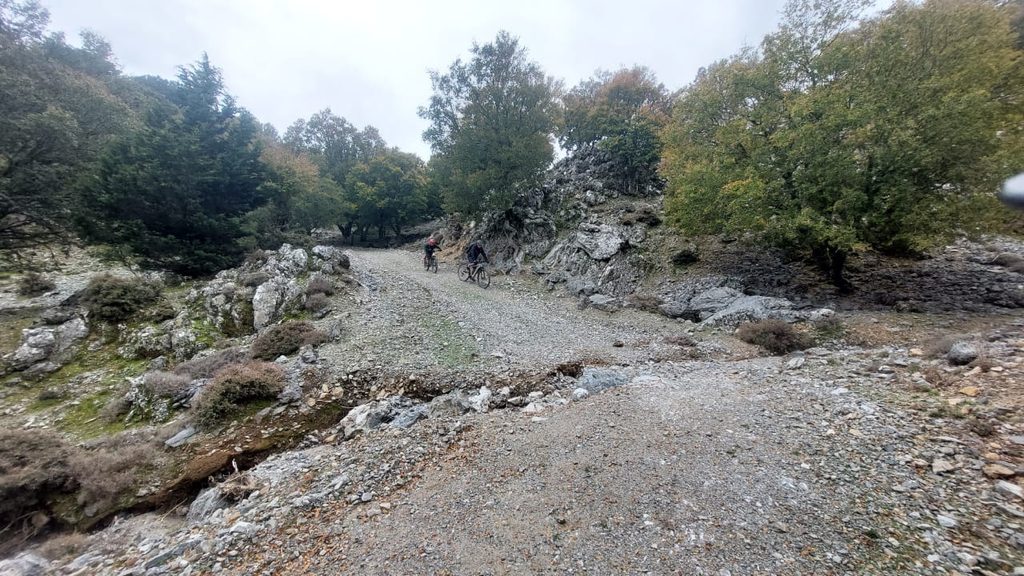
On the ascent, we came across a JCB repairing rain damage, filling in hollows washed into the track. It was a practical reminder of the maintenance these mountain routes require. We would encounter rather more substantial evidence of what rain could do when we tried our intended return route later in the ride.
Nevertheless, the landscape deserved attention. The earlier views above Imbros had been dominated by grey slopes and low scrub, but the trees added an increasingly rich range of autumn colours: yellow, ochre and russet among the darker green foliage. Some stood beside the track with thick, branching trunks; others occupied the hollows below, their crowns filling sheltered pockets between the rocky slopes. Pale lichen hung from branches, and patches of fresh green growth showed between stones and rounded bushes. November had supplied considerably more colour than a casual glance at the mountains from the coast might suggest.
The bends offered changing views of both the ground ahead and the route already covered. At some points, another length of track could be seen across the slope, apparently close until one examined the intervening hollow. This is one of the useful distinctions between looking at a route and riding it. A line on the far hillside takes very little time to admire and rather longer to reach, particularly when the ground between insists on being included.
Imbros remained visible below during parts of the ascent, providing a clear measure of our progress. It also offered repeated opportunities to consider the perfectly serviceable places where we might have spent the morning sitting down. Instead, we had brought our E-MTBs into the mountains. As a means of finding somewhere to sit, this involved considerably more effort than was strictly necessary.
At approximately 1,200 metres, the views opened out. Ahead lay successive rocky folds, scattered trees on the slopes and thicker growth in the deeper ground. To the south, cloud blocked our view towards the Libyan Sea. We had gained the height, but the sea view would have to wait for another occasion. One of the riders considered the clouds and supplied the customary reassurance: “At least it’s not moist.” This was the standard of meteorological commentary available within the group, offered freely and without any recognised qualification.
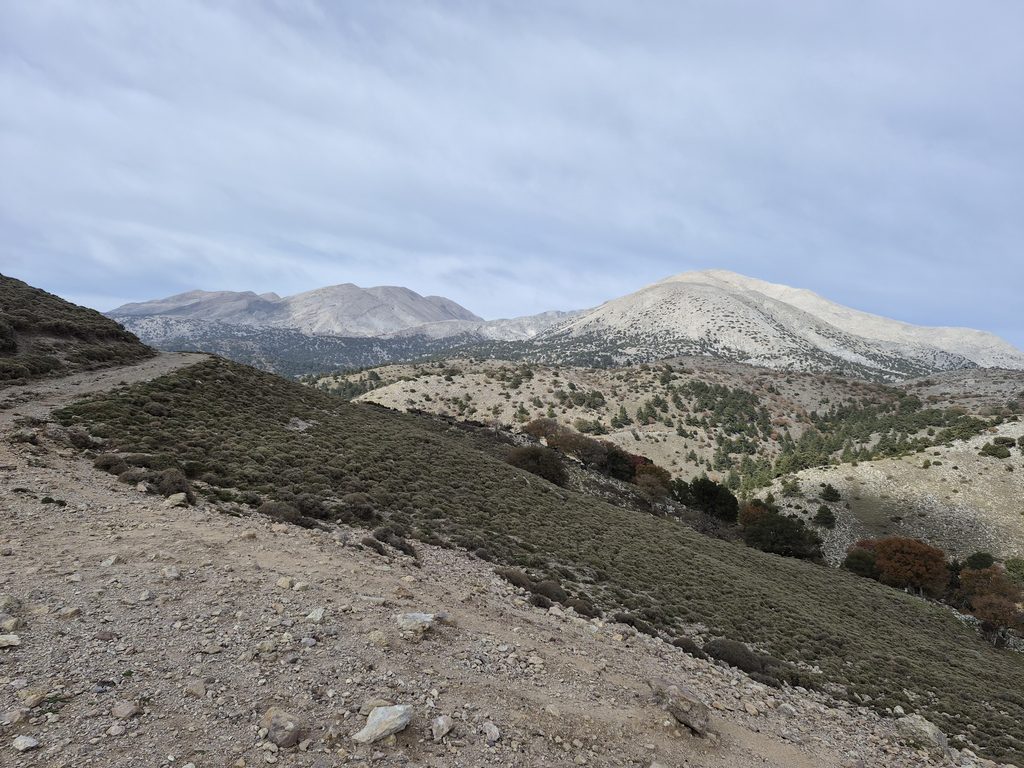
At that point, a Greek hunter stopped in his 4×4. After the usual exchange of greetings, he explained that he had been hunting rabbits but had had no luck. We had failed to see the Libyan Sea; he had failed to secure a rabbit. Between us, we had covered several of the morning’s disappointments, though the rabbits presumably regarded matters more favourably.
Cloud concealed sections of the ridges, while elsewhere breaks in the cover admitted brighter light and patches of blue sky. Some slopes looked almost white where the light caught the bare stone; others remained subdued beneath the cloud. The contrast between those pale heights and the autumn foliage below was one of the most striking features of the day.
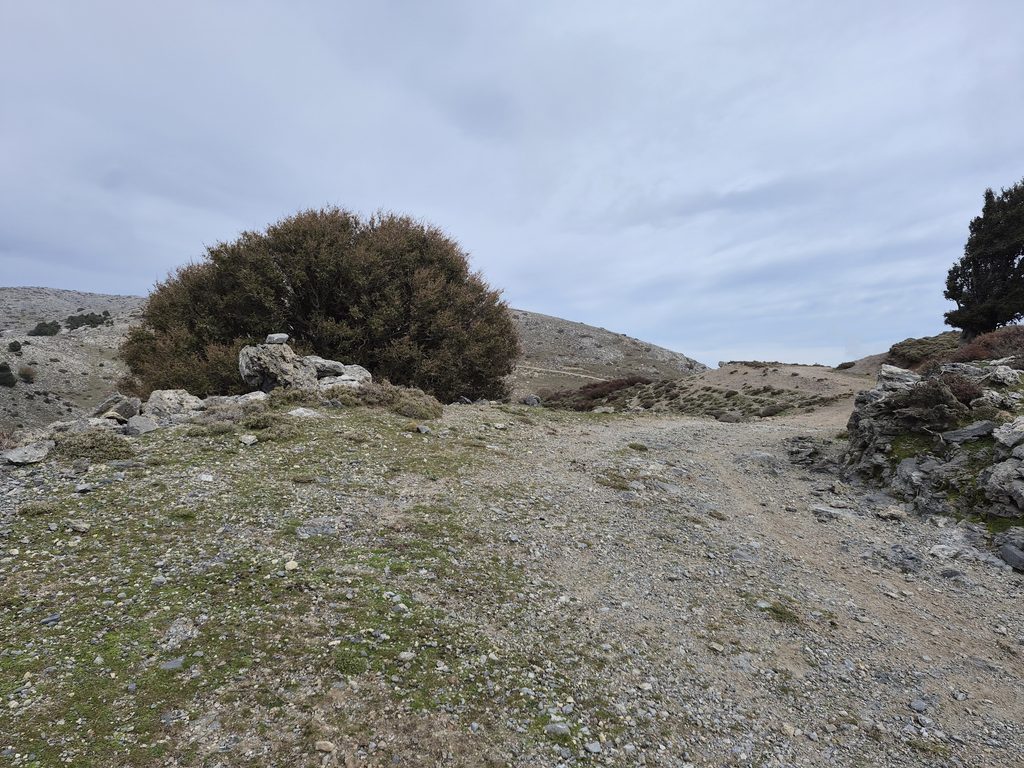
Beyond the main climb, the route undulated around the higher ground. Small losses of height were followed by further rises, which is perfectly reasonable mountain geography, though less satisfactory to anyone who has already decided that the uphill ought to be finished. Reaching a high point and completing the climbing are separate achievements. It is helpful to remember this before announcing either.
There were stops, naturally, with opportunities to look across the hillside and examine the onward track. With the E-MTBs stationary, it was possible to appreciate both the route ahead and the ground falling away below us. From a distance, the track looked straightforward enough, although we had already had ample opportunity to examine the difference between its appearance from afar and its surface beneath the tyres.
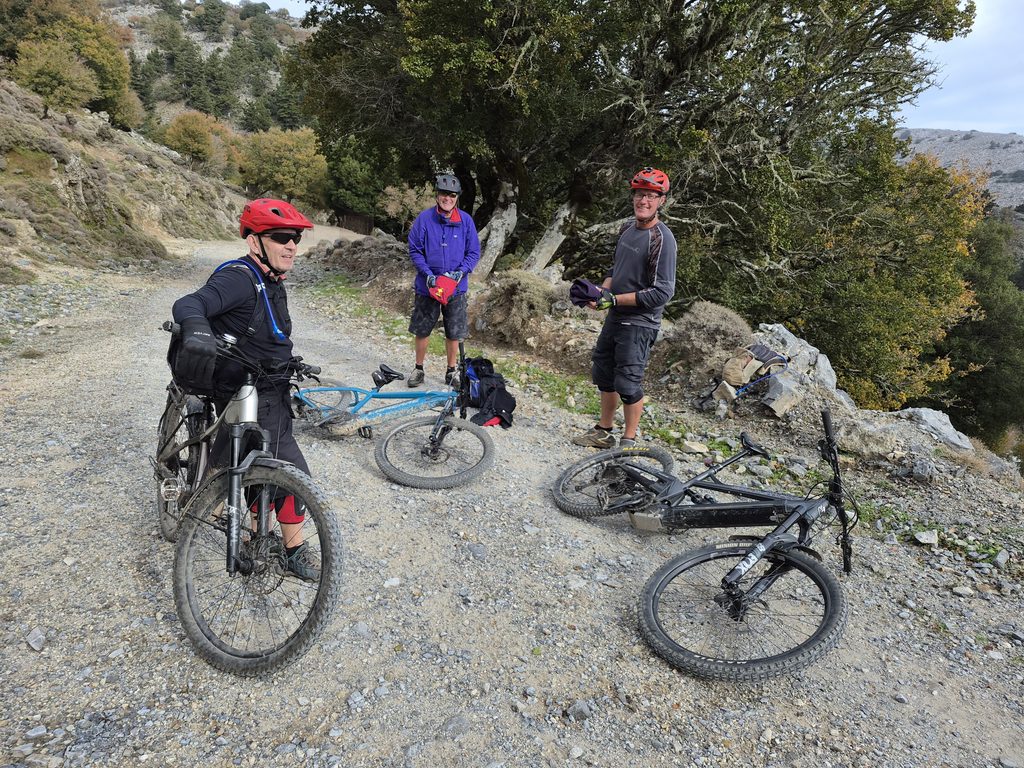
A large tree provided a place for another pause, with E-MTBs laid on the gravel and bags put aside. These pauses are part of the pleasure of riding together. There is time to look properly at the country, exchange a few words and appreciate where the climbing has brought you. A moving E-MTB demands attention to the next stretch of ground; a stationary one allows a rather wider interest.
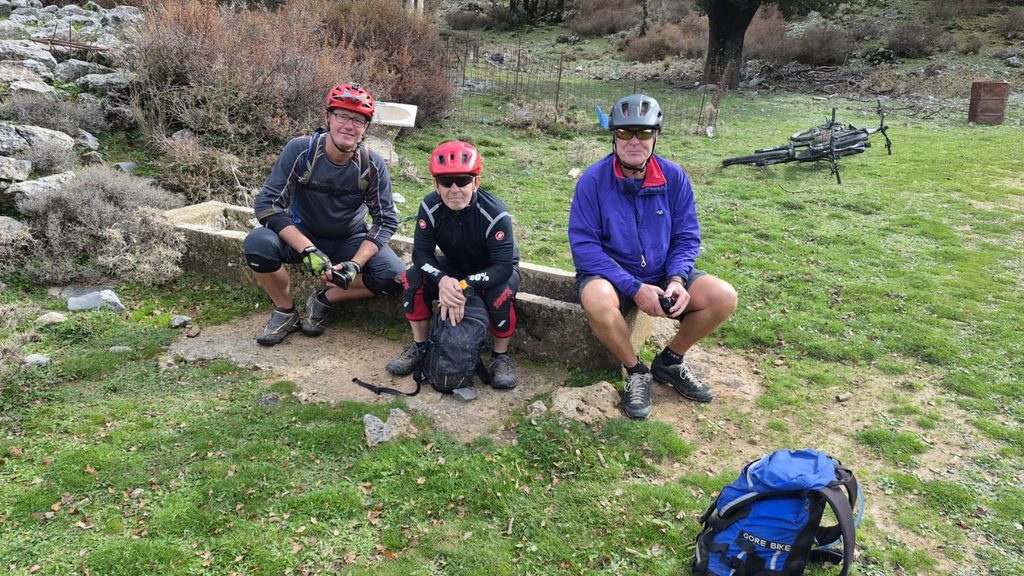
A concrete trough supplied seating for a further stop. As mountain furniture goes, it was practical: solid, conveniently placed and sufficiently long to accommodate three riders. Nobody had troubled to provide cushions, but standards become pleasantly straightforward during a ride. A satisfactory seat is often one that allows you to stop using your legs without requiring you to sit directly on the ground.
The greener hollows provided a different character again. Here were grassy patches, narrow tracks between trees, rusty-red shrubs and areas enclosed with wire fencing. After the exposed gravel and pale stone, these pockets of colour and vegetation held the attention. Within a relatively short ride, we had views over the village, open mountainside, wooded bends and sheltered ground where the grass was vividly green. The distance alone gives little indication of that variety.
Our plan had been to return to the start by a different track, descending through a gorge rather than retracing the ascent. Our intended return branched west from the outward route, taking us down into the gorge. It was a satisfactory arrangement until we examined what the rain had done to it. Deep erosion channels cut across the track, some up to a metre deep, with steep sides. Continuing would have involved rather more than ordinary riding.
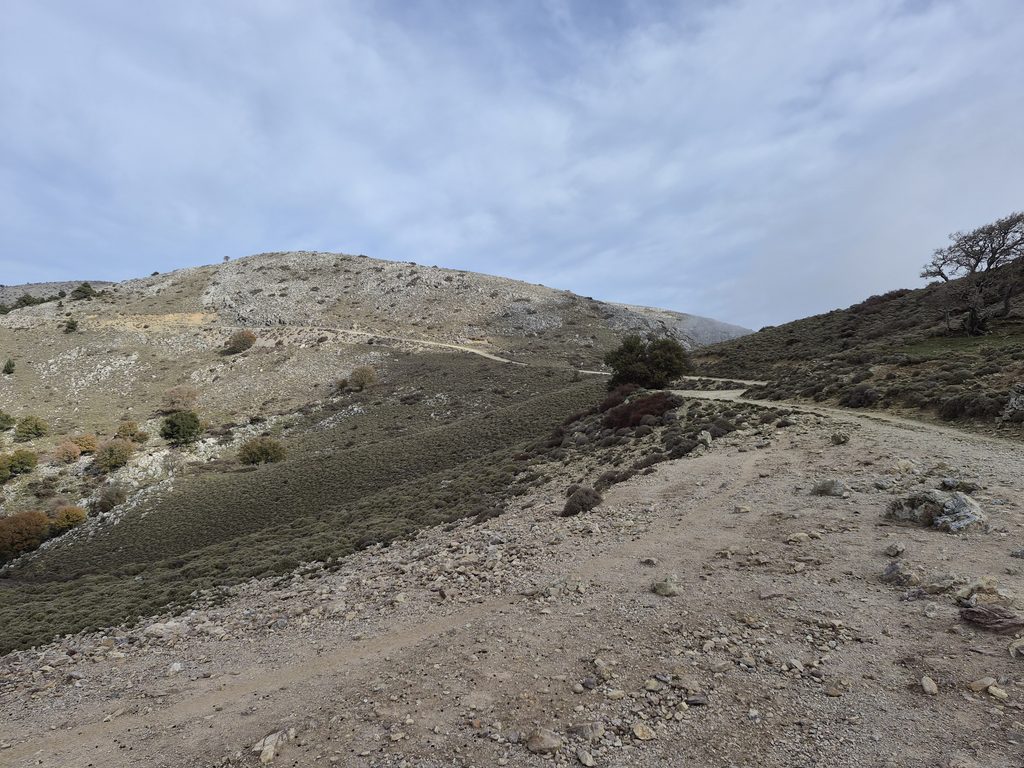
Sometimes discretion is the better part of valour. We abandoned the descent and turned around, which required regaining the height we had just lost before rejoining the track we had originally ascended. It was a sound decision, although sound decisions are more agreeable when they involve less uphill. A metre-deep washout is quite capable of settling a route discussion without anyone needing to make a lengthy speech.
That explains the second pronounced climb on the elevation profile. It was the consequence of withdrawing from an unsuitable descent and returning to a usable route. The Hammerhead identified the later ascent as 1.1 kilometres with another 100 metres gained. On paper, that is a manageable addition. In the legs, its reception depends partly on how confidently one has been anticipating the journey downhill. I would have preferred to discover the condition of the alternative track without having to climb back out, but field reconnaissance does occasionally involve returning over the field.
Once we had regained our original route, the profile finally settled into the longer descent towards Imbros. Height gained through sustained climbing was surrendered over the remaining kilometres, with the rough surface still requiring attention. Going downhill changes the work rather than removing it. Loose gravel, embedded stones and bends remain present, and there is little advantage in admiring a distant view while the front wheel is negotiating something more immediate.
Back at the village, the Hammerhead recorded 17.5 kilometres, 615 metres of ascent and 611 metres of descent. Moving time was one hour, thirty-six minutes and eleven seconds; the complete outing lasted three hours and eight minutes. That left one hour, thirty-one minutes and forty-nine seconds stopped—an almost exact balance between cycling and the other requirements of a satisfactory mountain ride. We had missed equal time by only four minutes and twenty-two seconds. With slightly greater discipline at the trough, we could have achieved it.
It was a short ride by distance, but a full morning among the mountains: gravel climbing, rocky bends, autumn trees, a conversation with a hunter and a return route amended after inspection. We had missed the sea view and gained an extra climb, but the country above Imbros had provided ample compensation. The hunter had no rabbits, and we had no uninterrupted descent. At least it wasn’t moist.