
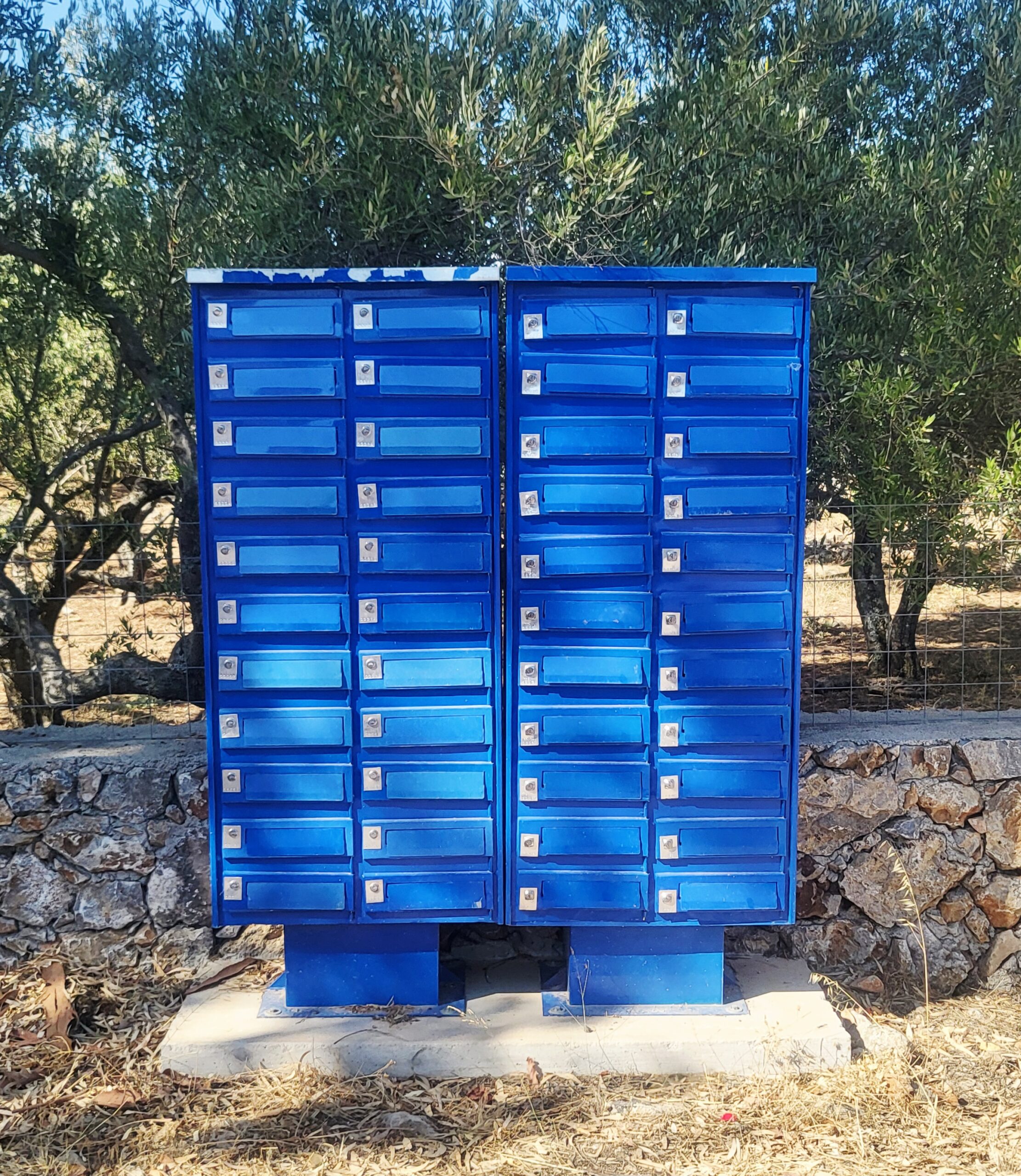
Rural Post, Cretan Style
These blue letterboxes serve dozens of households in scattered mountain villages — tidy, communal, and perfectly out of place. Out on the road near one of the smaller villages, I passed this bank of bright blue communal letterboxes — a fixture in rural Crete that many riders barely notice.
In places where homes are spread across hillsides and olive groves, door-to-door post doesn’t work; instead, villagers use a shared drop-point like this. Each box is numbered, locked, and painted in Hellenic blue. A neat, bureaucratic touch in the middle of an unpaved lane — a reminder that in rural Crete, community matters more than convenience.
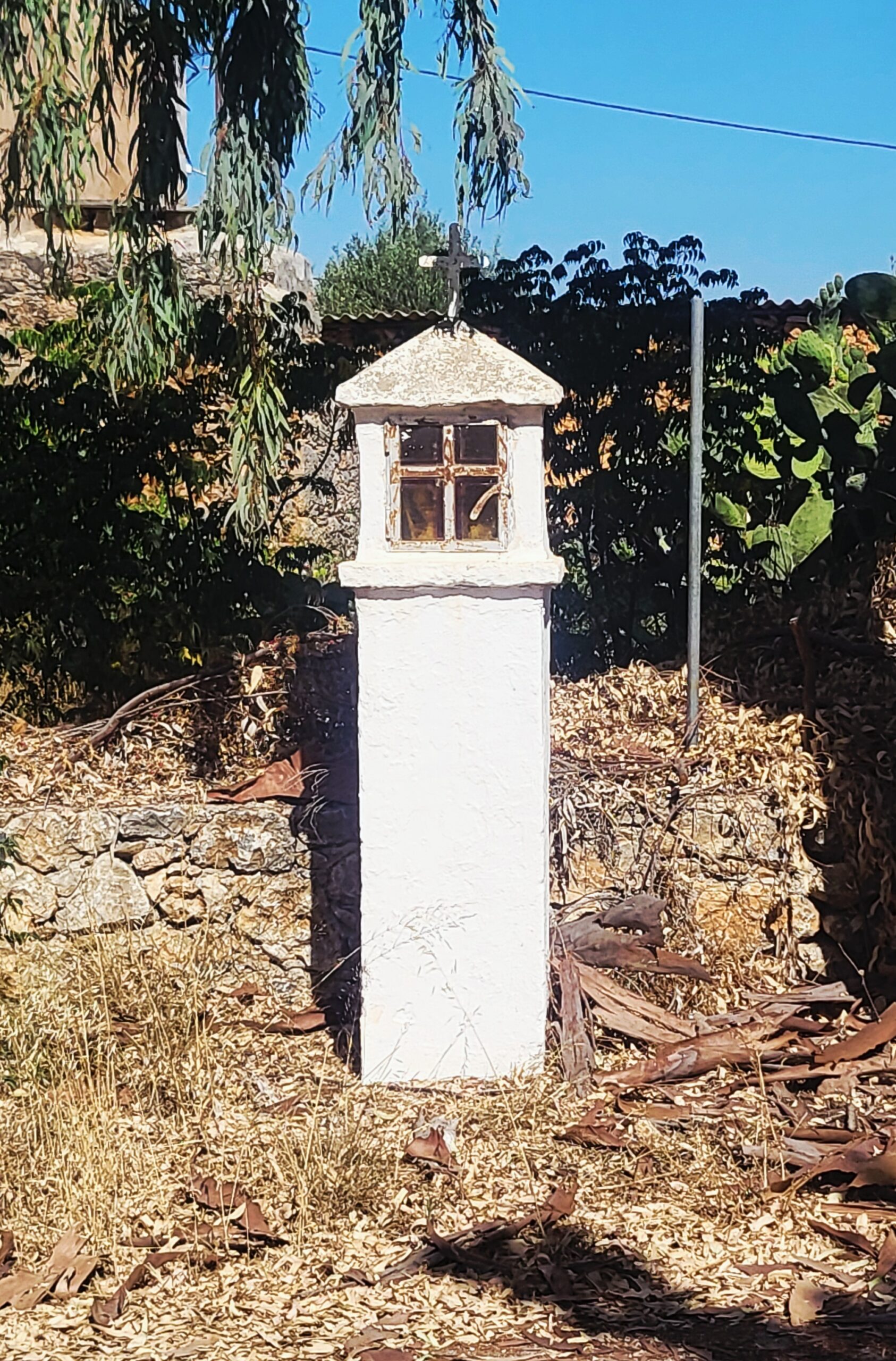
Roadside Kandilaki Shrine
I stopped at this small kandilaki — a roadside shrine typical of rural Crete. These shrines mark loss, give thanks for a life spared, or stand as a quiet act of devotion.
Weathered but upright, its cross intact, the small window rusted from decades of sun and sea air. Set beneath a eucalyptus tree and framed by dry-stone walls. For riders unfamiliar with Crete, kandilákia are reminders of the personal histories woven into the landscape — markers of grief, gratitude, and faith — and a sign you’re off the map, where the past is still visible and nothing is placed without meaning.
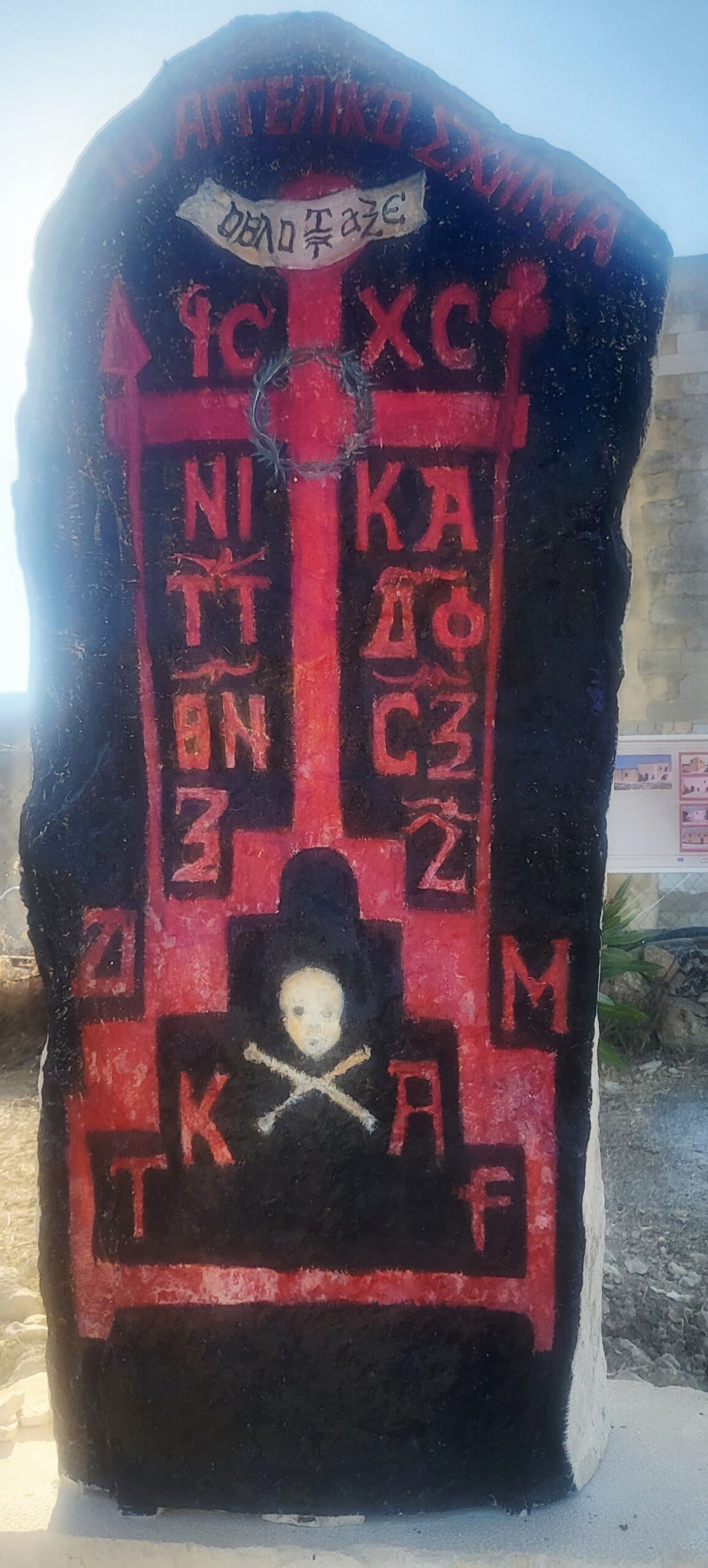
St. George’s Monastery Monument
This monument stands at St. George’s Monastery, located between Vamos and Vrysses. It features a striking red Byzantine cross with the inscription IC XC NIKA — the Orthodox declaration “Ιησούς Χριστός Νικά” (Jesus Christ Conquers).
The upper inscription reads ΤΟ ΑΓΓΕΛΙΚΟ ΣΧΗΜΑ (The Angelic Schema), signifying the highest monastic rank, while a white banner below carries the phrase ΟΔΟΝ ΞΕΣΣΕ — archaic for “Seek the path” or “Find the way.”
At the base, a skull and crossbones serve as a solemn memento mori — a reminder of mortality and the hope for resurrection, echoing the Orthodox tradition of depicting Adam’s skull at Golgotha.
The design intentionally pairs the proclamation of Christ’s conquest over death with a call to repentance and monastic vigilance. Its stark black-and-red palette and vivid imagery create a powerful visual statement rooted in Orthodox faith.
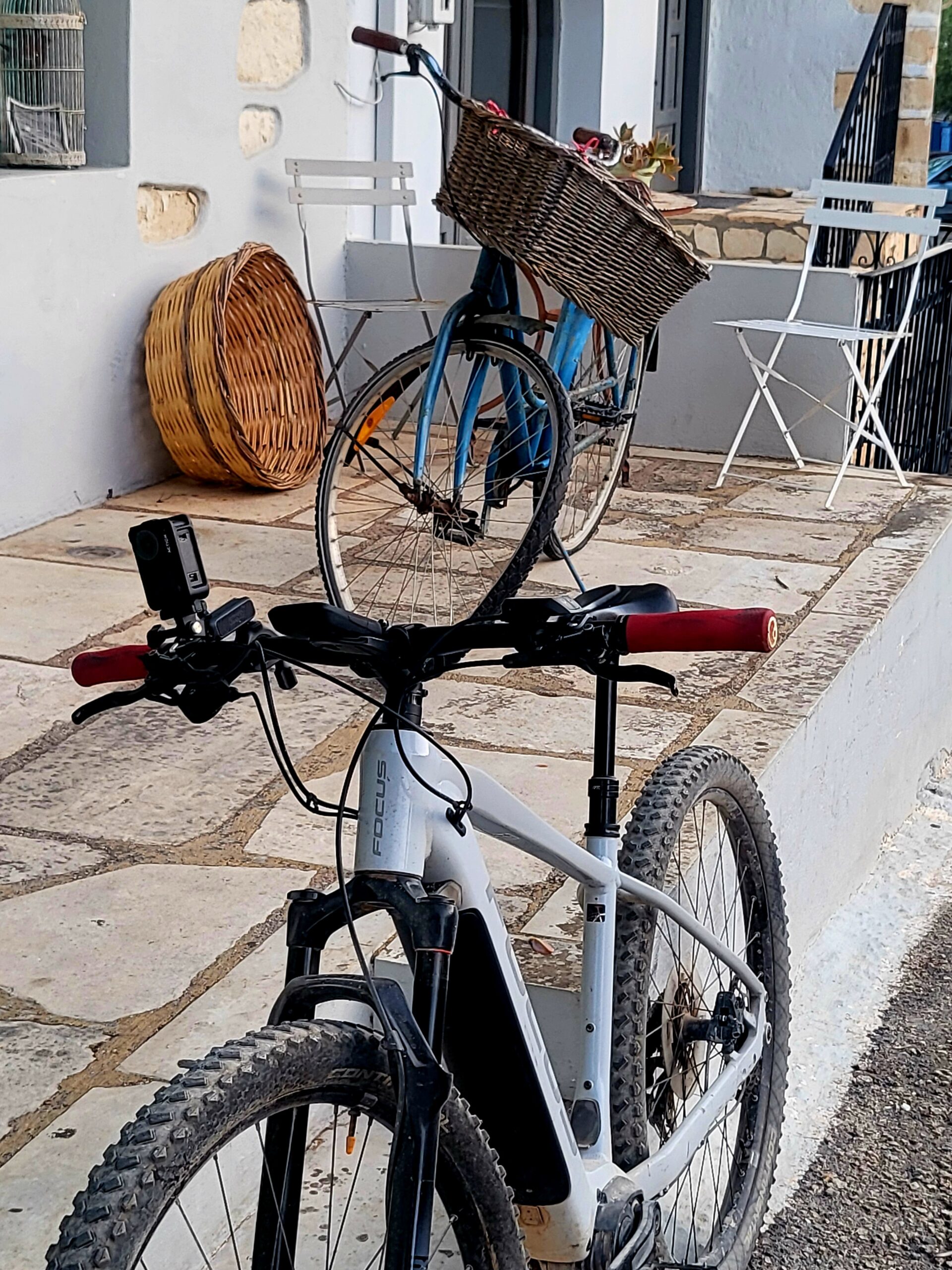
Bicycles in Gavalochori
A village still life, where the road between yesterday and today narrows to the width of a doorstep.
Here in Gavalochori, the blue frame of an old pushbike — rusted chain, basket worn smooth by time — rests beside the precision lines of an E-MTB. One belonged to a farmer or a baker; the other, to a rider chasing stories through olive trails and forest turns.
One bore bread, oil, letters, or flowers. The other carries memory, mapping the old paths anew.
This is Crete, where nothing is lost, only layered.
Τ’ άλογο έχασα κι επήρα μηχανάκι,
μα η σέλα δεν έχει τη μυρωδιά του γαϊδάρου μου.
“I lost my horse and bought a motorbike,
but the saddle no longer smells like my old donkey.”
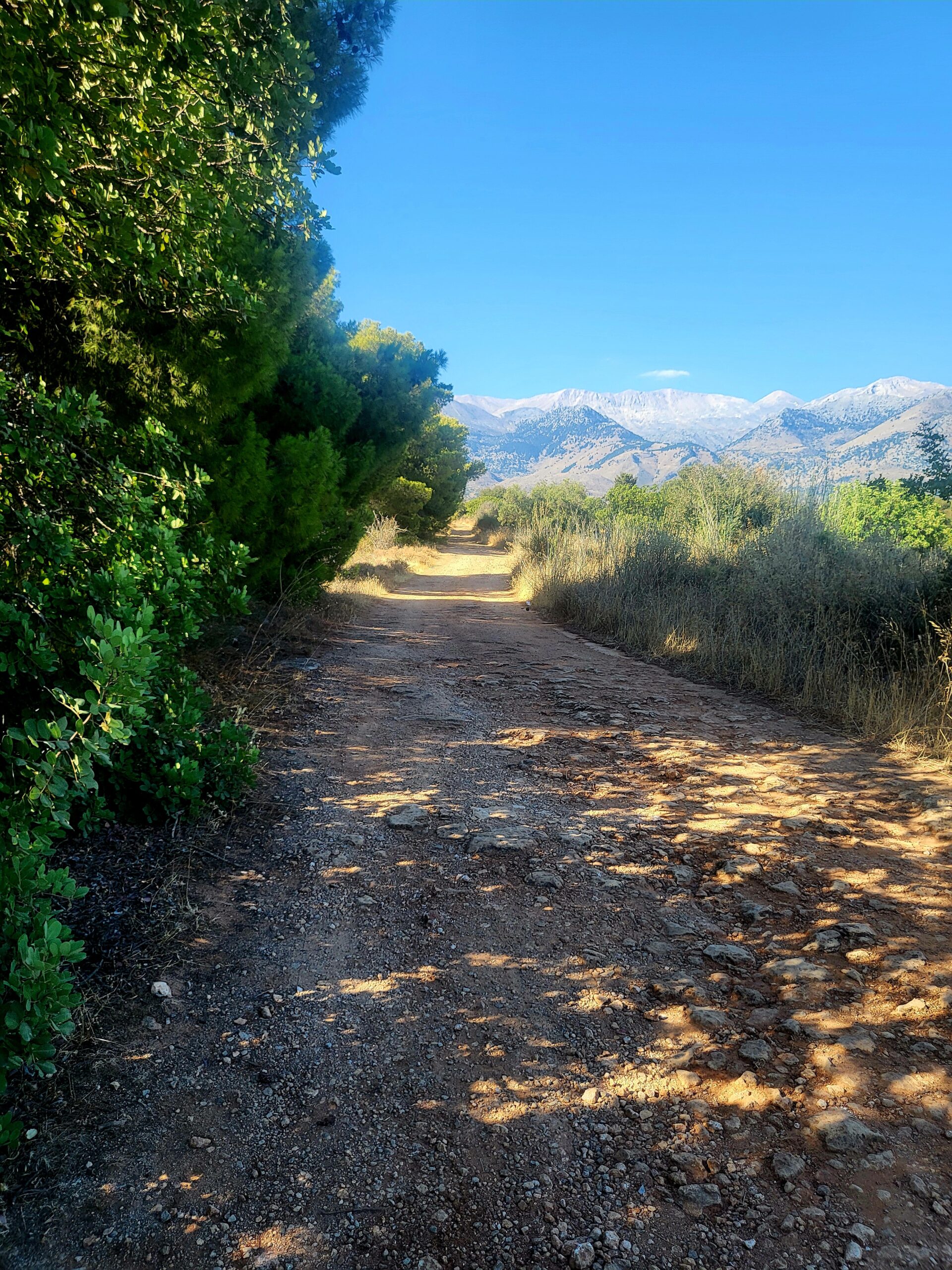
The track ahead is rough — pitted with stone, baked hard by the Cretan sun. The pines on the left throw cool shade across the path, while on the right, the scrub opens to reveal the wide Apokoronas plain.
In the distance, the White Mountains rise — the Lefka Ori — their pale limestone ridges holding the last light of morning. They look close enough to touch, yet every rider here knows that their slopes hide a labyrinth of trails, gorges, and history.
This is old ground. Shepherds once moved their flocks along this very path. During the war, resistance couriers — men like George Psychoundakis, the Cretan Runner — would have used it to vanish from sight within minutes, slipping into the folds of the land.
Today, it’s quiet. Just the crunch of tyres on stone, the smell of pine resin, and the steady pull towards the peaks. The mountains are calling — and the ride is just beginning.
Legend: Deep within the White Mountains, near the high plain of Omalos, lies the cave where Zeus was hidden as an infant, saved from his father Cronus, who devoured his children. The Kouretes, armed dancers, clashed their shields to mask his cries, ensuring the future king of the gods survived. Every echo across these slopes, locals say, is a reminder of their dance — and of the mountain’s role in sheltering the divine.