The small roadside shrines that mark remembrance, gratitude and personal devotion across the Cretan landscape
This ride marked the beginning of a new series. Rather than following battles, myths or historical figures, Objects Along the Way turns its attention to the ordinary features of the Cretan landscape—the things that are seen every day yet rarely examined closely. Together they form another way of reading the island, one object at a time.
There are thousands of roadside shrines across Crete. Some stand at road junctions, others beside mountain tracks, olive groves or isolated farmhouses. Most travellers pass them without a second glance, yet each marks a story known to someone, even if it has long been forgotten by everyone else.
Known in Greek as an εικονοστάσι (eikonostási), these small shrines serve many purposes. Some commemorate a fatal road accident or the place where someone narrowly escaped death. Others are built in fulfilment of a vow, in thanksgiving for recovery from illness, military service, a safe return from the sea, or simply as an act of personal devotion. They are not monuments in the formal sense. They are quiet expressions of remembrance and gratitude, placed where everyday life continues around them.
The shrine I stopped to photograph stands beside a quiet country road between Drapanos and Kefalas. It is simple, whitewashed and well maintained, with a small glazed recess containing a cross and devotional objects. There is nothing to identify why it was built or for whom. Like so many Cretan shrines, it keeps its story to itself.
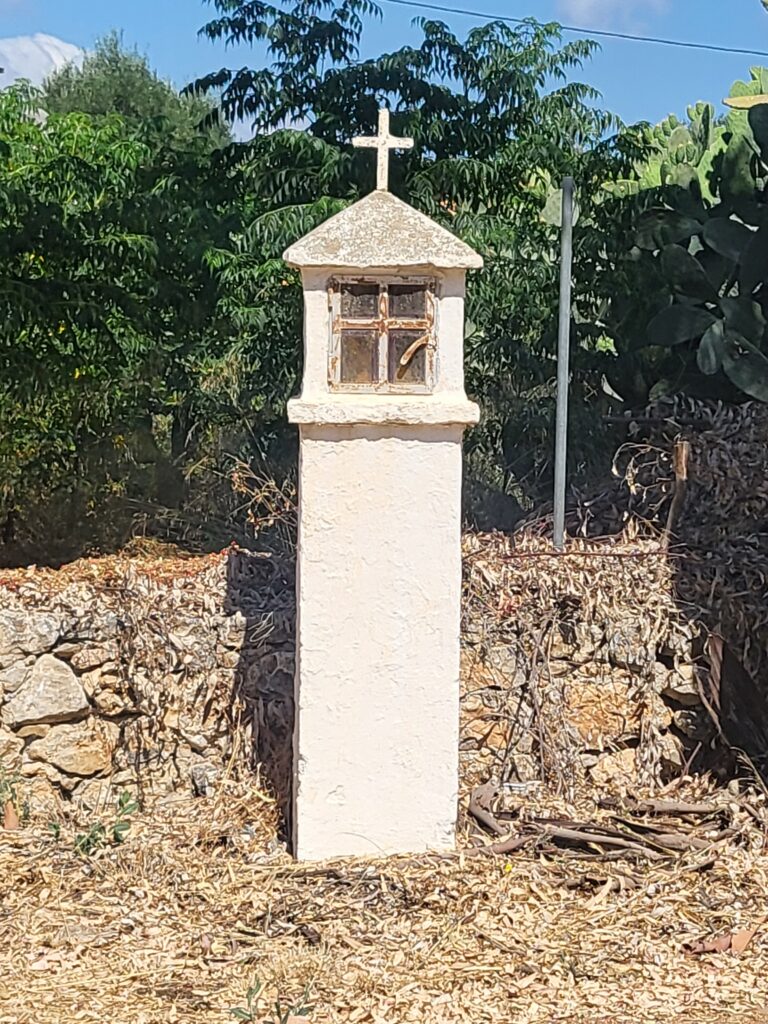
Roadside shrines are so common in Crete that they almost disappear into the landscape. Yet each one represents a moment in someone’s life that was considered important enough to mark in stone. We may never know the story behind this one, but its continued presence is a reminder that every journey leaves traces, even when the people themselves have long since passed.
A Note on the Mandináda:
I have spent several years studying the Cretan tradition of the mandináda: the short rhyming couplet through which Cretans have long expressed love, loss, humour, observation and memory.
I am not a mandinadológos (μαντιναδολόγος), nor do I claim these verses as part of the traditional Cretan oral repertoire. That tradition belongs to people who have grown up with its language, rhythms and conventions, and I approach it with respect.
For Objects Along the Way, I use the form in my own way. At the end of each journey, I take the object I have encountered and the story that has emerged from it and express that thought first in English. I then work towards a Greek version shaped by the language and structure of the Cretan mandináda.
The purpose is not to imitate a tradition that is not mine, but to acknowledge it and to allow each journey to end in a form closely associated with the island on which it took place.
For readers who do not speak Greek, I include the English version, the Greek version and a literal back-translation. The back-translation is deliberately literal: it shows what the Greek actually says rather than attempting to turn it back into English verse.
Mandináda
English
The story may be lost to us, the reason disappear,
but memory keeps its place beside the pathway here.
Greek
Μπορεί η αιτία να χαθεί, η μνήμη όμως μένει,
στην άκρη του περάσματος, σιωπηλή, προσμένει.
Literal back-translation
The reason may be lost, but memory nevertheless remains,
at the edge of the passage, silent, it waits.
Ride Information
The ride covered 29.9 km with 577 m of ascent and 582 m of descent, following a rolling profile with three principal climbs connected by high traverses and three corresponding descents. Moving time totalled 1:47:29, with an ascent time of 1:03:40 and descent in 0:42:12. Gradients reached +14.1% on the steepest section of the route and –14.3% on the descent. Maximum speed recorded was 55.6 km/h, averaging 16.7 km/h across quiet tarmac lanes, rough concrete climbs, loose limestone tracks, compacted dirt, rocky double-track and broken stone, with 75% off-road. It was a stepped route—three distinct climbs linked by flowing traverses and corresponding descents, with nothing unnecessary and every section serving the ride.